

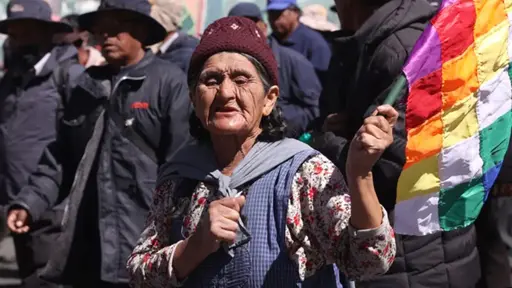
Demonstrations demanding the resignation of Paz intensified as authorities released a detained farmers’ leader.
On Wednesday, former Bolivian President Evo Morales challenged right-wing President Rodrigo Paz to travel to the Tropics of Cochabamba amid protests that thousands of workers, miners, and farmers have been carrying out for six weeks to demand his resignation.
“At a press conference, the president said, ‘If Evo is man enough, let him come to La Paz.’ If he gives me guarantees, I’ll go there, and if not, if Paz is man enough, let him come to Lauca Ñ to discuss social issues. We are not only going to talk about demands, we are going to teach him how to govern,” Morales said before hundreds of supporters gathered in the Chimore municipality.
Since October 2024, Morales has remained in the Tropics of Cochabamba, where Indigenous peoples have been protecting him to prevent him from being arrested in connection with a criminal case involving alleged “human trafficking.” In this legal action, the former president is accused of having had a relationship with an underage girl in 2016.
Morales accused Paz of being a “puppet” of U.S. President Donald Trump, who he said would support the right-wing leader at a time when protests against him have already continued for 41 consecutive days.
“We’ll see who really has his days numbered,” the former Bolivian president said in response to Paz, who continues to describe Morales and the protesters as “narco-terrorists” whose days are numbered.
Interior Minister Marco Antonio Oviedo even went so far as to describe nationwide protests as an “attempted coup d’etat” financed and operated by narco-terrorism.
In early May, the Bolivian Workers’ Central (COB) and other farmers’ organizations began protests and road blockades to demand Paz’s resignation, arguing that he has been implementing structural adjustment policies that have hit the most vulnerable social sectors particularly hard.
On June 8, Paz signed the Law Regulating States of Exception to allow the Armed Forces to participate in the repression of the massive protests. For it to become fully operational, the law must be complemented by a decree that has not yet been issued and that will have to be validated by Congress.
IMÁGENES MUESTRAN AL POLICÍA SACADO SU ARMA DESPUES DE DETENER AL DIRIGENTE
Efectivos policiales aprehenden a Vicente Salazar dirigente máximo de la Federación del de Trabajadores Campesinos Tupac Katari.#URGENTE #REBELION #BOLIVIA pic.twitter.com/9RCGrifIB7
— BoliviaLibre 🇧🇴🕊 (@BoliviaLibreNow) June 11, 2026
The text reads, “Images show a police officer drawing his weapon after arresting the leader. Police officers apprehend Vicente Salazar, the top leader of the Tupac Katari Federation of Peasant Workers.”
Paz Is Forced to Release a Farmers’ LeaderOn Wednesday, farmer Vicente Salazar, the principal leader of the unions blocking roads in the Bolivian highlands, was released just hours after his arrest following a demonstration in his support held in La Paz, the Bolivian capital.
Presidential spokesperson Jose Galvez acknowledged that Salazar had been detained but said the government released him because there was a “writ of liberty” in his favor.
Shortly after midday, Salazar was taken to a police office near Plaza Murillo, where the headquarters of the executive and legislative branches are located, after participating in a march organized by his union, the Tupac Katari Federation of Peasant Workers.
The Bolivian Workers’ Central (COB) and supporters of former President Morales also participated in the demonstration, including new groups of protesters who arrived from Potosi and the Tropics of Cochabamba.
Before beginning the march from the city of El Alto, Salazar told reporters that right-wing President Paz “has two paths left: his voluntary resignation or leaving amid social upheaval.”
Previously, the Paz administration issued arrest warrants for Salazar and COB leader Mario Argollo, accusing them of alleged terrorism and public incitement to commit crimes.
At the end of May, however, a court nullified those arrest warrants, although the Departmental Court of Justice of La Paz later explained that the suspension of the warrants was temporary while the Prosecutor’s Office corrected observations made by a lower court.
Currently, in the sixth week of the conflict, road blockades remain in place in six of Bolivia’s nine departments, particularly in the Andean and central regions, where shortages of food, medicine and fuel have been reported.
The Office of the Ombudsman has recorded episodes of extreme violence against protesters that have left at least three people dead. Social media posts have documented repressive actions in which police officers are accompanied by paramilitary forces that attack demonstrators with machetes and clubs.
(teleSUR)
From Orinoco Tribune via This RSS Feed.