

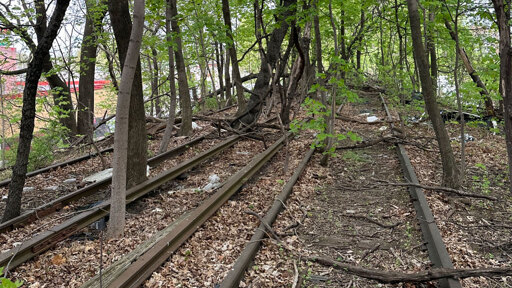
Travis Terry lives in Forest Hills, a neighborhood in Queens about 5 minutes from an abandoned rail line. He describes the tracks, last used in 1962, as a “blight” plagued by illegal dumping. “It’s been sitting there for 65 years now,” he said, “and those of us in the community, we got tired of what it had become.”
Terry has long seen great potential for a green space that would allow people to easily bike to Forest Park, the borough’s third largest park. He’s pursued this vision since 2011, advocating for a proposal, called QueensWay, to convert the 3.5 miles of idle railway into a 47-acre park.
But some would rather the tracks, once the Rockaway Beach Branch of the Long Island Rail Road, become a subway line running north-south through New York’s largest borough.
Andrew Lynch doesn’t see why it can’t be both. “When I saw this debate, I was like, ‘Man, none of you guys want to work together. Let me show you what’s up,’” Lynch told Grist. He wrote a blog post in 2016 outlining a project with rail service and green space. That led to the formation of QueensLink, a proposal to extend the subway’s M Train line and create 33 acres of parkland.
All these years later, the two ideas remain at odds, a dispute that mirrors debates in other cities over how to repurpose such infrastructure — whether as transit, green space or some combination of the two. Nationwide, more than 25,000 miles of rail have been converted to recreational trails. The Atlanta Beltline is among the most prominent examples with its 22-mile loop of trails and parks, though plans to include light rail have stalled.
The debate in New York is happening even as the city continues expanding its subway system. It is spending $5.5 billion on the Interborough Express to connect Queens and Brooklyn, and $7.7 billion on phase two of Manhattan’s Second Avenue Subway. Queens, meanwhile, has shown steady growth since the pandemic, and residents make more commutes by car than those in any other borough. New York also has a history of ambitious rail-to-trail projects, including The High Line, and officials have spent more than a decade investing in equitable park access.
This long-running question now confronts Mayor Zohran Mamdani. While QueensWay’s first phase is expected to begin construction later this year, supporters of QueensLink are urging city and state officials not to foreclose the possibility of restoring rail service.
As an assemblyman representing parts of Queens, Mamdani expressed support for QueensLink in 2023. As mayor, however, he included $43 million for the QueensWay park project in his $124.7 billion annual budget. “The City remains committed to expanding green and open space across the boroughs and is actively exploring all available funding options to make that a reality,” a mayoral spokesperson told Grist.
Lynch said QueensLink supporters were “miffed” and “shocked” by that decision. A City Hall official told Grist the decision to finance the park does not preclude building the rail line as well.
Phase one of QueensWay, which would create a 5-acre linear park, is set to begin later this year. Phase Two, which would have added a 1.3 mile extension, was to be paid for with a $117 million grant from the federal Reconnecting Communities initiative, but Congress rescinded funding for that program when it passed the Big Beautiful Bill.
Read Next
Your local park is bringing in the green (and by that, we mean money)
Mamdani’s staff recently told QueensLink supporters that the park project’s first phase is too far along to stop, according to Lynch, and said the administration will not rezone the land as park space. That preserves the possibility of also building the subway line, a point former Mayor Eric Adams’ administration made when it said one does not preclude the other. However, Lynch thinks the Metropolitan Transportation Authority, or MTA, which operates much of the region’s transit network, would balk at building a line on park land.
Lynch said QueensLink is looking for Governor Kathy Hochul, who appoints the MTA’s board and plays a major role in drafting its budget, to support the project. Her office directed Grist to the MTA and New York City Hall for comment.
The nonprofit Trust for Public Land has supported the park project since 2011. Tamar Renaud, its New York State director, said QueensWay will boost equity by eventually serving four of the 20 neighborhoods with the least amount of accessible park acreage. With 28 schools around the rail line, it would improve recreation for kids, while making the area more bikeable and walkable. “It was really about reconnecting communities that had been separated through these big infrastructure projects,” she said.
QueensWay supporters see their project as more practical. A 2019 MTA report found that the QueensLink rail line would cost $8.1 billion, but the agency has since revised that to $5.9 billion and estimated it would serve 39,000 daily riders. “Reactivating the Rockaway Beach Branch with NYCT service has a high cost and serves a relatively modest number of riders,” the agency concluded. “This project would reduce auto usage and provide additional rail connections, but compared to other projects, the benefits are average for sustainability and resiliency.”
Advocates for the park project, on the other hand, put its cost at around $350 million. “I think we all recognize that after all these studies there wasn’t going to be a train,” Terry said.
Railway supporters argue the MTA’s cost estimate is high and its ridership estimate low. They hired the consulting firm Transportation Economics & Management Systems to evaluate the report; it placed the cost closer to $3.5 billion. A New York University report estimated it would serve around 75,000 daily riders; another found it would take 14,800 cars off the road each day.
Eric Goldwyn, an expert on public transit project costs at the NYU Marron Institute, said QueensLink might not hugely boost ridership but that it would benefit operations by allowing busy trains on Queens Boulevard to run at a higher capacity.
In Goldwyn’s view, QueensLink is the project that harmonizes rail and park. Like Lynch, he thinks the advancement of QueensWay would not be a good sign for QueensLink. “Once that first spade of dirt is turned over, the odds become… longer,” he said. “It’ll be harder and harder to envision QueensLink in the way that it’s been proposed.”
This story was originally published by Grist with the headline What is the best use for old railroad tracks? New Yorkers have opinions. on Jun 12, 2026.
From Grist via This RSS Feed.