

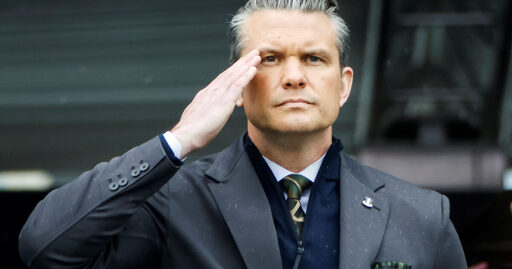
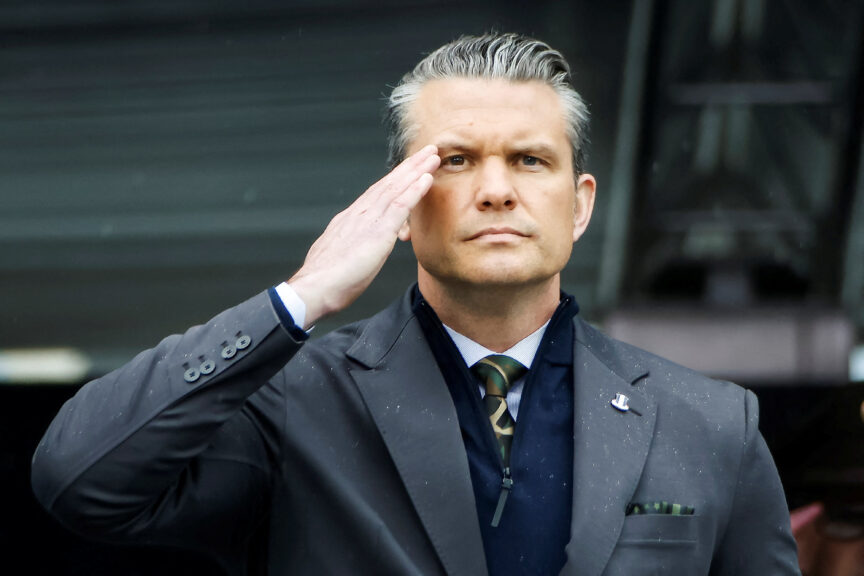
Weeks after his victory in the 2024 presidential election, president-elect Donald Trump announced his choice for secretary of defense: Fox News host and army veteran Pete Hegseth. This former infantry officer, who had served in both Iraq and Afghanistan, was suddenly in line to take command of the largest and most powerful military institution in human history.
The pick won praise from Trump’s political base. Hegseth had built his brand as a patriotic warrior, an unapologetic defender of “American exceptionalism”, and a virulent critic of so-called “woke” ideology in the armed forces. But concerning facts about his extremism soon came to the fore, centring around his many tattoos. Prominently inked across Hegseth’s chest was the Jerusalem Cross: a large central cross surrounded by four smaller ones. This symbol originated during the medieval Crusades and has been co-opted by far-right Christian nationalist movements and white supremacist groups. Within those circles, the Jerusalem Cross signifies a renewed “holy war” against Islam and multiculturalism. Military counter-extremism experts had long flagged the design as a potential marker of extremism when displayed by active-duty personnel.
Another Hegseth tattoo, inscribed on his upper arm, read “Deus Vult” – Latin for “God wills it”. This served as a rallying cry for crusaders marching to reclaim the Holy Land nearly a thousand years ago. Nowadays the phrase circulates among white nationalists and other far-right extremists as a meme promoting anti-Muslim ideology and fantasies of a Christian nationalist revival. In March 2025, photographs from a training exercise at Joint Base Pearl Harbor-Hickam revealed yet another of the defense secretary’s tattoos: the Arabic word “كافر” (kafir), translating to “infidel” or “non-believer”. This sat proudly on Hegseth’s right forearm, positioned just beneath the “Deus Vult” inscription and an American flag. In Arabic-speaking cultures, the word “kafir” has historically referred to non-Muslims in the pejorative; for a high-ranking US defense official to bear it as a badge of honour signaled defiance against a perceived Muslim threat.
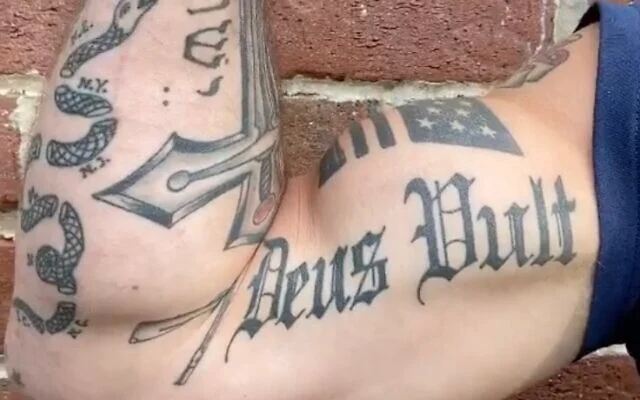
Hegseth’s tattoos. Photo: Pete Hegseth’s Instagram
For me, as someone who spent years investigating far-right extremism within the US military for my book Irregular Army: How the US Military Recruited Neo-Nazis, Gang Members, and Criminals, these revelations felt like a story coming full circle. Tattoos had always been one of the most visible markers of political ideology. During the war on terror, I had documented countless cases where soldiers had displayed extremist symbols – Norse runes, swastikas, neo-Crusader imagery – with impunity. Regulations existed to prevent such displays, but enforcement was lax as the US military needed more troops than it could recruit or retain. Now, decades later, the man appointed to oversee the Pentagon itself, the civilian head of all US armed forces, was emblazoned with the same symbols I had seen on the arms of soldiers in Fallujah and Kandahar.
The far-right ideology that once festered on the fringes of military subculture was no longer hidden but brazenly exhibited by the military’s top official. As I predicted when my book was first published, the political extremism unleashed by the war on terror – with its dangerous blurring of religious, nationalist and militarist commitments – had been normalised and, most dangerously, institutionalised. It would be hard to put back in its box.
6 January.
The fallout from the irregular army revealed in my book – its origins in the war on terror and its ties to Trump’s Make America Great Again (MAGA) movement – had already begun to surface during Trump’s first term. The 6 January 2021 attack on the US Capitol by far-right protesters was more than a political riot; it was an eruption of a militarised culture of grievance that had long been fueled by the war on terror. A significant portion of those charged in connection with the assault were former members of the US military. An analysis by the Program on Extremism at George Washington University (GWU) found that 12% of defendants had served in the armed forces. Veterans constitute about 7% of the national population.
The GWU report found that these individuals were not, as many might imagine, wayward young men acting out after short stints in uniform. On average they were in their forties and had served roughly nine years, many of them in leadership positions or on combat deployments to Iraq and Afghanistan. Roughly a quarter had been commissioned officers while nearly half had been deployed overseas. They represented every branch of service and embodied the professional backbone of the post-9/11 military. An NPR investigation further found that roughly one in five people charged in the first waves of prosecution had served or were currently serving in the armed forces. The pattern was clear. The question being asked was: why?
Irregular Army provides answers. Over many years, for example, far-right militias had strategically targeted veterans for recruitment, valuing their tactical skills as well as the political legitimacy that came from their service. Veterans were the perfect recruits: disciplined, trained and imbued with a sense of mission, yet often alienated by years of war and disillusioned with the political establishment. Furthermore, many extremists had been allowed to serve in Iraq and Afghanistan. There was every chance these rioters were radicalised not after their military service but before or during it.
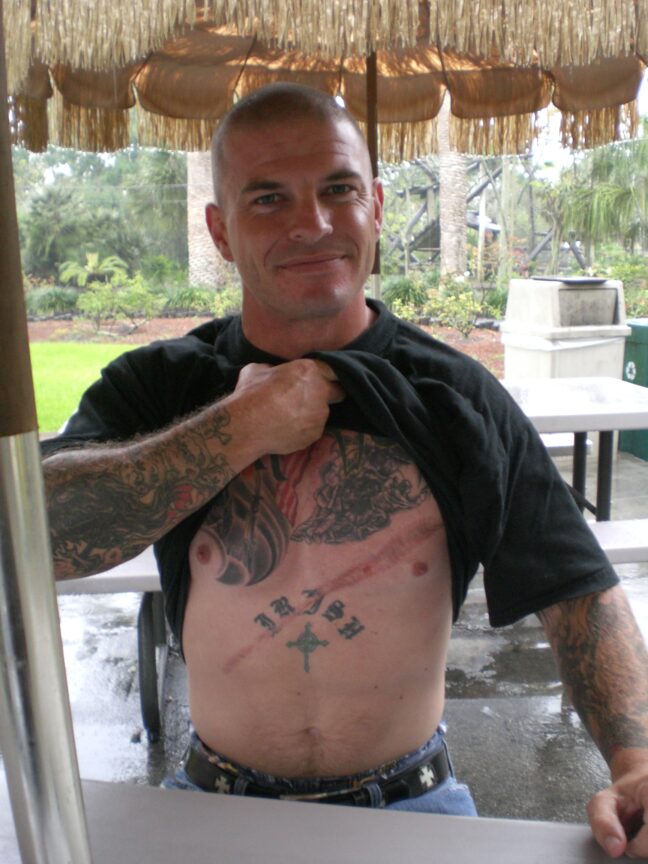
Forrest Fogarty, a neo-Nazi soldier who served in Iraq from 2004 to 2005. Photo: Courtesy of Matt Kennard
When the Capitol was breached, the influence of veterans was unmistakable. Amid the sea of Trump flags, one could spot small groups moving with military precision, advancing in tactical “stacks” through doorways and corridors. It was “instantly recognisable to any US soldier or marine who served in Iraq and Afghanistan,” noted PBS News. Surveillance footage later showed that some of these formations were made up of former soldiers and marines, communicating by radio and hand signal. Larry Brock, a retired air force officer, was photographed inside the Senate chamber wearing combat gear and carrying zip-tie handcuffs. Marine veteran Dominic Pezzola smashed a Capitol window with a stolen police shield, clearing the way for rioters to flood inside. Army reservist Timothy Hale-Cusanelli, who openly expressed Nazi sympathies, was among those arrested later for trespassing and disorderly conduct. A handful of active-duty personnel were there as well. In 2023, federal prosecutors charged three active-duty marines – Micah Coomer, Joshua Abate and Dodge Dale Hellonen – for entering the Capitol. Footage showed Hellonen carrying a “Don’t Tread on Me” flag – an eighteenth-century resistance symbol embraced in recent years by libertarians and the far right. The dynamics described in Irregular Army, set in motion decades before the MAGA assault on the Capitol, were coming home to roost.
Domestic terrorism.
In the years after my book was published, US counterterrorism analysts frequently warned that the centre of gravity in domestic terrorism had shifted decisively toward racially and ethnically motivated violent extremists, especially white supremacists, and that a non-trivial slice of those actors had military ties. The trend was manifest in data compiled by the Center for Strategic and International Studies (CSIS), which tracked a spike in domestic plots and attacks and documented an uptick in incidents involving active-duty or reserve personnel. It found that the percentage of all domestic terrorist incidents linked to active-duty and reserve personnel rose in 2020 to 6.4%, up from 1.5% in 2019 and zero in 2018.
Consider Brandon Russell. A former Florida national guardsman and co-founder of the neo-Nazi Atomwaffen Division, Russell surfaced publicly in 2017 after authorities found explosives and neo-Nazi paraphernalia in his Tampa apartment along with a framed picture of Oklahoma City bomber Timothy McVeigh. After serving time on explosives charges he was arrested again in February 2023 for conspiring to attack electrical substations around Baltimore. Prosecutors said his plan was intentionally designed to cripple a majority-Black city and induce societal collapse in service of a white-power “accelerationist” agenda. Russell was convicted and sentenced to 20 years in prison. Then there was Christopher Hasson, a coast guard lieutenant and former marine whose cache of weapons, hit lists and manifesto-style notes led prosecutors to label him a “domestic terrorist”. Court filings depicted a self-described white nationalist enthralled by accelerationist fantasies about collapsing the government and determined to “murder innocent civilians on a scale rarely seen”, as prosecutors put it. In January 2020, Hasson was sentenced to 13 years in prison.
Other cases show how neo-Nazi networks sought to fuse ideology with military skill. The Base, an explicitly white-supremacist accelerationist group formed in 2018, actively recruited veterans and leveraged paramilitary training to prepare for “civil conflict”. In January 2020, an FBI investigation into the organisation found a cell that included US army veteran Brian Mark Lemley Jr. and Canadian reservist Patrik Mathews. The men had discussed initiating an armed confrontation timed to coincide with a high-profile gun-rights rally in Virginia. In 2021, both pleaded guilty to federal firearms-related offences. “These individuals had a mission to terrorise and harm innocent people, and destroy infrastructure to cause chaos, all in an effort to advance their white nationalist beliefs. They spent months obtaining firearms and ammunition in preparation to execute it,” one investigator noted.
A still more chilling illustration came from within the army itself. In 2020, Ethan Melzer of the 173rd Airborne Brigade attempted to orchestrate an ambush of his own unit on behalf of the Order of Nine Angles (O9A): a neo-Nazi, antisemitic and occultist network that has promoted the infiltration of security institutions. Melzer fed sensitive military details to O9A, hoping to engineer a mass-casualty attack on fellow paratroopers during an overseas movement. He eventually received 45 years in prison. Another soldier, Jarrett Smith, was arrested in 2019 while stationed at Fort Riley. He admitted to distributing bomb-making instructions and discussing attacks on US soil in chats connected to neo-Nazi networks like Feuerkrieg Division. This drum began with the war on terror and has not stopped beating since.
From the war on terror to Donald Trump.
The war on terror fostered a national mindset based on fear and suspicion. Political leaders and media repeated ad nauseum that America faced existential danger from enemies both abroad and at home. A general atmosphere of grievance and insecurity took hold. Trump capitalised on this, positioning himself as a strongman outsider who alone could restore strength and impose order. His rhetoric about “American carnage”, dangerous foreigners (Muslims) and internal enemies both drew upon and fueled further the paranoid climate cultivated after 9/11.
The war on terror also blurred the line between foreign conflict and domestic politics. The 2001 USA PATRIOT Act, warrantless surveillance and the expansion of militarised policing normalised a more security-centric, authoritarian approach to governance. The idea of politics as warfare became embedded in the American psyche. Trump, whose political style is one of permanent combat, benefitted from this new martial ethos. His messaging treated political rivals, journalists and bureaucrats as enemies of the nation, tapping into a worldview consolidated during the long years of the counterterrorism emergency.
The wars in Iraq and Afghanistan transformed the US military and veteran communities in ways that built and radicalised what became Trump’s base. Millions of Americans had served in prolonged conflicts with ambiguous results and heavy personal costs. They returned to a society that appeared indifferent to their sacrifices. One Pentagon-funded study found that nearly half of the two million US troops that had deployed to Iraq and Afghanistan reported difficulties on their return home, and that many did not receive the care they needed from the Department of Defense and Department of Veterans Affairs. Frustrated and resentful, many gravitated toward populist narratives that promised victory, purpose, belonging – desires Trump actively engaged and enflamed. His jingoistic celebration of the military, combined with his willingness to channel anger at the political elites who had led America’s failed wars, resonated. During the 2024 election, one US veteran told Buzzfeed: “I really want to see a pay increase for active duty members. I’m voting for Trump because he has consistently demonstrated his support for our military members and their needs and will continue to improve the military when reelected.” A poll found that Trump led his Democratic opponent Kamala Harris by 51% to 41% among veterans and by 49% to 44% among active-duty guardsmen and reservists.
The war on terror also diverted enormous public resources toward military and security spending. Communities dependent on traditional industries saw little benefit from the trillions spent abroad. The sense that political elites had ignored domestic needs while pursuing illegal foreign wars proved fertile ground for Trump’s “America First” pitch. His promise to abandon nation-building and focus instead on jobs, borders and national pride spoke directly to those who believed the war on terror era had weakened, rather than protected, the country. Crucially, the war on terror had been a bipartisan project – a disaster for which the entire political class was culpable. As public confidence in government cratered, space opened for charismatic outsiders prepared to reject and denounce the consensus shibboleths of a discredited elite. Trump seized the opportunity with elan.
Global fascism.
Trump’s 2016 election victory gave a jolt to far-right movements across the globe. His ethno-nationalist rhetoric and disdain for democratic norms became a model. In an era of economic stagnation, mass displacement and climate crisis, Trump taught would-be demagogues the world over that hostility to immigrants, contempt for journalists and nostalgia for lost national glory could win elections.
In France, Marine Le Pen’s National Rally reached the 2022 presidential runoff with more than 13 million votes – the far right’s highest ever tally. In Italy, Giorgia Meloni’s Brothers of Italy, which traces back to post-fascist movements, now leads the government, promoting “God, family and homeland” as its guiding principles. Austria’s Freedom Party under Herbert Kickl topped national polls in 2024, becoming the first far-right party since World War II to win a federal election there. Germany’s Alternative für Deutschland (AfD) has surged to first place in several eastern states, breaking the post-war taboo against nationalist parties. And in smaller states such as the Netherlands, Sweden and Finland, far-right formations wield coalition power or critical parliamentary influence.
In Latin America, Brazil’s Jair Bolsonaro, a former army captain, rose to power in 2018 by invoking anti-communism, Christian fundamentalism and nostalgia for the military dictatorship. Once in office, Bolsonaro vilified environmentalists and indigenous peoples while inciting police brutality under the slogan “a good criminal is a dead criminal”. His contempt for democratic institutions was laid bare in January 2023 when his supporters stormed Brazil’s Congress and Supreme Court – a clear echo of MAGA’s 6 January attack in Washington. In neighboring Argentina, Javier Milei, elected president in 2023, channeled the same anti-elite rage as Trump and Bolsonaro but through libertarian economics. He pledged to “chainsaw” the state, abolish the central bank and smash the “political caste.” While presenting as anti-authoritarian, Milei’s threats to purge opponents, attacks on journalism and assaults on social welfare all mirrored Trump, whom he openly admired.
Trump’s second presidential term introduced a new fascistic element: unapologetic and untrammeled militarism. To be sure, contempt for international law and reliance on brute force have been longstanding tenets of US foreign policy. In the mid-1980s, Nicaragua filed a complaint with the International Court of Justice over US mining of Nicaraguan harbours and support for anti-government death squads. The Reagan administration boycotted the proceedings and, when the court found in favor of Nicaragua, vetoed a UN Security Council resolution calling for compliance with the ruling. The Bush II administration exploited the 9/11 emergency to boldly assert US imperial prerogatives. “The Clinton administration had said it was ‘multilateral when we can, unilateral when we must’,” one Guardian columnist observed in 2001. “The Bush administration seemed… ready to reverse that proposition.” The 2002 National Security Strategy declared that the US “will not hesitate to act alone” in waging “prevent[ive]” war – a concept indistinguishable under international law from the crime of aggression. That same year, Congress went so far as to adopt the so-called Hague Invasion Act, which authorised the president to use military force to free any US or allied citizen being held by the International Criminal Court.
The second Trump administration has radicalised this “might makes right” posture while abandoning even the pretense of legalistic justification or coalition diplomacy. In 2025, Trump floated the idea of the US “taking over” the Gaza Strip after a Washington-backed Israeli genocide had destroyed the territory. When questioned whether displaced Palestinian survivors would have a right to return under his plan, Trump replied, “No, they wouldn’t.” This was an explicit policy of ethnic cleansing. In January 2026, US forces unilaterally attacked Venezuela and kidnapped its head of state. Barely even attempting to contrive a lawful rationale, Trump declared that the US would “run the country” for an indeterminate period and promised that “our very large US oil companies” would “go in.” In the aftermath of this assault, administration officials proclaimed the entire “western Hemisphere” as “America’s neighborhood” then openly threatened that Colombia, Cuba and fellow NATO member Denmark could be next. “We do need Greenland, absolutely,” Trump affirmed, repeating previous threats to annex the Danish territory.
Such outrages herald a world of brazen gangsterism entirely unconstrained by shared norms. But if Trump and his coterie have finally derailed the international legal order, it was the bipartisan war on terror that set the train in motion. More than a decade ago, I looked under the hood of a critical US institution – the military – and found disturbing evidence of political derangement. Now, with humanity bracing for climate catastrophe and superpower confrontation, the extremists are at the wheel. Irregular Army helps show how they got there, and how deep the rot goes.
A revamped edition of Matt Kennard’s Irregular Army: How the US Military Recruited Neo-Nazis, Gang Members, and Criminals, first published in 2012, is out now.
From Novara Media via This RSS Feed.