

Andrea Egan, general secretary of Unison, has written to the Equality and Human Rights Commission (EHRC) to highlight the fact that workplaces across the country have already begun to withdraw their previous trans-inclusive policies.
After multiple failed attempts, the EHRC laid its current draft code of practice before Parliament. The guidance is now undergoing a 40-day period of scrutiny, after which MPs can choose to accept or reject it.
The draft code calls for service providers to exclude trans people from single-sex spaces reflecting their gender, and also often those of their sex assigned at birth. The government’s own impact assessment has acknowledged that it will likely harm trans and gender non-conforming individuals.
Unison — ‘Change the Law’
Because of the obvious discrimination at play in the draft code, Unison — the UK’s largest trade union — posted a callout to social media on 28 May:
MPs will decide on the guidance in the next 30 days — and we need to show them the reality
We need you to tell us why it’s unworkable and the real life impact it will have on you in the workplace.
The Union issued the call as part of its ‘Change the Law’ campaign. This echoed calls from MPs like Nadia Whittome, who urged Parliament to legislate to clarify that the trans-inclusive intention behind the Equality Act.
In reply to Unison’s post, the EHRC tried to argue that:
Our draft Code of Practice helps providers of services, public functions and associations apply the Equality Act 2010. It doesn’t apply to workplaces; employers should consult the Workplace (Health, Safety & Welfare) Regs 1992, the Equality Act, and seek independent legal advice.
‘Inundated with responses’
However, as Unison’s evidence-gathering has already highlighted, many workplaces were apparently unaware that the code didn’t apply to them. Andrea Egan, the union’s general secretary, highlighted that fact in a 9 June letter to EHRC chair Mary-Ann Stephenson, adding that:
We are also deeply concerned that a significant number of UNISON’s members who work in hospitals, schools, universities, prisons, gyms, leisure centres and public swimming pools will be required to implement the guidance.
Unsurprisingly, the union isn’t thrilled that its public sector members will have to play guess the assigned sex of the customers they serve. Egan added that:
Since the callout for examples, we have been inundated with responses from staff. You stated in your response to our change the law post on X that the guidance does not apply to workplaces. Unfortunately, we have already found that many employers are withdrawing existing trans inclusive policies and are using the code of practice guidance as the reason. This has caused distress not only to trans, non-binary and gender diverse workers, but also disabled staff. Accessible facilities are limited in most workplaces, and will now be put under greater pressure as they are expected to accommodate more staff to meet your requirements of gender neutrality.
That last point echoes statements from campaign groups like Disability Rights UK, which issued an immediate expression of solidarity with trans and intersex individuals after the EHRC released its draft code.
The organisation also branded the disabled toilet ‘workaround’ as a “vain attempt” to create infighting between the trans and disabled communities.
A feature, not a bug
Coming to the end of her letter, Egan also criticised the EHRC’s signposted sources for workplace guidance:
In your post, you point employers to the workplace requirements of 1992, the Equality Act, and independent legal advice. We have found that a substantial number of employers are already consulting the code of practice as the most up to date reference to the law and no doubt more will follow. Your proposed alternatives are either thirty years old, potentially ambiguous, or involve huge costs to already overstretched public service employers.
Instead, the union leader called for the ‘equalities’ watchdog to issue further information or clarifying documentation specifically for workplaces and employers. Likewise, she also reminded the EHRC that its role is to:
advise government on how to make equalities legislation more inclusive. It seems to us that this guidance does not achieve that aim.
A cynic might point out that the EHRC, once a trans-inclusive rights body, has been captured by anti-trans ideologies. As such, the fact that its code of practice is both explicitly harmful to trans people and unusably vague on how and where it applies is quite intentional.
Fortunately, we at the Canary are precisely that cynical. The EHRC knows that other workplaces will follow its transphobic example. It knows that this will damage trans, intersex and gender-non-conforming individuals’ lives far beyond the public sector.
These harms are a feature, not a bug, for the commission and the newly transphobic UK government.
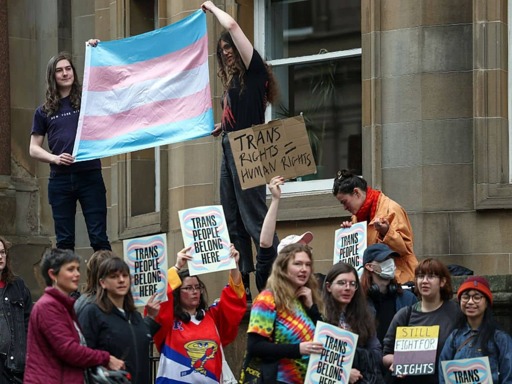
Featured image via Jeff J Mitchell/Getty Images
From Canary via This RSS Feed.