

The ultra right wing of the Hindutva variety, which took power in the 2014 elections in India, has grown stronger through every election since. In the last round of assembly elections, held in four of India’s 28 states, the Bharatiya Janata Party (BJP)-led alliances secured victory in two of them. If one is to count the elections in Puducherry, a Union Territory (UT) ruled directly by the federal Central Government, the gains of the BJP-led alliance are even bigger.
With this round of elections, the BJP is now in power in 19 states and two UTs, along with running the union government since 2014. This phenomenal rise of the BJP has significantly reshaped India and its polity. The country’s core values that emerged from its anti-colonial struggles, such as socialism and welfarism, secularism, religious harmony, and modernization are gradually giving way to neoliberalism, majoritarianism, and obscurantism in the dominant public discourse.
The most significant part of this regressive transformation of the country is the failure of the constitutional institutions, such as the Supreme Court, to make interventions, instead becoming part of this process.
Though it has not been able to win national elections yet, the left has always been a formidable force in Indian politics since the days of its anti-colonial movement. For a very long time it ruled states such as West Bengal (1977-2011), and Tripura (1978-1988 and 1993-2018). Kerala, where the left has been in power since its formation, boasts of being the first place in the world where a communist party was elected to power, in 1956.
The left in India has historically championed the causes of the working classes and pushed for the progressive and modern values of socialist economics, secularism, and rationalism. Despite its limits, whenever it could influence policy it pushed for people-centered reforms. It remains the only political force in the country that continues to lead movements countering the right-wing assaults on the people and the eroding values of India’s anti-colonial nationalism.
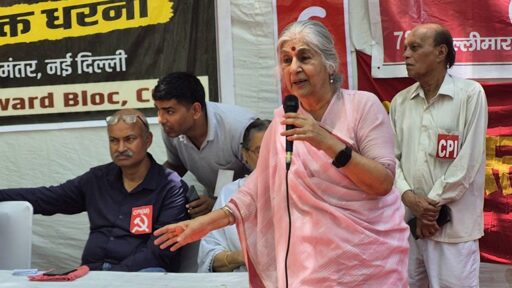
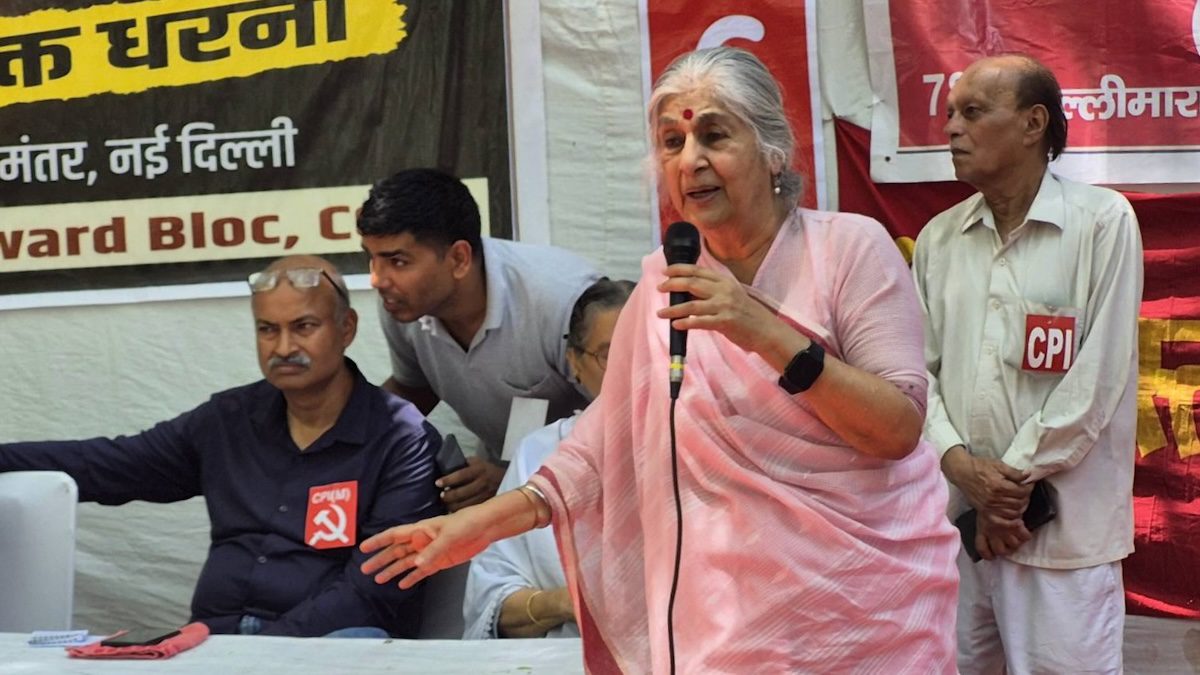
In this context, BreakThrough News spoke to Subhashini Ali, a veteran of the left movements in India, to understand the left’s overall assessment of the rise of the ultra-right-wing in the country and its impact on the popular movements, including on the youth (often referred to as “Gen Z” by the mainstream and legacy media).
Ali is a former polit bureau member of the Communist Party of India (Marxist), India’s largest communist party, a former member of parliament (MP), and a leader of the All India Democratic Women’s Association (AIDWA), one of the world’s largest women organizations.
She is still active in women’s movements and serves as the vice president of Dalit Shoshan Mukti Manch (DSMM), a platform working to unite movements involved in the liberation of India’s most marginalized communities.
The rise of ultra right wing in India
BreakThrough News: The BJP continues to win election after election since it first came to power in 2014. It now controls the majority of states and dominates almost every institution. What do you think is the reason for this rise of the ultra right wing in Indian politics?
Subhashini Ali: The rise of the ultra right wing is not a phenomenon or a process unique to India. It resembles in many ways the rise of ultra-right-wing forces in many countries across the globe – the US, Israel, Poland, Hungary, Ukraine, several Latin American countries and countries in Asia too. Of course, all these ultra-right-wing forces have characteristics that differentiate them, one from another, they have much in common with each other.
It is possible to plot their journeys to electoral success or success through coups etc. beginning from the demise of the Soviet Union and the collapse of the socialist camp which paved the way for the market becoming a dominant arbiter.
What this meant was that privatization of services became the norm, concepts of equality, equity, and inclusion became the objects of ridicule and the pursuit of profit was extolled as being the harbinger of development and prosperity.
The policies that governments resorted to in order to pursue this trajectory had to be divisive, promoting hatred between different groups of people and increasingly repressive.
In India, the Sangh Parivar [referring to Rashtriya Swayamsevak Sangh or the RSS and its affiliated organizations, of which the BJP is one] that represents the ultra right wing here, disguises its pro-monopolist, pro-imperialist and anti- working people policies as being part of a religious project, the establishment of a Hindu Rashtra [the Hindu Nation]. An important aspect of this is its commitment to upholding and strengthening the barbaric, hierarchical caste system [a peculiar feature of the social order in South Asia where caste groups are arranged hierarchically on the basis of birth. Each caste group has its assigned station and privileges and is prevented from mingling with each other through religious laws]. This imparts a particular viciousness to the State policies being implemented in India.
The impact of religious polarization on the left movements
BT: Let’s talk about RSS’ religious project. Of course it has been a disguise. However, its popularity is obvious, which seems to help the BJP navigate through the popular resentments due to the failures of most of its economic policies in the last decade. Do you think that is the case? How do you think religious polarization impacts the progressive and left movements in mass mobilizations?
SA: Combating strongly held religious beliefs, however illogical, unscientific, and even absurd they may be, is an extremely difficult task especially when large sections of the working class and the poor are not only deeply committed to these beliefs but are also divided by caste loyalties which are, in turn, given religious sanction in their minds.
Those belonging to the progressive and left movements face different kinds of problems and challenges. They themselves are products of a society in which religious beliefs and caste identities are extremely strong and deep-rooted and, at the same time, they have to confront and also organize struggles against the ways in which religion and caste are used to divide the working classes and the exploited.
At a time when religious and caste identities are used across the political spectrum and by various organizations to mobilize people behind them, the left and progressive movements and organizations have to completely eschew these methods because of their very nature and the cause that they uphold.
It is not surprising, therefore, that the growth of religious polarization – fostered and encouraged by the ruling classes and their various political parties and organizations – has been accompanied by a weakening of organizations like trade unions and movements for radical change. At the same time, the policies being implemented by those responsible for growing religious polarization create growing unemployment, immiserization, repression, and hardship and, therefore, create a need for strong, united movements and struggles.
Gen Z and the left
BT: Do you think RSS/BJP have been able to attract the so-called Gen Z in particular as several commentators have identified after the recent elections? How does the left plan to break this alleged stranglehold of the right over Gen Z?
SA: Very often new phrases, new names, new categories are invented and then encouraged to become part of the general discourse through the use of social media, articles, scholarly analyses etc. That, however, does not mean that these phrases like “Gen Z” should not be questioned.
The phrase “Gen Z” is widely used all over the world for youth today, protesting youth, disgruntled youth, angry youth, cynical youth, questioning youth and, often, sections of youth that are mobilized into mass action by forces that are often invisible and not taken note of are referred to as Gen Z. Recent political changes in Bangladesh and Nepal have been attributed to Gen Z creating the impression that both have been propelled by the same force when actually those making up the protests and struggles that led to regime changes in both countries are very different from one another.
It is also important to remember that a term like Gen Z, like much of the phraseology that can be loosely ascribed to postmodernism, papers over basic class differences that exist within the broad category of “youth.”
It is important to remember that the vast number of youths protesting against corruption, unemployment, a feeling of being let down and cheated by politicians and the ruling class, belong to lower middle class, working class and poor peasant families. They are very much part of the exploited classes who are not equally aware of the class interests responsible for their problems. There is no doubt that privileged, affluent youths are not to be seen among the protestors willing to face repression, beatings, imprisonment and even death.
What this means is that the widespread protests of young people that we are witnessing in India and it is important to remember that there have been huge numbers of young people taking to the streets, facing water cannon and police brutality before the Cockroach Party [referring to a recent political movement of the youth which emerged on social media in reaction to adverse comments made by country’s chief justice] emerged, should be supported and strengthened by the left since they are the result of government policies which are openly condemned by the protesters.
In each one of these protests of the last few years and in the most recent Cockroach protest, those responsible for the desperate conditions that young people find themselves in are very much recognized and targeted by them. The Supreme Court, the government, several ministers and the corporate houses benefiting from government policies are all named in the protestors’ posters and speeches.
Left and progressive forces need to understand these protests and to find ways of supporting them, expressing solidarity with them, standing up for the protestors’ rights and opposing government repression without trying to take them over and trying to get themselves recognized as “leaders.” The spontaneity of the movements, the courage of their participants and the many creative and inspiring methods that they are employing must be recognized and appreciated.
Two mistakes must be avoided – the protests must not be dismissed out of hand as “childish,” “ineffective,” “bound to fail,” “handiwork of vested interests” etc. and also the temptation of completely submerging organizational identity and ideology for short term gains must be resisted.
While, of course, vested interests will try to influence and direct these movements, it is incorrect to say that the youth suffers from a stranglehold. If it does not in large numbers subscribe to left ideology that is a problem that must be addressed with patient ideological work and example.
elevation , June 11, 2026
From BT News via This RSS Feed.