

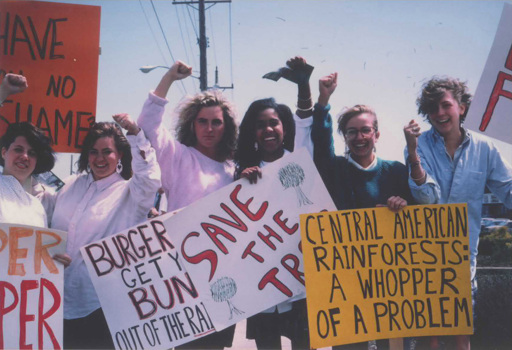
When Rainforest Action Network began in 1985, it had little of what usually makes an organization powerful. It had no large budget, no legal department, no reliable access to politicians, and no formal way to force global corporations or development banks to change. It had Randy Hayes, a wide activist network, a way to connect distant forest destruction to everyday choices, and a willingness to use tactics that many mainstream environmental groups avoided. David Benac’s new book, Rainforest Radicals: A History of Rainforest Action Network and Transnational Organizing, tells the story of how that combination became effective. RAN’s early campaigns targeted Burger King over rainforest beef, True Geothermal in Hawai‘i, the World Bank over development projects, and Mitsubishi over tropical timber. These were different fights, involving different places, institutions, and coalitions. Together, they show how a small San Francisco-based group helped bring tropical deforestation, Indigenous rights, and corporate accountability into late twentieth-century environmental politics. Rainforest Radicals: A History of Rainforest Action Network and Transnational Organizing Benac, an environmental and public historian of the postwar United States, came to the subject indirectly. He was researching timber-industry history in the Pacific Northwest when he encountered the MacMillan Bloedel papers and a grassroots campaign against clear-cutting in British Columbia’s coastal rainforests. RAN appeared in the archival trail. That led him to Hayes, RAN’s co-founder, then to a larger oral-history project with activists, allies, and contemporaries. The result is a history built around interviews, archives, and a close look at how people organize when…This article was originally published on Mongabay
From Conservation news via This RSS Feed.