

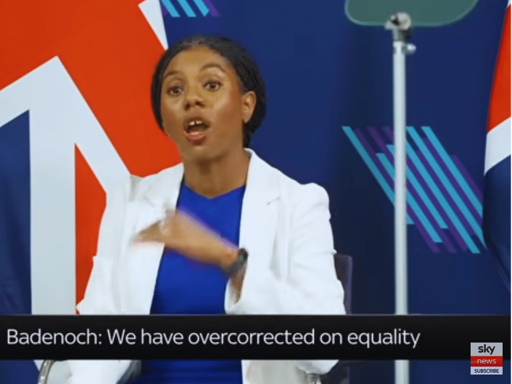
Legal experts and social justice campaigners have hit back against Kemi Badenoch’s plan to scrap the public sector equality duty, PSED, aka ‘the duty’.
Besides the obvious dire impact that the move would have on minoritised individuals across the UK, Badenoch’s argument displayed fundamental misunderstandings of the duty itself — which requires public bodies to assess the impact of their services on people with legally protected characteristics.
Dancing to Reform’s tune
In a 9 June speech, the Tory leader announced her intention to “repeal the public sector equality duty in its entirety.” Badenoch claimed the PSED had led to a pursuit of “equality of outcome” rather than “equal treatment and equality under the law”. She added that:
There are many laws which were brought in with good intentions but are delivering perverse outcomes and unintended consequences.
The PSED requires public sector leaders to abide by equality considerations set out in the 2010 Equality Act. Principally, this means working to prevent discrimination against people with protected characteristics — race, sex, disability etc — and monitoring the outcomes of that work.
Badenoch’s speech came just a week after Nigel Farage exploited the murder of Henry Nowak to attack diversity, equity and inclusion initiatives — better known as ‘EDI’ in the UK. Reform UK had also announced, several months earlier, that it plans to rip up the Equality Act completely.
Equality duty is ‘there to help’
In response to Badenoch’s announcement, a spokesperson for the Equality and Human Rights Commission (EHRC) — the body responsible for overseeing the application of the Equality Act — explained that the PSED doesn’t function as the Tory leader was trying to make out. Rather, they stated:
The PSED is not a barrier to these organisations doing the job the public expects them to do.
Most take it seriously and use the requirements of the PSED to design the best possible services for everyone. It’s there to help them make good decisions, based on an understanding of the impact those decisions have on everyone that they affect.
Professor of human rights law Colm O’Cinneide, of University College London, took a similar tack:
What the duty does is to impose a positive obligation upon public bodies to engage with these issues and to do more than just to maintain basic legal compliance, but to actually take proactive steps to eliminate problems that may exist, even if they’re not triggering a specific litigation risk.
He also underlined the shoddy nature of overall argument against the PSED:
A lot of the criticism is effectively cherrypicking individual issues and saying that because these controversies are in some way tangentially related to the duty, the entire mechanism is flawed.
Wrong… or opportunistic?
However, as the Muslim Engagement and Development (MEND) highlighted, Badenoch knows perfectly well how the PSED actually functions. MEND commented on the leader of the opposition’s glaring hypocrisy:
Kemi Badenoch says the Equality Act should be “a shield to protect you from discrimination, not a sword for social engineering.” But the duty she wants to scrap is precisely what makes that shield work. It requires public bodies to consider who their decisions might harm before they act. Remove the duty and you take the shield away.
This is also a remarkable reversal from Badenoch, who in December 2023 when Minister for Women and Equalities, wrote to every public authority instructing them to comply with this very duty, and stated that there is no hierarchy of rights because every person holds a protected characteristic. Either she was wrong then, or she is being opportunistic now.
You can read that letter here, complete with the call for public sector leaders to “ensure that equality issues are actively considered”. No prizes for guessing the Canary’spick out of “wrong then” and “opportunistic now”.
‘Free hand to harm your life chances’
Meanwhile, other commentators focused on the dire impacts that scrapping the PSED would have on all minoritised communities. Paul Nowak, general secretary of the Trade Union Congress, didn’t hold back:
This proposal would give a future Tory government a free hand to harm your life chances if you’re a woman, gay, black, disabled or working class.
Likewise, the Traveller Movement — a charity supporting Irish Travellers, Romani and Roma people — stated that:
Removing the Public Sector Equality Duty risks creating a cycle in which inequalities are identified only after harm has occurred, rather than being addressed at the earliest stage. Over time, this could result in the experiences and needs of marginalised communities carrying less weight in public decision-making, making it harder to challenge disadvantage and rebuild trust in public institutions.
For Romani (Gypsy), Roma and Irish Traveller communities, which continue to face significant barriers in areas such as education, health, housing and access to public services, the potential consequences of weakening these safeguards are particularly concerning. Any proposal to remove the Public Sector Equality Duty would lead to the most marginalised communities being put most at risk.
‘Common sense’ is a call for more racism
Lastly, independent MP and career-long human rights advocate Diane Abbott commented that:
Ending current equality rules is dangerous and divisive; a green light for all the bigots and racists. This happens when your ambition is no greater than to be the Nick Clegg in a Farage-led government
In particular, the mother of the house highlighted the Tory leader’s ridiculous appeal to ‘common sense’ to prevent discrimination. Regarding the issue of public accommodations for disabled people, Badenoch claimed that:
You don’t need a duty to tell you to take account of differences. Quite often differences are obvious.
Abbott, in return, stated that:
We live in a society where racism is commonplace. Macpherson’s call to tackle it were only ever partially taken up. ‘Common sense’ is a call for more racism not less.
The reference to Macpherson in there refers to Badenoch’s attacks on the Macpherson report. After the shamefully police handling of the racially-motivated murder of Stephen Lawrence in 1993, the landmark report branded UK policing as institutionally racist.
It’s natural that Badenoch would try to critique the Macpherson report. Likewise, it’s natural that she’d fail so spectacularly. The report and its findings are the quintessential example of just how wrong the Tory leader and her ilk are.
If avoiding discrimination is simply a matter of common sense, then the police ignored it in favour of vicious racism. Conversely, if avoiding discrimination isn’t common sense, then the duty to consider it is a helpful, legally enforceable reminder.
Unfortunately for Badenoch, she’s wrong either way you slice it.
Featured image via YouTube / the Canary
From Canary via This RSS Feed.