

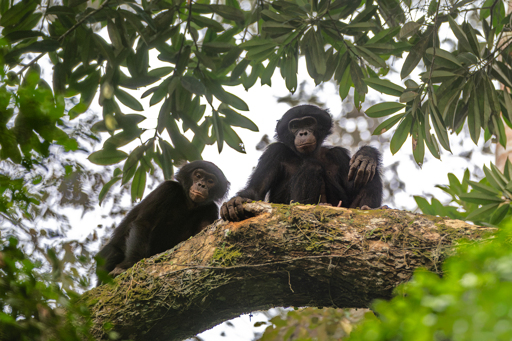
SALONGA NATIONAL PARK, Democratic Republic of Congo — Just before sunrise, while much of the rainforest remains cloaked in darkness, a team of researchers and trackers leaves the Inkomu research camp. Their destination is the previous night’s nesting site of a group of bonobos deep within the Salonga forest, located in the center of the DRC. Their mission is to persuade the bonobos (Pan paniscus) to accept human presence as a natural part of their environment. By earning the animals’ trust, researchers hope to create opportunities to better understand their behavior, ecology and health. This painstaking process, bonobo habituation, involves spending time near the apes day after day until they gradually become accustomed to people. It is a slow and demanding undertaking that can take years, requiring patience, consistency and thousands of hours in the forest. Long before dawn, often around 3 a.m., trackers — some of them former poachers whose knowledge of the forest has become an asset for conservation — begin making their way toward the previous night’s nesting site. They must arrive before the bonobos wake. Then begins an all-day pursuit through one of the most remote rainforests on Earth, following the apes from dawn until they build fresh nests for the night. “The whole idea of habituation is that you meet the group every day in a very friendly, non-interactive way so they accept you as part of the forest,” says Felix Bofeko, an assistant researcher working with a bonobo habituation program in Salonga National Park.…This article was originally published on Mongabay
From Conservation news via This RSS Feed.