


Amelia Schafer
ICT
MILWAUKEE, Wisc. – A small corner office in Milwaukee’s coveted Third Ward neighborhood just south of downtown is home to one of the few Native-owned salon businesses in a major city.
If you blink you’ll miss it, but inside this salon, Oneida Tribe of Wisconsin citizen Bailey Skenandore is building a space where her clients, whether Indigenous or not, can find freedom through their hair.
Hair can be a lot of things, including a form of expression or something much deeper. For some tribes, hair represents a connection to their ancestors, holds spiritual significance and can hold memories and power. With over 575 federally recognized tribes in the United States, it’s impossible to sum up what hair means to all Indigenous people.
During the federal Indian Boarding School era, students’ hair was cut upon arriving at school, a tactic used for assimilation and control. To this day, Native children still get harassed over their hair and in some cases Native students have reportedly had their hair cut without their permission by school officials.
“Hair is such a big part of our identity,” Skenandore said. “There’s two sides to it. There’s that fear because it’s somebody’s identity, but also you can make them feel incredible because it’s such a big part of who they are.”
While the space may be small, the feelings Skenandore’s business brings aren’t. Stepping inside Sweetgrass Salon feels like stepping into a warm hug. From several sweetgrass braids to calming music and a cohesive comforting boho-chic design, the space is comforting and relaxing.

Sweetgrass Salon owner Bailey Skenandore poses for a photo in her salon in Milwaukee’s third-ward. (Photo by Amelia Schafer, ICT)
Maintaining a safe place where the client is heard is paramount to Skenandore’s business approach, she said.
Skenandore said she recently had an Indigenous client come in who had gone through a tough period and was requesting their hair be cut. For some tribes, members will cut their hair during times of mourning or hardship.
“I think it’s just (about) being mindful and being there for people,” Skenandore said. “It’s not an easy thing, there’s a lot of history there with our hair. I definitely keep that in mind and want to create a space where people feel comfortable (cutting their hair) if that’s something they’re looking to do.”
Just as hair plays an important role in many tribal nations’ cultures, it’s also been a form of expression for some since time immemorial.
Not all Native people traditionally wore their hair long, many woodlands tribes created unique, shorter hair styles with shaved sides or plucked hairlines. The infamous “mohawk” hair style known today for its presence in punk culture was actually traditionally tied to Haudenosaunee war traditions.
In the southwest, a unique hairstyle worn amongst women of the Hopi tribe actually served as an inspiration for Star Wars franchise director George Lucas when creating Princess Leia’s iconic double-bun hairstyle. Other Southwestern tribes such as the Pima people are known for their blunt bangs. Overall, hair has for Indigenous people been a form of self-expression tied to identity and tradition.
“You really can make someone feel more like themselves through their hair,” Skenandore said.
In the same way that hair can make someone feel more like themselves, being a cosmetologist has helped Skendanore find herself.
‘Something that just clicked’
Skenandore said she initially started off attending a traditional four-year college studying education, but she quickly realized it wasn’t what she actually wanted to do. It was just what she thought she should do. On the flip side, hair is something she’s always been passionate about.
Skenandore grew up styling her own hair for school dances, dying her own hair and helping her sister style her hair as well.

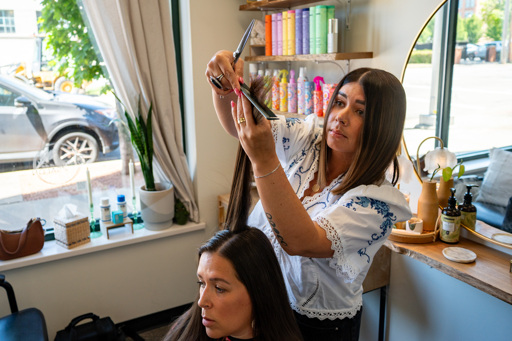
Bailey Skenandore, Oneida, styles her sister’s hair at her salon, Sweetgrass Salon, in Milwaukee’s Third Ward. (Photo by Amelia Schafer, ICT)
“Hair is just something I’ve always loved,” she said. “I love talking with people, I like working with my hands and honestly cosmetology school was the first time it made sense. I feel like school was never really my thing so it was nice to finally have something that just clicked.”
For Skenandore, owning her own businesses has been a way to connect with her community, connect with herself and find freedom.
She spent eight years working at a salon under a different owner. Overall it was a good experience and taught her a lot, but there wasn’t space to grow, she said.
“I had things that I wanted to create,” Skenandore said. “A space that I wanted to be mine and solely mine, and I think that’s kind of when I knew that I needed to pull the trigger on it.”
Around 2020, Skendandore established her limited-liability company, which is a business structure used by business owners to protect themselves from personal liability when creating their own venture. She began brainstorming what her space would look like. In northern Wisconsin, among her family, she developed the name Sweetgrass Salon.
“Sweetgrass being like an uplifting medicine and just bringing good energy, I thought it was perfect for the space I was looking to create,” she said.
It’s been four-and-a-half years since Skenandore made the decision to launch her own business, and it’s a decision she hasn’t regretted.
“Obviously, there’s work to it but getting your LLC and getting started, I feel like really isn’t that hard,” Skendandore said. “It’s really nice to work for yourself and kind of build your business the exact way you want it and want it presented to people.”
Indigenous small business ownership has steadily increased across the United States over the past several decades, according to data from the U.S. Census Bureau.
From 1997 to 2012, the number of Native-owned businesses grew modestly from 2,338 to 3,115. Since then, the number of Native-owned businesses has increased by 36 percent, according to data from the Association for Enterprise Opportunity.

Bailey Skenandore, Oneida, styles her sister’s hair at Sweetgrass Salon in Milwaukee’s Third Ward. (Photo by Amelia Schafer, ICT)
As of 2025, roughly 408,519 Native-owned businesses were in operation across the United States. A majority of Native-owned businesses are construction companies or food vendors, according to the U.S. Census Bureau. And a majority of Native-owned businesses are located in rural areas.
Despite the steady increase in Native-owned businesses across the United States, there’s still room for more.
Hair salons, like Sweetgrass Salon, are considered retail-trade businesses, which is a type of business where goods or services are sold directly to customers. In Wisconsin, there are just over 100 Native-owned retail-trade businesses statewide, according to findings by the University of Wisconsin-Madison, compared to over 36,000 White-owned retail-trade businesses statewide.
To anyone on the fence about opening their own business, Skenandore’s advice is simple: Just do it.
“In hindsight, we always look and think, ‘Why did I worry about that,’” she said. “Just go for it, believe in yourself.”
The post Oneida salon-owner reflects on the importance of hair, freedom of entrepreneurship appeared first on ICT.
From ICT via This RSS Feed.