

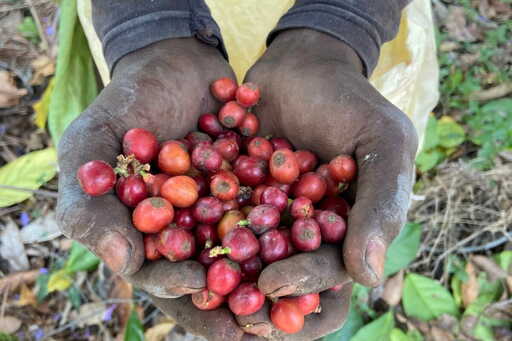
As rising temperatures, shifting rainfall, and increased pest pressure reduce yields and quality of Arabica and Robusta coffees, the two species that account for nearly all commercial production, researchers and growers are turning to overlooked coffee species for a more climate-resilient future, Mongabay-India contributor Meena Menon reports. Arabica (Coffea arabica) and Robusta (C. canephora) have long dominated the global coffee industry. Other coffee species such as Excelsa (C. dewevrei) were previously relegated to the margins of coffee plantations as boundary markers or shade trees in India. Akshay Dashrath, co-founder of the South India Coffee Company (SICC), is leading efforts to re-evaluate Excelsa for its potential resilience. According to the SICC, a British planter introduced Excelsa to India in the late 1800s as an alternative to Arabica. However, it grew tall and dense, making it an impractical crop to manage and commercialize. Dashrath’s farm in Kodagu district in Karnataka state has 60-year-old Excelsa trees that his family preserved, which are now a source for trials aimed at scaling production. His company is collaborating with the Royal Botanic Gardens, Kew to do the research. Aaron Davis, a senior research leader at the Royal Botanic Gardens, said that the dominance of Arabica and Robusta in the global markets could see major disruptions in the next decade or so from other coffee crop species adapted to altered climates. Excelsa, native to parts of Tropical and West Africa as well as Southeast Asia, is already being scaled in Uganda and Vietnam. According to Kiwuka Catherine,…This article was originally published on Mongabay
From Conservation news via This RSS Feed.