

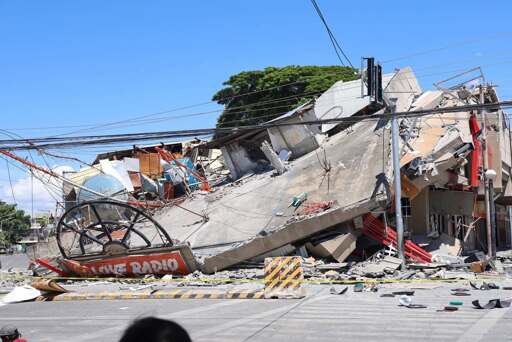
MANILA — The Philippine chapter of an international human rights group lamented the dire situation of Mindanao folk after a major earthquake struck the island on June 8, seeing it as a consequence of the failure to hold the government accountable for leaving communities vulnerable to precarious living conditions.
Ritz Lee Santos III, section director of Amnesty International Philippines, said this is the time to look into what the government owes the people of Mindanao after years of warnings, repeated tragedies, and missed opportunities to center human rights in governance and public service.
“This is not simply a result of natural hazards but unnatural disasters made possible by the lack of commitment of local government units to make certain that communities can thrive despite disasters,” Santos said in a statement.
At 7:37 AM on June 8, a 7.8 magnitude earthquake hit Sarangani province in the Soccsksargen region and neighboring areas. According to the Philippine Institute of Volcanology and Seismology (Phivolcs), it has an offshore epicenter located 32 kilometers west of Maasim, Sarangani, and may be attributed to subduction along the Cotabato Trench.
Occurrences of tsunamis have been recorded in the towns of Kiamba and Maasim in Sarangani; Kalamansig in Sultan Kudarat; and the cities of Zamboanga, Mati in Davao Oriental, and Tandag in Surigao del Sur, ranging from 0.09 to 1.48 meters in tsunami height.
The latest report of the National Disaster Risk Reduction and Management Council (NDRRMC) showed that 1,738 aftershocks were recorded as of June 10, 1:00 AM, ranging from 1.3 to 6.4 magnitude. The deadly earthquake took the lives of 45 individuals and affected nearly 150,000 people from 11 provinces in Mindanao.
Santos acknowledged the tireless emergency responses in times of disasters, which are commendable. However, he pointed out that rescue operations are insufficient if the government lacks prevention efforts, stressing that the state has an obligation to protect people from foreseeable disasters through effective regulations and risk reduction measures under their right to life and adequate housing.
Carlos Isagani Zarate, former Bayan Muna representative, on the other hand, demanded the Ferdinand Marcos Jr. administration fulfill its mandate to build disaster-resilient evacuation centers clearly stipulated under Republic Act No. 12076, or the Ligtas Pinoy Centers Act.
Zarate criticized the ongoing practice of using schools, covered courts, and other non-resilient structures as evacuation centers.
“We have been pushing for a long time that schools, covered courts, and other non-resilient structures should be utilized as evacuation centers because they are also not safe and they have no enough facilities for our people,” he said in a statement in Filipino.
The Amnesty International Philippines, meanwhile, also expressed support for the proposed Independent People’s Commission Act, a proposed legislation that allows professionals and non-government organizations to investigate anomalies of public infrastructure projects.
The human rights group highlighted the proposed measure, as they saw post-disaster funding as vulnerable to irregularities.
Beyond infrastructure, Zarate called for a comprehensive review of environmental policies that exacerbate disasters.
The post Rights group on deadly Mindanao quake: People paying the price of accountability failures appeared first on Bulatlat.
From Bulatlat via This RSS Feed.