

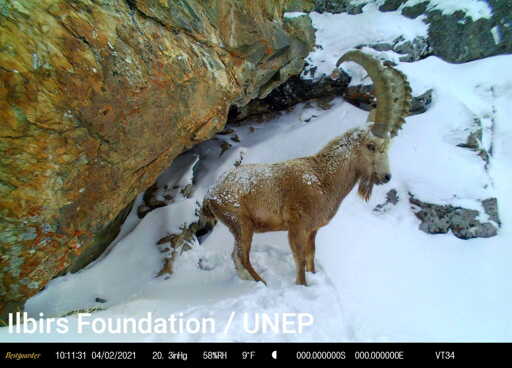
Kyrgyzstan has officially designated a massive stretch of its high-altitude landscape as a protected corridor for snow leopards and other mountain wildlife. The Ak Ilbirs ecological corridor, formalized in 2025, spans nearly 800,000 hectares (2 million acres) and was designed with the future climate in mind, Mongabay’s Liz Kimbrough reports. The corridor connects several existing protected areas in the country, as well as pastureland, forest and other ecosystems across 14 rural municipalities to ensure wildlife, including snow leopards (Panthera uncia), can move freely as climate change shifts their habitats. The project was spearheaded by the Central Asian Mammals and Climate Adaptation (CAMCA) initiative, led by the U.N. Environment Programme (UNEP) in collaboration with the Kyrgyz government, Humboldt University of Berlin, and local conservation groups including CAMP Alatoo and Ilbirs Foundation. Murat Zhumashev, director of CAMP Alatoo, said that while the Ak Ilbirs corridor carries official protected area status, it functions differently from most. “The ecological corridor in Kyrgyzstan is based on a regulatory rather than a restrictive approach,” Zhumashev and his colleague Salamat Zhumabaeva told Mongabay by email. “It builds on existing environmental legislation, but unlike strictly protected areas, it does not involve land withdrawal or the introduction of strict prohibitions.” To design the corridor, scientists at Humboldt University “applied a combination of expert local knowledge, climate predictions and technical expertise to build the narratives for the future scenarios,” Julieta Decarre from Humboldt told Mongabay by email. Under future climate emissions scenarios, more than 60% of suitable habitat for snow…This article was originally published on Mongabay
From Conservation news via This RSS Feed.