

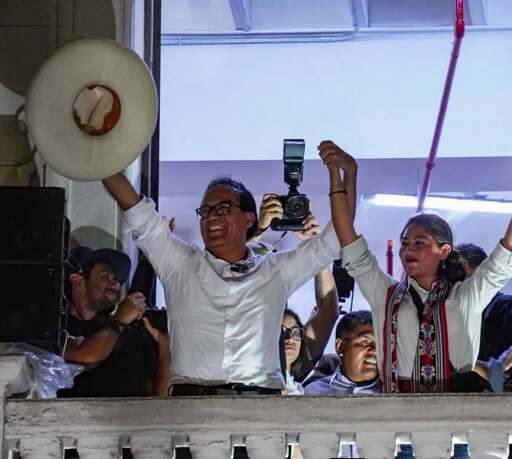
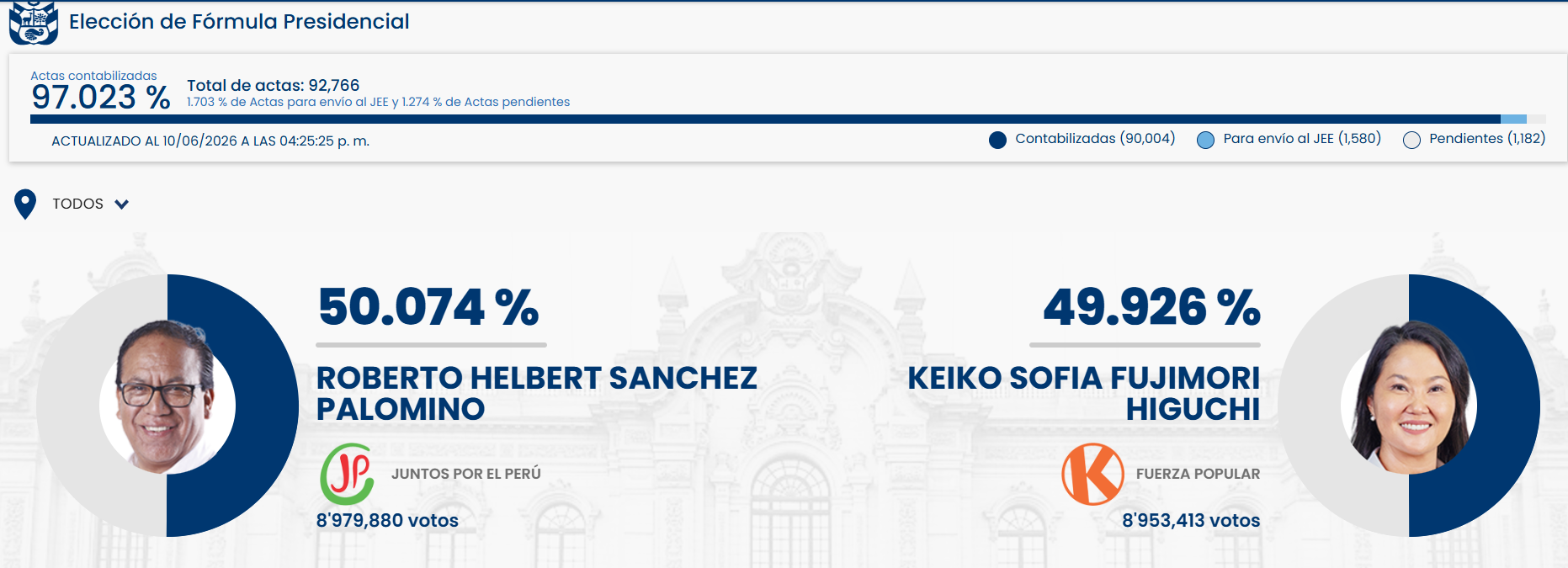
The National Office of Electoral Processes of Peru (ONPE) reported that, with 97.023% of ballots counted, leftist candidate Roberto Sánchez of Together for Peru is leading the second round of the presidential election with 50.074% of valid votes (8,979,880 votes), compared to 49.926% (8,953,413 votes) for far-right candidate Keiko Fujimori.
This data, updated on the ONPE website on Wednesday, June 10, at 4:25 p.m. local time, closely aligns with the preliminary results of the comprehensive quick count conducted by the National Democratic Institute/Ipsos. That poll, based on a 72.4% participation rate, projected 50.3% for Sánchez versus 49.7% for Fujimori. Meanwhile, ONPE reported an official turnout of 69.7%.
According to the quick count, Fujimori would win only in the capital area with 63.6% and in the northern region with 52.4%. This would not be enough to defeat Roberto Sánchez, who is projected to win in the southern mountainous regions with 75.0%, in the eastern Amazonian region with 57.4%, and in the central region with 51.5%. The result would be a national outcome of 50.3% for Sánchez against 49.7% for Fujimori.
As there are still ballots pending to be counted and others in the process of formal submission to the Special Electoral Jury (JEE), the outcome of the electoral process remains uncertain.
The official count carried out by the ONPE, which began after voting closed at the 90,223 polling stations enabled nationwide, is the only institutional mechanism with legal validity to determine who will become the head of state.
The uncertainty surrounding this second round is nothing new. In the last two presidential elections that were decided in a runoff, Keiko Fujimori, who is running for her fourth election and has been defeated in three previous elections, came close to becoming president but was defeated by narrow margins.
In 2016, she lost to Pedro Pablo Kuczynski by just over 40,000 votes. Five years later, in 2021, she was defeated by Pedro Castillo with a similar margin. At the moment, Sánchez is leading by a little over 26,000 votes.
Peru’s Presidential Elections: Leftist Sánchez and Far-Right Fujimori Separated by Less Than 0.1%
Impeachment as a weapon against a president who inconvenienced the elites
In the run-up to December 7, 2022, Castillo was facing a new motion for impeachment due to “permanent moral incapacity,” a constitutional figure that has become a tool of political pressure and turned Congress into a power capable of conditioning or toppling governments.
In that climate, President Castillo issued a message to the nation that his opponents branded a coup attempt. The armed forces and the police did not support him. Congress approved his removal, and Castillo was arrested while trying to head to the Mexican embassy.
The Peruvian judiciary institutionalized the injustice: Castillo was convicted of conspiracy to commit rebellion. In addition, Betssy Chávez, then president of the Council of Ministers; Willy Huerta, Castillo’s minister of the Interior; and Aníbal Torres, former president of the Council of Ministers and close advisor to the president, were sentenced to prison.
Roberto Sánchez as representative of marginalized Peru
The candidacy of Roberto Sánchez, a leader of Castillo’s party and former minister of Foreign Trade and Tourism during Castillo’s government, has been able to resonate with the rural, Andean, and popular vote that made Castillo president in 2021.
His advance against Keiko Fujimori cannot be seen merely as an electoral surprise. It is the demonstration that the Peru that supported Castillo did not disappear with his imprisonment.
Special for Orinoco Tribune by staff
OT/SC/SH
From Orinoco Tribune via This RSS Feed.