

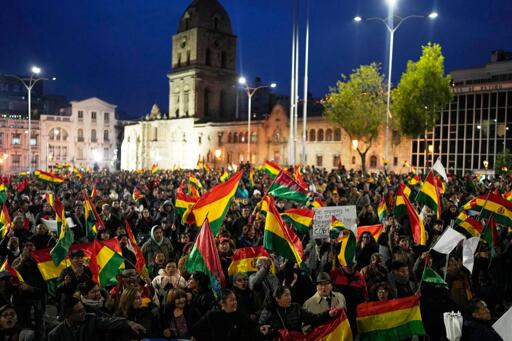
The rebellion in Bolivia is part of a deep-seated trend toward polarization that has become the norm in Latin America. A distinctive feature of this phenomenon is the proliferation of trends toward what Antonio Gramsci called “organic crises” — crises that affect not only the economy or a specific government but also the entire social, political, and economic order. The ruling classes lose their ability to govern through consensus, and the ground is laid for “solutions by force.” Gramsci writes,
At a certain point in their historical lives, social classes become detached from their traditional parties. In other words, the traditional parties in that particular organisational form, with the particular men who constitute, represent, and lead them, are no longer recognised by their class (or fraction of a class) as its expression. When such crises occur, the immediate situation becomes delicate and dangerous, because the field is open for solutions by force.
The right wing comes to power but then wears itself out very quickly and is unable to govern. This pattern repeats itself in Latin America. And, as shown in the case of Bolivia, the tendency toward violent solutions — which lies at the root of right-wing governments’ authoritarian methods, and which Marxists would call Bonapartism — includes the intervention of the working and peasant masses through direct action.
State of Emergency and “Violent Solutions”
On Monday, June 8, President Rodrigo Paz enacted the State of Emergency Law, after it was approved in the Senate and the Chamber of Deputies. This gave him the power to deploy the military against the movement calling for his resignation. So far, however, he has not issued a decree to bring it into effect. While hardline sectors of the Right continue to push for a forceful crackdown on the protests, the Paz government is intensifying threats to force “in extremis” negotiations. At a press conference, Paz referred to the now 40-day-long rebellion of workers, Indigenous communities, and peasants as “narcoterrorism,” following the script of figures like Donald Trump and Marco Rubio.
Although it tries to appear strong, the government is on the back foot after suffering an initial defeat by the movement. On Saturday, June 6, it deployed a major police and military operation — alongside far-right racist groups — to clear a highway blockade in the small town of San Julián in Santa Cruz. It was a failure: after six hours of fighting on the highway, the police had to retreat, acknowledging their inability to clear the road. Far from breaking the movement, the heroic resistance of the blockaders and the condemnation of the actions of racist gangs (who looted residents’ homes) deepened support for the uprising among the wider population. The next day, increasing numbers of protesters joined mobilizations to strengthen the blockade in San Julián.
What is happening in San Julián is a paradigmatic example of the political process unfolding in Bolivia. Paz won nearly 60 percent of the presidential election vote, but now many of the sectors that elected him are at the center of resistance against his government. Many had voted for him with the hope of improving their living conditions, but what they got was a brutal, across-the-board attack.
The Paz government has been carrying out repressive raids to “test” the balance of power, without going so far as to launch a widespread crackdown. This would be a very risky move for the government, one that could backfire badly. The example of San Julián shows that there will surely be resistance, and that it could spread. Meanwhile, Paz is banking on wearing down the movement, seeking to divide the mobilized forces before intensifying the repression. Bolivia’s largest trade union federation, the Central Obrera Boliviana (COB), reported that several of its leaders were illegally abducted by hooded police officers. So far, these tactics have not dulled the movement’s power; over the past week, the number of roadblocks has remained steady at about 100.
At a town hall meeting in the city of El Alto on June 2, which was attended by thousands of people, those present voted to continue the protests in the face of government repression and to reject the treacherous “negotiations” proposed by Paz and his advisers. Similar resolutions were passed in other areas of the country, after thousands of people took part in deliberations. In city streets and on blockaded highways, anger and the demand for Paz’s resignation can be heard everywhere. The regime’s calls to “come to the negotiating table” are being massively rejected.
But as our comrades in Bolivia remind us, the COB has already shown its willingness to negotiate with Paz; during the initial protests against gas hikes in January, the COB leadership reversed course and struck a deal with the government. So far, the union federation seems to be playing a game of attrition, refusing to mobilize its full forces toward a general strike. But if there is an escalation in repression, we could see a corresponding escalation in resistance and confrontations against a government whose fate remains uncertain.
The Proliferation of “Organic Crises” in Latin America
Tendencies toward organic crises are also deeply entrenched in another Andean country: Peru. The elections on Sunday, June 7, resulted in a virtual tie between Keiko Fujimori, the daughter of dictator Alberto Fujimori and heir to authoritarian neoliberalism, and Roberto Sánchez, who came in first by a narrow margin. Sánchez served as a minister under former president Pedro Castillo, who was imprisoned after the right-wing institutional coup in 2022. Let us recall that at that time, there was a popular uprising against the leader of the coup, Dina Boluarte, which was harshly repressed by the military. Last week, Sánchez presented a moderate platform in an effort to win over the political center.
The election was geographically polarized, reflecting a deep divide that mirrored Castillo’s voting map. The Andean south, the rural highlands, and the Amazon region overwhelmingly supported Sánchez, while Lima and the urban coast leaned toward Fujimori. The southern part of the country is where more than 70 people were killed in 2022 during the military repression of the popular uprising against Castillo’s removal from office and imprisonment. For example, in Chumbivilcas, a province in the Cusco region located 3,660 meters above sea level, where extreme poverty exceeds 54 percent in some areas and chronic malnutrition affects 17.4 percent of children under five, Sánchez won 94 percent of the vote. Meanwhile, in San Isidro, Lima’s wealthiest district, Fujimori won 84 percent of the vote.
What happens next? The country is facing a massive political crisis, with a regime that has completely lost its legitimacy. This stems from a succession of short-lived presidents, either removed from office or having resigned: including the winner of the next election, Peru will have had nine presidents in just ten years. Will Congress, controlled by Fujimori supporters, attempt another impeachment maneuver? During the election campaign, agricultural producers launched protests. After the elections, the pending question is how to defeat the economic and political force that sustains Fujimorism. The most interesting development in the realm of mobilization has been the process of university occupations and student struggles, with demands for democracy, better conditions for students, and challenges to university authorities. Will this herald the entry onto the scene of other sectors — workers, peasants, and Indigenous peoples — opposing imperialism’s extractivist and plundering project in Peru?
Another expression of the trends toward organic crisis sweeping the region can be seen in Chile. Polarization has only grown in the face of the failure of center-left governments to deliver on the aspirations of the masses; as we saw with Gabriel Boric’s defeat by José Antonio Kast, the Far Right capitalizes on this disappointment. But the Right, once in government, quickly loses steam because it lacks a hegemonic project capable of winning popular support.
Last week in Chile, high school and university students participated in a massive national day of action. In the capital city of Santiago alone, over 20,000 students mobilized. There were large protests of thousands of people in Valparaíso and other cities across the country. Protesters marched against budget cuts and the government’s proposed education reforms. In Santiago, Kast deployed special police forces to repress and arrest students, but the students marched anyway. Everything indicates that the Chilean student movement is awakening. Opposition to the Right does not come from the usual “dialogue seekers” like the Communist Party, el Frente Amplio, or the Socialist Party, but from the streets. This is becoming a trend across the southern part of the continent.
These right-wing governments — such as those of Paz in Bolivia, Javier Milei in Argentina, and Kast in Chile — are implementing “chainsaw-style” austerity measures against the working class. They are also deeply racist and seek to attack the rights won by the feminist movement. In response to these attacks, women are playing a leading role in the rebellion in Bolivia, and the feminist movement is mobilizing en masse in other countries, such as Argentina. The traditional skirts of Indigenous women in Bolivia are visible on the front lines of every roadblock; these women are spearheading the movement, organizing protests, and taking charge within their communities. They are peasant women, precarious workers, or both, representing the face of a new working class in Bolivia, where women’s struggles intersect with racist and colonialist oppression against the Indigenous population, against the Aymara nation, and other oppressed nations. In Argentina, a massive mobilization occurred on June 3, with tens of thousands of people across the country chanting “Ni una menos” (Not one less), against femicides and sexist violence. This demonstration followed the brutal femicide of Agostina Vega, highlighting the immense anger on the streets. In Argentina, a femicide occurs every 30 hours, while the Milei government, which makes misogyny a state policy, denies the very concept of femicide.
The Hegemonic Decline of the United States
All this is taking place within the context of Trump’s imperialist offensive in the region. Marco Rubio called the president of Bolivia to offer support, and the U.S. Secretary of Defense labeled the protesters “narco-terrorists.” They aim to target Cuba, having already imposed a protectorate in Venezuela.
Trump also endorsed the far-right candidate in Colombia, Abelardo de la Espriella, who advanced to the runoff against Iván Cepeda, the political heir of the country’s current president, Gustavo Petro. De la Espriella is a Trumpist who uses “iron fist” rhetoric, reminiscent of El Salvador’s Bukele. He is extremely misogynistic and an admirer of Milei, successfully absorbing a significant portion of the traditional right-wing vote in Colombia. Trump wants to transform the country into a platform for his imperial policies in the region, as in the years of “Plan Colombia.” The underlying reality is that major structural problems remain unresolved in Colombia, including dependence on imperialism, wealth concentration, agrarian issues, precarious labor conditions, and violence against social leaders.
Yet Trump’s image of invincibility is fading. It was revealed that he called Benjamin Netanyahu to urge him not to jeopardize the agreement with Iran. Nevertheless, Israel is advancing into Gaza, the West Bank, and Lebanon. Trump wants to end the war, so he is pushing for a ceasefire. But he cannot control his Zionist allies. Hezbollah, meanwhile, will not accept a truce as long as Israel continues to occupy southern Lebanon, making the situation far from easy. Meanwhile, Iran is attempting to establish a new deterrence equation in the Gulf.
Trump has also suffered significant domestic defeats in the courts and in Congress. Last week, the House of Representatives voted to limit his war powers regarding Iran, with four Republicans voting in favor. Although the resolution is not binding, it is a strong political blow against an unpopular war. Republicans are increasingly concerned about the November elections, while Trump’s approval ratings continue to fall. These are various manifestations of the United States’ hegemonic decline, which impact Latin America, where its “pawns” are in crisis.
Strategic Lessons from Bolivia
Tendencies toward organic crises are the DNA of Latin America’s contemporary history, and they share a common backdrop: an extremely unequal and complex social structure, marked by dependence on imperialism. As seen in Bolivia, the oligarchy’s deep-seated racism against Indigenous peoples is intertwined with the land issue, the persistence of large estates, the advance of agribusiness, and extractive projects. This is linked to the struggle against precarious and informal labor, and the degradation of the lives of women and the working class — a result of the structural adjustments imposed by the International Monetary Fund. In other words, to break the cycle of economic and social crisis, it is necessary to articulate an anti-imperialist and anti-capitalist solution. All these issues become very concrete when workers’ and peasants’ rebellions arise, as in Bolivia, against a plan dictated by imperialism.
Over the last 40 days, instances such as assemblies and town hall meetings have multiplied, where self-organized sectors participate, and union leaders from the COB, peasant federations, and neighborhood associations also take part. The COB bureaucracy, however, has been avoiding passing resolutions to make the general strike effective, something that would deliver a checkmate to the Paz government. This strategic contradiction was pointed out in a recent interview with Javo Ferreira, a leader of Left Voice’s sister group in Bolivia, regarding the massive town hall meeting on June 2 in El Alto:
It was an important town hall meeting that was replicated nationally. … However, the weak point was that no new measures were adopted aimed at guaranteeing a general strike, at making it effective. In mining, manufacturing, and some key service sectors, although workers are joining the mobilizations called by the COB and the unions, there has been no work stoppage. In other words, workers are joining the mobilizations and even the roadblocks, but they do so without interrupting production. And this is a problem, because it allows Rodrigo Paz’s government to gain the advantage of time and the exhaustion of the mobilizations, in an effort to try to divide it through partial negotiations, combining them with brutal repressive attacks.
These are some of the strategic issues that arise very concretely in the Bolivian people’s rebellion. Bolivia is today a laboratory of struggles and resistance. If the peasant, Indigenous, and popular rebellion manages to coordinate with an effective general strike — as many people are demanding in town hall meetings and assemblies — it is possible to defeat the Paz government. What happens in Bolivia will have consequences far beyond the Andes, the Altiplano, or the Yungas. Will this be the beginning of a continental counteroffensive against the lackeys of imperial power?
This article was originally published in Spanish on June 9 in La Izquierda Diario.
The post The Rebellion in Bolivia Shows the Organic Crisis in Latin America appeared first on Left Voice.
From Left Voice via This RSS Feed.