

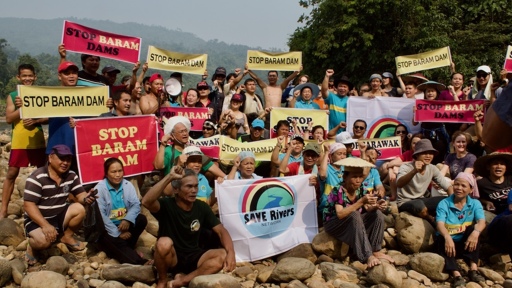
In October 2015, Indigenous activists from Indonesia, Malaysia, the Philippines, Cambodia, Brazil, the United States, and Honduras, together with delegates from longhouse communities throughout the Malaysian state of Sarawak, gathered at Tanjung Tepalit, an Indigenous Kenyah village on the Baram River on the island of Borneo. They called the gathering WISER: the World Indigenous Summit on Environment and Rivers. Tanjung Tepalit hosted the gathering because the village, along with more than two dozen others along the river, was scheduled to be drowned. The Baram Dam, a 1,200-megawatt hydroelectric mega project backed by the Sarawak state government and aligned with a regional industrial development scheme called the Sarawak Corridor of Renewable Energy (SCORE), would have flooded an area of more than 400 square kilometers (more than 150 square miles) and displaced an estimated 20,000 Kenyah, Kayan, and Penan people. Muslims, Catholics, Evangelicals, Buddhists, agnostics, and people who followed traditional Indigenous religions were among the attendees. As we gathered, Peter Kallang, the Kenyah founder and chair of the local advocacy group SAVE Rivers, addressed the assembly: “We are people of many faiths,” he said, “but we are united in one mission. To protect our forest homes and our ways of life.” In one sense the WISER gathering was a strategy meeting to coordinate an international coalition against a state-corporate project. In another, and perhaps deeper sense, WISER was rooted in something older. It was an assertion that the values that hold communities to their land across generations — the sanctity of the…This article was originally published on Mongabay
From Conservation news via This RSS Feed.