

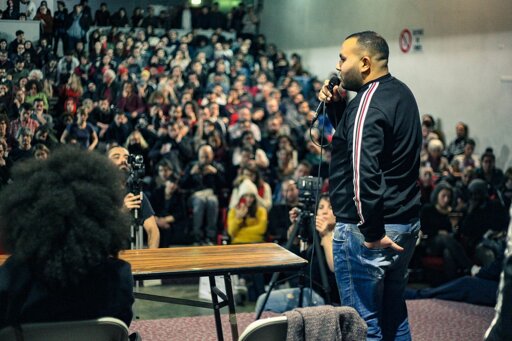
The following is an editorial published by Left Voice’s sister organization, Révolution Permanente — part of the Current for Permanent Revolution (CPR-FI) — launching the presidential campaign of railway worker Anasse Kazib. Though it is written for a French audience, it provides vital insights into the foundations of a revolutionary socialist campaign that centers the struggles of the working class and oppressed, and the task of socialists to build new, independent organizations of the working class to fight against militarism, imperialism, and capitalist crisis.
***
The French ruling classes need a turning point in the 2027 presidential election. After 10 years of Macronism, they hope to overcome the regime crisis that has deepened since 2022 and address the crisis of French capitalism. In a situation marked by the disintegration of the U.S.-dominated international order and by the sharpening of rivalries between world powers, this strategy promises new attacks on the working class. But in a context in which imperialism is being thwarted in Iran, and in which attacks led by Trump’s allies are generating uprisings, as in Bolivia, these plans could also face significant difficulties.
Economic, Social, and Political Crisis: Major Capitalists Go on the Attack for 2027
Members of the far-right National Rally (RN) Marine Le Pen and Jordan Bardella are meeting with big business leaders; RN Deputy Gabriel Attal promises to gut unemployment insurance; Bruno Retailleau of the conservative Republicans Party (LR) seeks to militarize working-class neighborhoods, and current Minister of Justice Gérald Darmanin vows to toughen xenophobic policies. Former prime minister and current mayor of Le Havre Édouard Philippe, who a few years ago advocated for retirement at 67, now intends to make us “work more.” All of them promise to accompany these policies with harsh austerity measures to pay off the debt and deficit, exacerbated by the more than 200 billion euros in annual handouts to big business following the presidencies of Sarkozy, Hollande, and Macron. These savings are intended to finance militarization and to better defend the interests of the French state and its multinationals by force of arms. This is what Macron’s government is already doing in the Strait of Hormuz by deploying the aircraft carrier Charles de Gaulle.
All these issues will dominate the presidential election. They signal harsh attacks to come against workers, young people, and the working class. While the wealth of France’s 500 richest people has ballooned by nearly 1 trillion euros in the last 20 years, enriching the bosses of luxury goods, mass retail, arms sales, telecommunications, and finance, workers’ standard of living has declined considerably. Today, workers are on the front lines of the international economic crisis. Inflation is back; in particular, rising fuel prices are impoverishing the working class while enriching Total, France’s main multinational energy company. Unemployment is rising again as business closures multiply. But the goal of most candidates is to go even further, launching new attacks on our pensions and other “systemic reforms,” as already demanded by the MEDEF (French Business Confederation).
Yet significant contradictions will likely prevent them from implementing their plan. First, large sectors of the ruling classes are worried that the presidential election will result in a weak government and a renewed deadlock, given the country’s deep political crisis. This problem is compounded by the absence of a natural successor to Macronism, someone who could guarantee a degree of stability and address the structural crisis of French capitalism. While the National Rally (RN) is best positioned, with its increasingly “pro-business” profile, the reactions its rise to power might provoke are worrying big business. Meanwhile, Philippe, Attal, and Retailleau are vying for dominance in the center and right without managing to differentiate themselves. Finally, on the center-left, attempts to revive social liberalism in crisis are encountering profound difficulties, despite the ambitions of Glucksmann and Hollande.
This situation is fueling simmering anger, the first signs of which are appearing in local strikes, such as at Airbus. On television, journalists and politicians are already expressing concern that new large-scale mobilizations will undermine the plans of the next government. Despite this, no project seems to place the new working class, its demands, and its methods of struggle at the center in order to prepare for the period that has begun. Faced with a capitalist system in crisis, which promises only misery, authoritarian hardening, and a tendency toward war, we need a project and a strategy that are commensurate with the radicalism of the ruling classes but that serve the interests of the working classes.
Making the Voice of the New Working Class Heard
From the Yellow Vest movement to the pension reform battles, from the movement against the labor law to the strikes waged by railway workers, refinery workers, cleaning staff, healthcare workers, and education workers, both documented and undocumented — for the past 10 years, it is the workers and oppressed people who have been the main force of opposition in the country, using their own methods of struggle. Despite the grand neoliberal narratives about the “disappearance” of the working class, the majority in society remains those forced to sell their ability to work to survive and occupy a lower position in the chain of command. Today’s workers are struck by precarity and unemployment, working for subcontractors or major clients, on permanent or temporary contracts, full-time or while studying; they are more feminized, racialized, and LGBTQ+ than ever, confronted with state racism, police violence, immigration problems, as well as with the rise of sexism, transphobia, and ableism. They are politicized by solidarity with Palestine, environmentalism, and the fight against the Far Right, yet they are also permeated by the influence of reactionary ideas. The working class is heterogeneous and larger than ever.
Even so, the world of work is invisible in political debates and in the presidential election. With the notion of a “new France,” La France Insoumise (LFI) promises a project of “national reconciliation,” which contrasts sharply with the racist and xenophobic offensive at the heart of the plans of the various bourgeois candidates. Its project, however, makes workers one component among others in an electoral bloc into which they must be diluted. Its strategy of “citizen revolution” claims that it would be possible to “change life” through the ballot box by pulling the right institutional levers. This effectively eliminates the specific nature of workers’ positions in production and their methods of struggle, condemning the movement to systematically channel anger into “civic” forms of action, whether peaceful marches or elections.
On the other side, the National Rally (RN) of Le Pen and Bardella regularly tries to present itself as a party that defends workers, highlighting the proportion of “tradesmen” in its electorate. But this stance poorly conceals its racist agenda, which seeks to divide workers, as well as the Far Right’s opposition to workers’ struggles, trade unions, and demands as basic as raising the minimum wage and overall wages. In recent years, the RN has only reinforced its pro-business agenda, increasingly meeting with CEOs, congratulating Total and the shipping company CMA-CGM on their billions in profits, and challenging the repeal of Macron’s pension reform, not to mention Bardella’s public pronouncements about his relationship with a multimillionaire aristocrat.
Conversely, to confront the current crisis, we are convinced that it is essential to defend a policy of class struggle, one that stems from the contemporary realities of the working class and their potential. This policy will unify and mobilize all the forces of the working class, which have been divided in recent years. It will allow for dialogue with thousands of abstaining workers, who see that the electoral process changes nothing in their living conditions, and with sectors won over to far-right ideas, hammered home daily for decades and reinforced by the notion that there is “no alternative” other than competition between French and foreign workers to snatch a few crumbs. This perspective has nothing to do with those who claim to address workers to counter the influence of the Far Right but adapt to reactionary ideas, whether by participating in the stigmatization of “welfare recipients,” denouncing any form of radicalism, or pitting the world of work against struggles against racist or gender oppression.
This is what Anasse Kazib, a railway worker and political and trade union activist, who has been at the heart of all the major movements of recent years — whether it be the battle for pensions, the Yellow Vest movement, or the movement of solidarity with Palestine — wants to bring to the presidential election.
You might be interested in: “In Macron’s France, Tweeting in Support of Palestine Can Get You Jail Time”
Workers Need a Revolutionary Perspective
The unique position of the working class in society gives it a decisive role in overturning the established order, using its own methods. Yet, on the Left, institutional orientations prevail. These lead even the most radical forces, such as LFI, to ally themselves with enemies of workers. The Socialist Party (PS), for example, has played as central a role as the Right in the neoliberal offensive and advocated only mild reforms despite the level of crisis facing capitalism. Faced with war profiteers like Total, LFI’s movement proposes capping profit margins or partially nationalizing the company while paying it tens of billions in compensation. On such burning issues as wages, LFI promises an increase in the minimum wage (SMIC), but defers any increase in overall wages to negotiations with employers. Finally, faced with the regime’s authoritarian hardening and the crisis of the Fifth Republic, LFI proposes a vague project for a Sixth Republic, to be negotiated with all the forces of the regime, to the point that Mélenchon does not rule out retaining an institution as authoritarian as the presidency.
More broadly, this purely institutional approach implies that LFI must negotiate with economic power, promising that its stimulus policies will “fill the order books” of large companies or courting the leaders of “Small and Medium-Sized Enterprises” (PME) that exploit entire sectors of the workforce. On the international stage, in a period where opposing war and imperialism will be a key task, Mélenchon presents France as a power for peace and embraces the legacy of De Gaulle and Mitterrand. He thus justifies defending the interests of the French state, its arms industry, and its army, even going so far as to support the operations launched by Macron in the Strait of Hormuz in the name of the need to “honor France’s commitments to its allies,” namely the reactionary Gulf monarchies. Any perspective that refuses a genuine confrontation with the ruling classes and the state ultimately opposes the overthrow of capitalism, even if it claims to represent a “rupture.” On the contrary, we believe that defending the interests of the new working class requires rebuilding a consistent, revolutionary, anti-capitalist Left, capable of translating its strategy into a policy that engages with the reality of our class.
On this point, socialist organization Lutte Ouvrière (LO) claims to adhere to revolutionary Marxism and maintains a line of class independence, but we believe this organization is not an alternative. Imbued with profound skepticism, it posits that we are in a period of decline, requiring a “trade-unionist” approach within the working class, propaganda for communism, and a focus on the self-construction of its organization. This leads LO to conduct routine, denunciatory campaigns centered on a few anti-capitalist economic demands, which struggle to convince our class. Further, LO considers all issues not directly related to capitalist exploitation to be secondary, or even diversions that divide the working class, to the point of sometimes adapting to dominant ideas on these subjects, as seen in its consistent alignment with a secularist tradition of the Left. Neither its defeatist logic, increasingly out of step with the crisis of the international order and the resurgence of class struggle since 2008, nor its workerist approach is capable of convincing the new working class.
Conversely, we aim to make Kazib’s campaign a tool for discussing all the problems facing the working class. To do this, we must confront the challenge of unifying it by fighting its internal divisions: differences in status, racism, and sexism. We must also consider the alliance between workers and other oppressed sectors of society, whether small farmers, artisans, or feminist, anti-racist, or environmental movements. We are convinced that making the voice of the new working class heard means defending a radical perspective, one that harbors no illusions about the state or employers, but instead embraces the idea of ending capitalism and demanding a different societal project: communism. As we face a capitalism that has entered a new era of wars and catastrophes, it is imperative to link every struggle to this horizon.
You might be interested in: “Victories for Revolutionary Socialists in France Show the Power of Running Openly Anti-Capitalist Campaigns”
A Workers’, Anti-boss, Anti-imperialist, and Revolutionary Campaign
The program we will defend must first and foremost reject the idea that the current crisis should be paid for by workers and oppressed people. This means advocating for proactive responses to the crisis, starting with demanding an increase in the minimum wage to 2,000 euros and in all wages, indexing them to inflation, and retirement at 60 (55 for physically demanding jobs) without any requirement for years of contributions. It also means massively funding public services, placed under workers’ control, to meet the immense needs of recipients in education, healthcare, and transportation, and to put an end to the deteriorating daily lives of workers in these sectors. At a time when business closures are multiplying, we must put an end to the unemployment and job insecurity that benefit employers, by prohibiting layoffs and job cuts, by mandating the hiring of all precarious workers — those on fixed-term contracts, temporary workers, or contract employees — and by distributing working hours equally among everyone. If companies refuse these measures, they must be expropriated under workers’ control, and, more broadly, strategic sectors like energy and health care must be expropriated without compensation or buyouts. This is the prerequisite for implementing economic planning that goes beyond mere suggestions made to big business. Confronting corporate dictatorship is essential at a time when the grip of big capitalists on our lives is tightening every day.
Our program must also be a tool to stop the march toward war. For this, we have no illusions about France’s role; quite the contrary. We are convinced that the fight against militarization requires opposing our own imperialism: by demanding the closure of all military bases; the withdrawal of all French troops; and the end of all military operations abroad, beginning with the withdrawal of the Charles de Gaulle from the Strait of Hormuz; and dismantling the arms industry and all the merchants of death, complicit in the genocide in Gaza, and putting their production under workers’ control. By opposing military budgets and all measures aimed at indoctrinating youth and the population, with the slogan “Not a single euro, not a single life for their wars.” War money must be used to massively finance public services, which must be placed under the control of workers and recipients, whether it be health care, education, or transportation, which should be free. Finally, these demands must go hand in hand with an internationalism that supports all anti-imperialist struggles, beginning with support for the Palestinian people’s struggle, or the defense of the defeat of the United States and Israel in their war against Iran.
These struggles are inseparable from the fight against growing racism and authoritarianism. The fight against the Far Right requires a clear rejection of the racist division between national and foreign workers, achieved by nationalizing all undocumented immigrants and enforcing freedom of movement and settlement. It also implies advocating for measures such as the immediate dissolution of all special police forces and the repeal of all authoritarian and racist laws, from the 2004 law to the separatism law. But the current authoritarianism is also a product of the hardening of a corrupt regime, the Fifth Republic. Faced with proponents of a Sixth Republic, which would simply be a return to a parliamentary system, we demand the abolition of the presidency of the republic, the Senate, and the Constitutional Council, and the establishment of a single assembly concentrating executive and legislative power. Its members should be elected for two-year terms, subject to recall, and paid the median wage, like a teacher or a nurse, to challenge the privileges of professional politicians.
The struggle for these demands must be a springboard to advance toward the overthrow of capitalism and a workers’ government. This can only emerge from an explosive mobilization of the masses, the preparation for which requires taking stock of the last few years of class struggle and waging a fierce battle against union bureaucracies and for self-organization. Only a movement based on mass self-organization can replace the bourgeois state, which serves a minority of capitalists, with workers’ power. The establishment of a socialist society, led from below, based on the democratic socialization and planning of production, would be the condition for confronting the climate crisis by reorganizing production. It is also one of the conditions for ending patriarchy, beginning with the socialization of all domestic labor to liberate women from it. Finally, at a time when wars are making a strong comeback, which only prolongs rivalries between states, it is also the only way to avoid a future of barbarism.
So the New Working Class Can Have a Say in the Presidential Election
Kazib’s presence is far from guaranteed, however. The requirement of 500 endorsements from elected officials exists precisely to prevent subversive candidacies that defend interests contrary to those of the ruling classes. This is why the first battle will be a democratic one for the right to be on the starting line and to champion a political project that, otherwise, will not be championed by anyone else. The existence of a strong working-class, communist, and revolutionary Left will be decisive, regardless of the outcome of the presidential election. This is why Révolution Permanente calls on all its supporters, as well as those who, while not necessarily agreeing with our ideas, believe we should be able to express them in the presidential debate, to help us, whether financially, by contacting elected officials, or by participating in endorsement-seeking tours alongside our activists.
This article was originally published in French on June 1 in Révolution Permanente. Translated and adapted by Adrien Masson.
The post Révolution Permanente and Anasse Kazib Launch Presidential Bid in France to Make the Voice of the New Working Class Heard appeared first on Left Voice.
From Left Voice via This RSS Feed.