

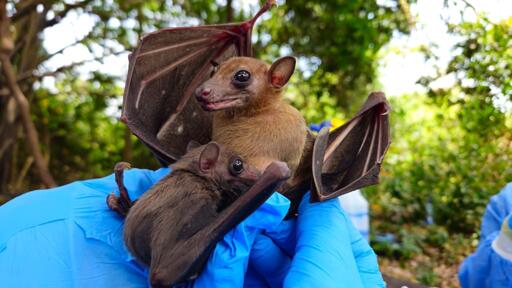
As the Democratic Republic of Congo grapples with another Ebola outbreak, bats have once again come under scrutiny as a possible reservoir for the virus. But according to bat ecologist Paul Webala, there is no conclusive scientific evidence linking bats to Ebola and the natural reservoir remains unknown. The current Ebola outbreak is caused by the Bundibugyo strain, a variant for which there are currently no approved vaccines or treatments, according to the World Health Organization. In this interview with Mongabay, Webala discusses why bats are often misunderstood, details the important ecological services they provide, and explains why habitat destruction may pose a greater risk for zoonotic diseases that spill over between animals and humans than bats themselves. Webala is a wildlife biologist at Maasai Mara University in Kenya who has studied bats for more than two decades. Rousettus aegyptiacus, commonly known as the Egyptian fruit bat, a widespread species found across much of Africa. Photo courtesy of Paul Webala. Mongabay: Many people immediately think of bats whenever there is an Ebola outbreak. Are bats unfairly stigmatized? Paul Webala: Bats are the second-largest group of mammals after rodents. Roughly 25% of all mammal species are bats. They play extremely important roles in ecosystems and are an integral part of biodiversity. Remove them, and entire ecological systems could begin to collapse. Unfortunately, bats are associated with many myths and misconceptions. Some communities associate them with death, evil spirits or bad omens. Because of these longstanding beliefs, bats have often been persecuted.…This article was originally published on Mongabay
From Conservation news via This RSS Feed.