


Mark Wagner
Special to ICT
The Rev. Mike Smith recalls vividly the evening before Day 1 of the 86th U.S. Open in 1986 at Shinnecock Hills Gulf Club.
He had spent the day preparing the golf course with his brother Peter. As night fell, he looked out and saw his father, Shinnecock tribal member Elmer — the first full-time superintendent of grounds — standing with Scotsman Charlie Thom, the first full-time golf pro at the course.
“It was quiet,” Mike Smith recalled, “and there was this sunset over the ocean. Purples and reds and oranges painting the sky. And I looked over and saw my father and Charlie Thom, just as they always were. My father had his arms crossed and a cigar in his mouth, and Charlie had his hands in his pockets. They had looks of satisfaction on their faces. They knew the course would defend itself.”
A nor’easter began to gather in the Atlantic. Beach plums and laurel and holly that lined the spirited fairways began to wave, and ancient spirits became players. By 1986, his father and Thom had been gone for years, but their influence lived on.
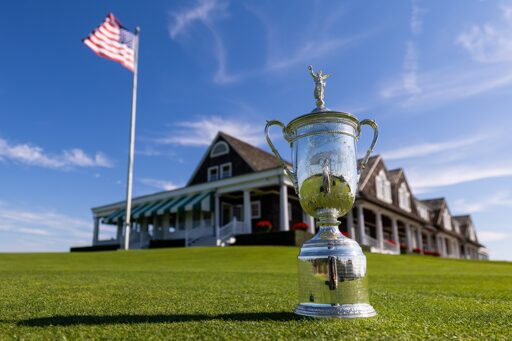
Today, as golfers, spectators and the Shinnecock Nation prepare for the U.S. Open to return to Shinnecock Hills Golf Club on eastern Long Island starting June 18, the relations between the Shinnecock Hills course and the Shinnecock Nation come into relief.
Ancient tribal lands
The Shinnecock Hills Golf Club is built on ancient tribal lands, and many golfers from the Shinnecock Nation have played and worked over the past century at the club, which sits a long stone’s throw across the Montauk Highway from Shinnecock Indian Territory.
No other golf course has ever hosted the U.S. Open over three centuries. And although many of the hole names speak to Scottish traditions — including Redan and Eden and Ben Nevis, named for the highest hill in the Highlands —it’s worth noting that the one hole named for the tribe — the 17th hole, the Shinnecock — is uphill and faces into changeable winds.

A sketch by artist David Bunn Martine shows Elmer Smith, front, the first full-time superintendent of grounds at the storied Shinnecock Hills Golf Club on Long Island, with his infamous Ford truck. Also shown in the sketch are, from rear, left, Charley Thom, the first golf pro at the club; Oscar Smith Bunn, Martine’s great-grand uncle who became the first Native American in the U.S. Open in 1896; and renowned golfer Willie Dunn. A portrait of Bunn painted by Martine now hangs in the U.S. Golf Association’s Golf Museum in New Jersey. Credit: Courtesy photo
At the Second U.S. Open in 1896, Shinnecock golfer Oscar Smith Bunn became the first Native American to play in the tournament. He represented the course along with African-American golfer John Shippen, the grandson of freed slaves who lived on the territory and who would marry a Shinnecock woman, Maude Elliot Lee.
In the decades since that 1896 U.S. Open, many Shinnecock tribal members have both played and worked on the course.
Brad Smith, the cousin of Mike Smith, is a retired police officer and has been a member of Southampton Country Club since 1991. Southampton adjoins Shinnecock Hills, and Smith was the first minority member at Southampton.
Brad Smith said he began to caddy at the Shinnecock Hills course in the 1960s, and notes that not all caddies were allowed to play the storied course.
“We got $4 for a round, and $6 if we carried two bags,” Brad Smith recalls, noting that times have changed since the early 1960s, when rounds for Native golfers were scarce.
In the 1970s, Brad Smith was one of six founding members of the Shinnecock Golfers Association, led also by Shinnecock tribal members Rodney Crippen, Tom Williams, Donald Williams Sr., Tom Lee Franklin and Luben Hunter.
“There were a large number of African-American and Native males that played well, that probably could have been on tour in the ‘60s and ‘70s. But we couldn’t get a game,” Brad Smith said. “So we, as minorities, formed our own associations.”
In some cases, those golfing leagues – sometimes called Loops – were the remnants of the United Golfers Association, formed in 1925 to represent Black golfers until it disbanded in 1961.
“We went as far as South Carolina and Virginia,” Brad Smith said. “We wanted to play against the best minority players.”

Shinnecock Indian Nation officials meet with the Shinnecock Golfers Association and collegiate women golfers at the Shinnecock Powwow in 2025. Association President Mitchell Williams is at far right in red shirt.
Credit: Courtesy Shinnecock Golfers Association
Today, the Shinnecock Golfers Association counts 16 Shinnecock as members. Each year, Shinnecock Hills provides the golf course for the association’s annual fundraiser, which for more than 50 years has provided need-based, educational scholarships to Shinnecock youth.
Meanwhile, across the Montauk Highway, the Smith family’s legacy at “Shinny” — the Shinnecock Hills Golf Club — remains a work in progress.
Generations of care
Mike Smith was also a gifted golfer and is keeper of his family’s lineage. His maternal grandfather, Charles Dyson, and his paternal ancestor, George Thomas Smith, worked on the original course.
Reverend Mike, as he is known, also worked at the club for many years as a young man alongside his brother Peter under the tutelage of their father. Elmer was appointed superintendent at Shinnecock Hills in 1955 and held the position 25 years until his death in 1980. By then, Elmer had become a legend, loved by both Shinnecock Nation and the East Enders at the club.

This undated historic photo shows the Shinnecock Hills Golf Club in its early years. The 2nd U.S. Open was played there in 1896, and the tournament returns to the club from June 18-21, 2026. Credit: Archive photo
Even The New York Times took note.
“Elmer Smith is a legendary figure, famous for his grass-growing genius, his probity, his decency, his way of treating everyone, caddies and members, with the same respect,” the newspaper noted in an article published June, 2004, in the weeks before the 104th U.S. Open was played at the course.
When asked about the Shinnecock mystique, Mike Smith said, “It’s as if the Creator landed the finest links in the world on the narrowest expanse of land on Long Island.”
He recalls a story his father passed down, about his green Ford pickup, an infamous ride used to ferry the many Shinnecock men and women who worked at the club. The reservation’s West Gate is a short drive to Tuckahoe Road, which bisects the course.
One season, Elmer Smith’s truck broke down. He tried to get it fixed once, and it came back broken, so, he sent it back in. When it wasn’t right, he talked to Henry Ford II, one of the club’s members.
“For the rest of my father’s life, the bills for his repairs went to Henry Ford himself,” Mike Smith said, laughing as he tells the story that speaks to the high-wire act his relatives strung between ‘The People of the Stony Shore,” as the word Shinnecock describes, and the EastEnders.
Mike’s mother, Elmer’s widow, still has the gold embossed invitation Elmer received for the marriage of Bingham Morris and Janet Lee Bouvier, the mother of Jacqueline Kennedy. (Rev. Mike reports that his father did not attend the wedding.)
This history between the Shinnecock Nation and “the millionaires club” goes back to at least 1730, when a group of New Yorkers “purchased” the highlands from the tribe. Because the deeds and sales happened before the United States was founded, lawsuits by the tribe to recover the land run into the so-called Doctrine of Laches. The federal courts have ruled, in effect, they do not have jurisdiction over exchanges and deeds from before the country was founded.
‘God entrusted us’
Ronald Eleazer Jr. is another of the Shinnecock Nation’s legendary golfers and a member of the Shinnecock Golfers Association.
Eleazar’s father and brother also worked for decades on the grounds alongside the Smith family, and the Eleazer family are direct descendants of the Bunns. Eleazer speaks to this history in a way that sees the Native people and the golf club in a kind of complicated reciprocity.
“To some folks, Shinnecock Hills is just a golf course, but the course sits on our ancestral land,” he said. “God entrusted us to take care of it.”
First Native pro golfer gains new recognition after 100 years
While ownership and the place of a creator may be points of contention, the Smith family and members of the Shinnecock Nation continue to take care of and work with the club. In 2022, the club announced a scholarship in the family name. The Elmer and Peter Smith Scholarship funds a member of Shinnecock Nation to study turf management at Rutgers University.
The first recipient? Reverend Mike’s son Matthew.
“I didn’t think I wanted to go back to school,” Matthew Smith says, with a soft chuckle just like his dad’s. “But my father coaxed me to take up the mantle.”
Matt Smith completed his degree at Rutgers and is now the fourth generation of Smiths preparing the course for the upcoming U.S. Open, considered the premier event in golf after the British Open.
As he takes up the family trade, Matt is also passing down songs and stories of generations. He named his son Menuhki — the Algonquian word for strong. His daughter Annabella is named for his mother.
A parallel history
Richard Coard is the current vice president of the Shinnecock Golfers Association. He never worked at Shinnecock Hills, but has embraced the game of golf and the tribe’s relationship to the course.
Alongside his brother, Kenny Coard, and association President Mitchell Williams, Richard Coard maintains the Shinnecock Golfers Association Scholarship Fund, which helps young Native athletes access higher education.
Richard Coard was the #1 player on the Southampton High School golf team from 8th grade to his graduation, but for a variety of reasons, one being his height, he was steered toward basketball.
One of the country’s best basketball players in his college days, “Richie” Coard ran alongside household names. His second year of college, he had one of the country’s highest-scoring averages.
“I played in the Rutgers and 14th street tournaments, all over,” Richard Coard told ICT at a recent golf event. “Played with a lot of the greats. . … Len Bias, Sam Casell, Stefan Marbury.”
His brother, Kenny, suggests a parallel history could also have been possible.
“If he had stayed with golf, he would have been the first Tiger,” Kenny Coard told ICT.
After he established himself as a physician’s assistant and with his three children grown, Richard Coard returned to golf. He plans on playing in this year’s Native American Open, which runs Oct. 16-18 at the Santa Ana Pueblo in New Mexico.
Carrying on the vision
As Mitchell Williams and Kenny and Richard Coard maintain the efforts of the golfer’s association, Brad Smith notes that access to golf for Native and minority youth has changed in many ways in recent years, with the Professional Golfers’ Association and the U.S. Golf Association working to open up the game.
“The PGA and the USGA have developed programs that give access to many more kids coming up,” Brad Smith said.

A portrait of Oscar Smith Bunn, Shinnecock Montauk, who played in the 1896 and 1899 U.S. Opens, now hangs in the U.S. Golf Association’s Hall of Fame in Pinehurst, North Carolina. It was painted by Bunn’s nephew, artist David Bunn Martine, Shinnecock/Apache.
Credit: Courtesy of U.S. Golf Association Hall of Fame
When the U.S. Open was last at Shinnecock in 2018, the USGA paid for and installed a practice facility on the territory named for Oscar Smith Bunn.
When the world’s elite golfers tee up for the 126th U.S. Open, the Shinnecock mystique will bring this complex history into view. And where some tournaments feature golfers going many strokes under par, the sublime Shinnecock Hills course can challenge even the best.
“In 1995,” Mike Smith notes, “Corey Pavin won on even par.” In 2018 Brooks Koepka’s winning score was one over par.
There has been drama at Shinnecock Hills in the U.S. Open over the course of three centuries. In 2004 (when, it should be noted, no Smith was on the grounds’ crew) the greens dried up and became too fast.
In 2018, the winds whipping between Peconic and Shinnecock Bays were so fierce a player (Phil Mickelson) was penalized for hitting a moving ball. In 1896, John Shippen would have won if not for landing his ball on a sandy road. (Sand wedges weren’t yet invented.)
Whatever transpires at this year’s U.S. Open, the spirits of Elmer and Peter Smith, and Charlie Thom and countless others, will ensure that the course — this ancient tribal land — will defend itself.
The post A Window on History: Native legacy shines at Shinnecock Hills appeared first on ICT.
From ICT via This RSS Feed.