

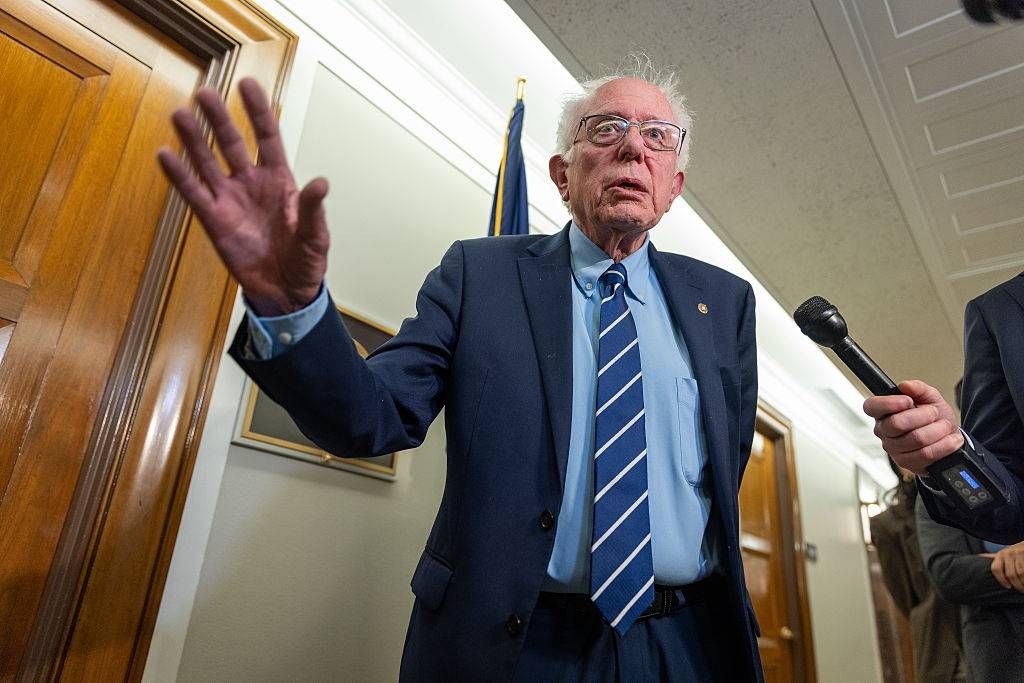
With President Donald Trump seemingly open to the idea of having the federal government take a stake in major artificial intelligence firms, Sen. Bernie Sanders emphasized on Monday that he and the president have two very different visions when it comes to regulating AI.
During an interview at the National Press Club, CBS News’ Robert Costa asked Sanders (I-Vt.) to comment on Trump last week showing interest in the government partially owning Big Tech firms whose AI models could potentially disrupt American society in the coming years.
Sanders credited Trump with having sharp political instincts on the matter, theorizing that he understands the deep unease and anxiety that people feel about AI, particularly the fear that it could put millions of Americans out of work while benefiting Big Tech CEOs like Elon Musk and Mark Zuckerberg.
“So as a politician, I think that’s where he’s coming from,” Sanders said. “Do I have great confidence that Trump will do the right thing? No.”
Sen. Bernie Sanders (@SenSanders): “Trump is many things, but he is a good politician.” pic.twitter.com/2iGu0kXZBa
— CSPAN (@cspan) June 9, 2026
Trump so far has only hinted at plans for a public stake in AI firms and hasn’t released any concrete plans.
In contrast, Sanders earlier this month wrote an editorial for The New York Times in which he proposed creating an AI-based sovereign wealth fund that would impose a one-time, 50% tax on OpenAI, Anthropic, and other AI behemoths, paid in the form of stock.
Sanders argued that the wealth fund was necessary to “give the public a direct role in determining the future of this technology” and “guarantee that the trillions of dollars potentially generated by AI are used to improve the lives of all of us—not simply to make the richest people in the world even richer.”
Noting that AI companies’ large language models (LLMs) were only made possible with the inputs of centuries’ worth of human knowledge and writing, Sanders said that it’s only reasonable that the public have a strong degree of control over how such technology is used.
“When a public resource generates wealth, the public should share in that wealth,” Sanders wrote. “The future of AI and the fate of humanity must not be decided behind closed doors in Silicon Valley. It must not be dictated by billionaires seeking to maximize their power and profit.”
Progressive economist Dean Baker on Tuesday pushed back on Sanders’ idea for an AI sovereign wealth fund, in particular arguing that it may be unwise for the government to create a wealth fund based on what might be a wildly overvalued asset.
“Most likely the AI sector is in a massive bubble,” cautioned Baker. “An AI sovereign wealth fund is likely to end up being a mechanism to shovel yet more money to Elon Musk, Mark Zuckerberg, and the rest of the right-wing billionaire gang. We have already given this crew enough money.”
Instead, Baker proposed handling the potential negative consequences of AI disruption through a mix of higher corporate income taxes, stricter antitrust enforcement, and shorter average work weeks.
“We have all the tools needed deal with an AI productivity boom; we just lack the political will to use them,” Baker concluded. “The sovereign wealth fund idea is a massive leap in the wrong direction.”
From Common Dreams via This RSS Feed.