

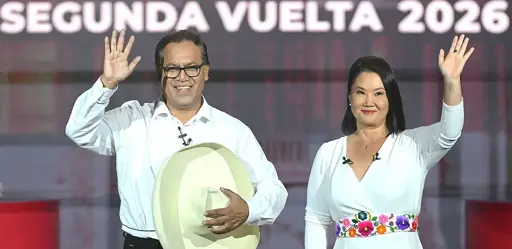
Caracas (OrinocoTribune.com)— Peruvian citizens are closely following the vote count from Sunday’s second round of the presidential election. Data from the National Office of Electoral Processes (ONPE) showed that by 1:22 p.m. local time on Monday, June 8, with 94.06% of the ballots counted, the difference between the two candidates in the presidential runoff was less than one percent. This represents a mere 9,621 votes, with a late trend favoring leftist candidate Roberto Sánchez.
According to the figures, Sánchez has just pulled ahead of right-wing candidate Keiko Fujimori, obtaining 50.027% (8,802,540 votes) compared to Fujimori’s 49.973% (8,792,919 votes).
The majority of earlier votes came from Lima and major urban centers, which are traditional far-right strongholds. Fujimori, who is running for the presidency for the fourth time, is the daughter of former Peruvian dictator Alberto Fujimori. In contrast, Sánchez is garnering stronger support in rural, mountainous areas, where votes are typically counted last. During the first round, Sánchez outperformed the previous favorite, former Lima Mayor Rafael López Aliaga, due to this late rural trend.
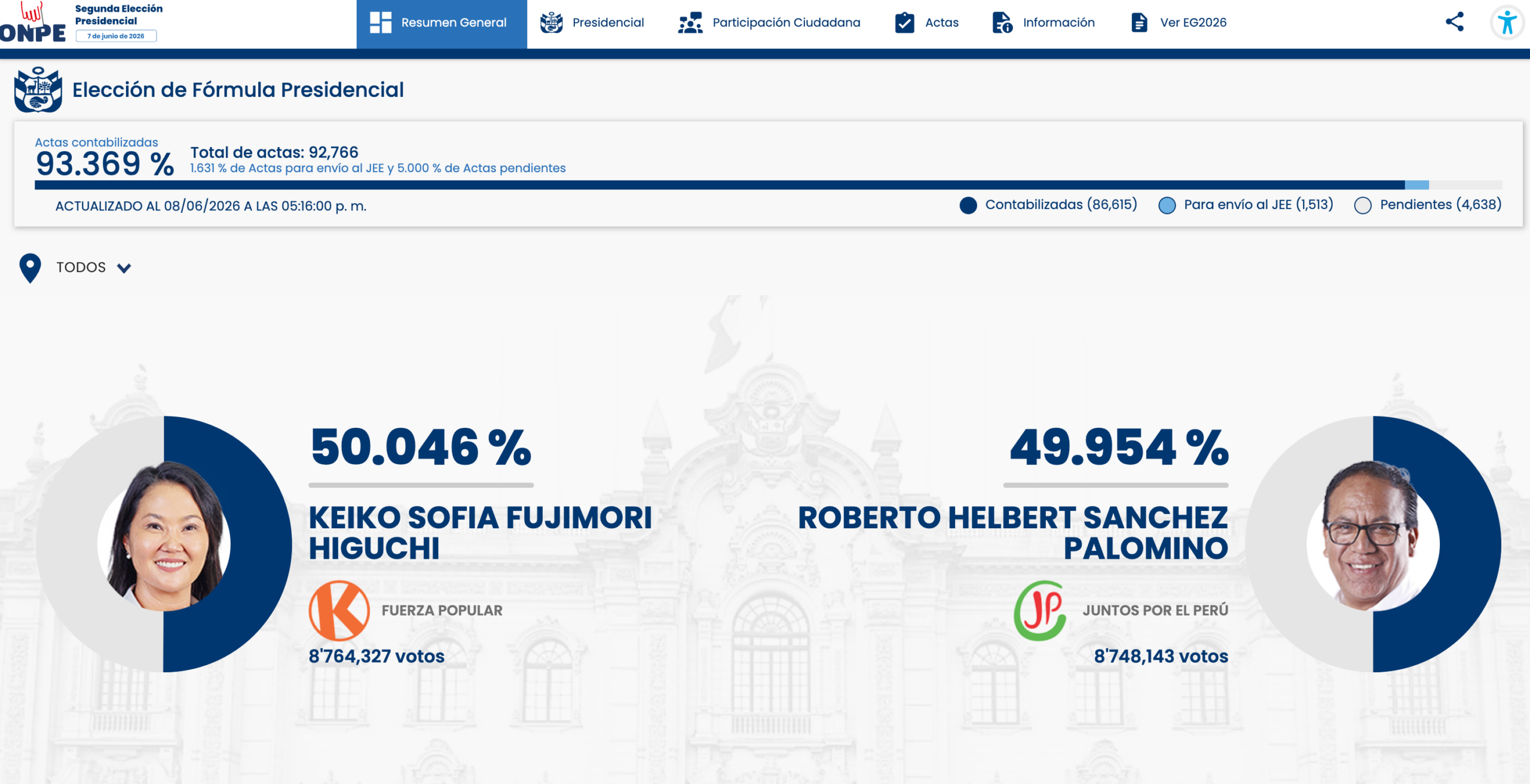
Peru’s presidential runoff vote count from two hours earlier.
Reuters reported that an early Sunday tally by pollster Ipsos showed Roberto Sánchez leading the race with 50.3% compared to Keiko Fujimori’s 49.7%, a statistical tie according to Ipsos representatives. Exit polls released immediately after voting concluded on Sunday also found a virtual tie.
Historical parallels and institutional crisis
Most analysts agree that the election will be decided by a few thousand votes, mirroring the 2021 elections, when rural teacher Pedro Castillo defeated Fujimori in the second round by a razor-thin margin of 50.13% to 49.87%. Press reports from that period indicate that Castillo won by just 40,000 votes. A similar scenario unfolded in 2016, when Fujimori, representing the Fuerza Popular party, lost to Pedro Pablo Kuczynski.
Over 27.3 million Peruvians across 90,223 polling stations were called to vote in the second round of the presidential elections on June 7. The winner will govern Peru for the 2026–2031 term, inheriting the consequences of a decade of severe political instability. Peru has had eight presidents in 10 years due to successive presidential impeachments and usurpations orchestrated by an unpopular, corrupt far-right Congress. Meanwhile, the deep-seated social impacts of a neoliberal economic model have generated greater inequality and poverty.
The national electoral authority rejected generalized claims of fraud and reaffirmed its commitment to addressing isolated incidents reported by political parties. The most serious infraction occurred at a polling station in Lima, where two alleged observers were arrested after being caught marking 90 ballots in favor of Fujimori. International observers monitoring the process reported no major systemic disruptions during election day and urged the population to wait calmly for the official final results.
Sánchez calls for vigilance and calm
Speaking to a crowd from a balcony near Plaza San Martín in Lima on Sunday night, Sánchez stated that his political coalition, Together for Peru (Juntos por el Perú), will await the final official tally from the electoral authorities.
“This is the moment for a great consensus among patriots, democrats, and those of us convinced that the only enemy of the homeland is corruption,” Sánchez declared as supporters chanted “democracy yes, dictatorship no.”
Despite the variations between initial quick counts and the ongoing official ONPE count, Sánchez called for public calm. The leftist candidate emphasized that the legitimacy of the democratic process rests solely on the ONPE’s verification. He stated that his political movement will fully respect the official election results regardless of the outcome.
Peru’s Presidential Runoff: Debates and Polls Reveal Great Division
Sánchez noted that his campaign’s oversight work entered its most crucial phase after the polls closed. He reported that his accredited representatives will exercise their legal right to physically monitor the counting of each tally sheet at official computation centers, ensuring that citizens’ true votes are recognized under conditions of total technical transparency.
Closing his address in a combative tone, Sánchez criticized what he termed “the mafia-like pact that has seized control” of the country’s public institutions, asserting that his political movement remains determined to “reclaim the government for the people.”
Special for Orinoco Tribune by staff
OT/JRE/SF
From Orinoco Tribune via This RSS Feed.