

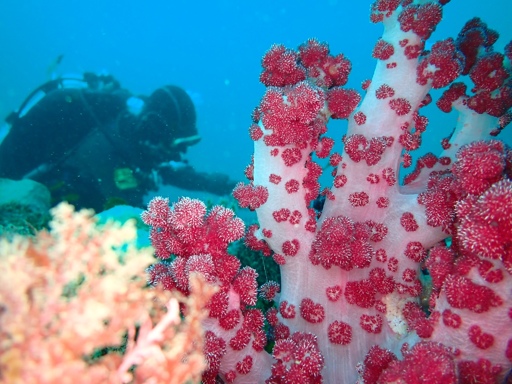
JEJU ISLAND, South Korea — In April 2025, I zipped myself up into a thick wetsuit and inched down a steep, rocky ledge toward the gray-blue water encircling Beomseom, a small island off the southern coast of Jeju Island in South Korea. Then I leapt into the chilly sea and wriggled into my scuba gear while floating on the surface. In the water with me was Sanghoon Yoon, an adviser for Paran Ocean Citizen Science Center, a South Korean civil society group that advocates for the protection of the ocean. That day, Yoon was my scuba dive buddy. Yoon and I sank beneath the dangling legs of snorkelers into a watery realm of rocks and kelp. Once in deeper water, I encountered gelatinous stalks of soft coral. The polyps appeared purple, pink, red, and even orange, depending on the light. The islet of Beomseom off South Korea’s Jeju Island hosts colorful gardens of soft coral. Image courtesy of Paran. Sanghoon Hoon, an adviser to the Paran Ocean Citizen Science Center, dives among soft corals in the waters off Jeju, South Korea. Image courtesy of Paran. The soft corals I saw that day were healthy. But in 2024, soft corals around Beomseom Island and other parts of Jeju experienced what scientists are calling a “slumping” event — and what Yoon describes as “melting” — which saw soft corals losing their shape, drooping, and even dying. The event was widely reported in local media and attributed to marine heat as Jeju waters…This article was originally published on Mongabay
From Conservation news via This RSS Feed.