

Barclays has quietly stopped underwriting Israeli wartime bonds, Novara Media can reveal, as pressure grows on European institutions to distance themselves from Israel.
Data seen exclusively by Novara Media reveals that Barclays has not publicly underwritten a single Israeli government bond since January 2024, despite publicly claiming that it would continue doing so, and despite numerous opportunities to get involved since.
The data, sourced by Profundo, an Amsterdam-based sustainability research and consultancy firm, shows that French bank BNP Paribas has also withdrawn from its role as underwriter of Israeli bonds since early 2024, but, unlike Barclays, it has openly acknowledged the move.
Government issued bonds have been crucial to the financing of Israel’s war in Gaza and its occupation of the West Bank. Without their key underwriters, Israel’s multibillion-dollar international bond issuances would not have been possible. Barclays’ and BNP’s withdrawal from underwriting is a blow to Israel’s carefully curated image of institutional and ethical legitimacy among its allies.
The near-hegemonic support for Israel across British, European and US politics has long given the impression that Benjamin Netanyahu is beyond accountability. But cracks are forming. Governments in Spain, Ireland and Norway have broken ranks, and a small but significant group of financial institutions have followed suit.
The UK’s largest private pension fund – the Universities Superannuation Scheme – sold £80m in Israeli assets in 2024 as part of what the Financial Times described as “a wave of global retirement funds retreating from the conflict-ridden region following public pressure over Israel’s human rights record.” In August 2025, Norway’s Government Pension Fund Global, the world’s largest sovereign wealth fund, divested from 11 Israeli companies and excluded Caterpillar and five Israeli banks over links to settlements. The following month, Ireland’s Central Bank stepped back from approving Israeli bond prospectuses, and Denmark’s academics’ pension fund excluded Israel entirely.
Were banks to boycott Israeli assets, it could spell trouble for Israel’s heavily indebted wartime economy. Israel relies on borrowing to finance its massive military spending and plug its ballooning deficit. The country’s bond issuance hit historic highs in both 2024 and 2025, at above $75bn (£55bn) and $60bn (£44bn) respectively. While the majority of this money has come from domestic investors, the Israeli government has also relied on huge sums from foreign investors, selling $6bn (£4.4bn) in bonds in January of this year alone.
Profundo’s data shows that, between October 2023 and January 2026, a group of seven major western banks – Goldman Sachs, Bank of America, Citigroup, Deutsche Bank, JPMorgan Chase, BNP Paribas and Barclays – underwrote $29.1bn (£21.6bn) of Israeli government bonds. In that time period, Barclays stands out for having participated in just two bond issuances: one for $278m (£206m) in November 2023, and the other for $223m (£165m) in January 2024. The bank has not underwritten a single Israeli bond since. BNP has not underwritten any Israeli bonds since March of that year.
Profundo’s figures only capture publicly disclosed bond deals, leaving open the possibility that Barclays and BNP may have continued underwriting Israeli debt through private placements – smaller transactions that do not appear in public datasets and are far harder to trace.
‘Hot air’.
Barclays’ and BNP’s retreat comes as Europe’s largest financial institutions are under increasing pressure from activists and politicians.
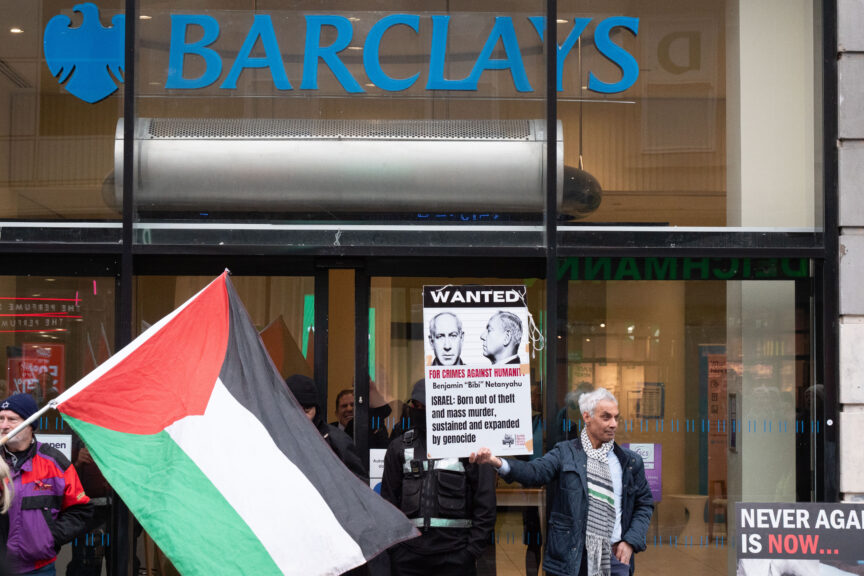
In mid-2024, Barclays briefly considered stopping its underwriting of Israeli bonds, following pressure from Palestine activists. This included hundreds of artists boycotting Barclays-sponsored music festivals over the bank’s provision of financial services to Israel, activists smashing windows and spraying red paint at twenty branches of the bank across the UK. The pressure was significant enough that Barclays CEO CS Venkatakrishnan wrote op-eds in both the Guardian and the Times in June 2024, defending the bank’s position and attacking protesters’ “lack of respect for facts” – a remarkable intervention that only served to amplify the controversy further.
In the end, the summer of 2024 saw Barclays U-turn and reaffirm its role as one of Israel’s key underwriters. Yali Rothenberg, Israel’s accountant general, thanked Barclays for its “continued commitment to the state of Israel” and commended the bank for resisting “anti-Israel pressures, particularly those promoted by BDS movements.”
Profundo’s data suggests that Barclays’ commitment was “hot air”, said Max Hammer, a campaigner for BankTrack, which monitors commercial banks’ impacts on human rights and climate change. He believes that Barclays’ silence has been partly shaped by the threat of anti-BDS legislation, laws that in the US have created a climate in which financial institutions feel unable to withdraw – or at least, to acknowledge withdrawal – from Israeli markets without risking legal consequences.
Hammer says banks feel “caught between their international legal and human rights obligations, and the very real material pressures placed on them by US states that have passed anti-BDS laws and are quick to weaponise them. In any case, it’s clear that they’re trying hard to make as little noise as possible about their retreat”.
To this day, Barclays’ website hosts an FAQ page – entitled “Is it true that Barclays funds the state of Israel?” – that claims: “As a global investment bank, we act as part of a syndicate of international banks that connects the world’s largest economies to the international capital markets through weekly debt auctions. This includes the state of Israel.”
However, Profundo’s data shows that Barclays has quietly exited that syndicate of underwriters – Goldman Sachs, Bank of America, Citigroup, Deutsche Bank, JPMorgan Chase, BNP Paribas and Barclays. Of those, all but BNP Paribas have continued to support Israel in raising tens of billions of pounds through international bond sales over the last two years.
Barclays is not alone in having stepped back from the syndicate. BNP Paribas – France’s largest bank – underwrote its last Israeli government bond in March 2024, as part of an $8bn (£6bn) multi-tranche deal, according to Profundo’s dataset.
Unlike Barclays, however, BNP has been quite open about its retreat from Israel’s international bonds. In late 2025, the bank told investigative website Follow the Money that its underwriting role “as an intermediary is now over”, and that the two deals it was involved in with Israel after 7 October, worth approximately $2bn, had been “arranged with other banks before the conflict”.
Asked by Novara Media why it was withdrawing from underwriting, the bank replied: “BNP Paribas evaluates its financing decisions on a case-by-case basis,” adding that it was “deeply concerned about the tragic events in the region and, in particular, the devastating impact on civilians. The bank is neither involved in, nor is it funding, the conflict.”
Barclays declined Novara Media’s request for comment.
Having it both ways.
Despite BNP’s and Barclays’ retreat from Israeli bonds on the international market, both banks are still regularly buying Israeli government bonds in Israel’s domestic market according to the Israeli Ministry of Finance website.
It should be noted that domestic and international bond markets are two different worlds. International bond underwriting is relationship-intensive: the bank puts its name on the prospectus and works closely with the Israeli government – and can get a lot of press attention. By contrast, when investors purchase Israeli bonds on the domestic market – through the standardised auction process run by the Bank of Israel on behalf of the Ministry of Finance – the process is passive and mechanical: A bid is submitted electronically, allocated automatically, with no direct relationship with the Israeli government, no prospectus involvement and no public announcement. It rarely makes headlines, if at all.
Ward Warmerdam, senior researcher at Profundo, thinks that Barclays and BNP are trying to have it both ways: distancing themselves from the Israeli government without burning commercial and political bridges. “Their activity on the domestic Israeli market serves their local Israeli customers and signals their continued support for the Israeli government. And [now that they’ve] quietly wound down their international underwriting and investing, Barclays and BNP may consider it too risky to stop purchasing Israeli bonds in the domestic market [lest they be perceived as boycotting], something that could lead to backlash from the Israeli governments and private sectors.”
It is easier for both banks to remain half-in, half-out while just staying silent about their rationale, says Joseph Wilde-Ramsing, advocacy director at the Amsterdam-based Centre for Research on Multinational Corporations. As such, any explanation or public policy stance from them is very unlikely.
“Withdrawing from Israel’s international markets significantly lowers their exposure to Israel and the risks that come with that,” says Wilde-Ramsing. “But”, he adds, “buying Israeli bonds on the domestic markets still leaves both banks vulnerable to potential legal risks in terms of war crimes being committed by the Israeli government”.
Wilde-Ramsing, who spent 15 years with OECD Watch network – a civil society network that monitors corporate compliance with human rights and sustainability guidelines – explains that banks are required to conduct human rights due diligence on their financing activities and cease supporting governments involved in serious violations. Although the guidelines are voluntary, a finding of a breach against a major bank carries significant reputational consequences. According to those standards, Barclays and BNP should not be involved in bonds (internationally or domestically) of any government that is potentially committing war crimes.
“If already invested, banks should try to use their leverage to get the government to stop committing war crimes, and if that is not successful – as is the case with Israel now – banks should not engage in any new investments or underwriting and consider divesting from existing bonds and from underwriting relationships,” he says.
Following Barclays’ and BNP’s departure from Israel’s international bond market, the remaining players actively underwriting Israeli bonds on the high-profile international scene are a five-bank syndicate of Goldman Sachs, Bank of America, Citigroup, Deutsche Bank, and JPMorgan Chase. All have co-run enormous auctions of Israeli bonds over the last two years, including a $5bn (£3.7bn) issuance in February 2025 and a $6bn (£4.4bn) one in January 2026.
Demand for January’s sale was so high that it reached $36bn (£26.8bn), six times the amount actually sold, from over 300 institutional investors across more than 30 countries, despite Israel’s credit downgrades from all three major rating agencies over the last two years. In short: Israel continues to have no shortage of banks who are willing to underwrite or buy its bonds, regardless of the ICJ’s finding of plausible genocide in Gaza.
“It’s not a coincidence that this new, now five-bank, consortium is made up of American or German banks,” one bond trader who chose to remain anonymous told Novara Media. “It’s a geographic split that reflects the different political pressures operating on institutions in those countries compared to their French and British counterparts.”
Growing discontent.
These five banks appear unfazed by the multifaceted risks of auctioning Israeli government bonds, assets that, according to Hammer, are particularly difficult for banks to justify compared to other investments in terms of ethics and compliance. “It’s undeniable that these bond issuances are being made specifically to finance Israel’s wars, so they can’t pretend they didn’t know”.
That link between bonds and military spending is well evidenced. Israel’s February 2025 $5bn bond issuance was sold to institutional investors across 30 countries to fund its budget deficit swollen by war costs. That same year, Israel’s ministry of finance Bezalel Smotrich said that his budget: “Is a war budget. And with God’s help, it will also be the victory budget” – the very budget that was, and continues to be, largely funded through bonds.
“The documented links between the proceeds of bond deals and Israel’s military spending in Gaza […] makes banks’ continued involvement as bond underwriters or holders harder to defend,” says Anne-Marie Brook, an economist and co-founder of the Human Rights Measurement Initiative.
Discontent and concern is growing among Europe’s financial institutions. Last year, the Central Bank of Ireland (CBI) raised questions about the extent to which Israel’s international bond sales were financing the country’s actions in Gaza and elsewhere. Following mounting political pressure from activists and politicians, CBI relinquished its role as the EU’s regulatory authority for the approval of Israeli government bond sales.
The regulatory scrutiny followed the bonds to Luxembourg. At a conference in May organised by Amnesty International Luxembourg, UN Special Rapporteur Francesca Albanese and legal experts argued that Luxembourg’s approval of Israel’s bond programme breaches its obligations under international law, including its duty to prevent genocide under the Genocide Convention.
Speakers called on Luxembourg to block the planned September renewal of that approval, with Irish Senator Alice-Mary Higgins warning that “failing to exercise this discretionary power when the risk of complicity is serious clearly constitutes a breach of their obligations.” Luxembourg MP Franz Fayot, meanwhile, pledged to bring the conference’s legal findings to parliament.
“The sale of these bonds is illegal under international law because it goes directly to funding the genocide,” Albanese said at the event.
“International law says that all financial actors have to abstain from directly being linked to human rights crimes. And those who have authorised sale of bonds were implicated. It is morally and legally wrong to sell these bonds.”
From Novara Media via This RSS Feed.