

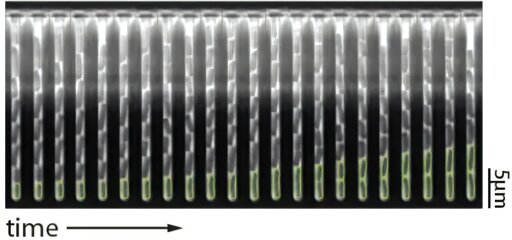
Researchers at Carnegie Mellon University have shown that bacteria can learn from past experiences, store memories across generations and adapt their behavior to changing environments, all without a brain or nervous system. The research could shape how scientists think about bacterial infections and antibiotic treatment.
From Biology News - Evolution, Cell theory, Gene theory, Microbiology, Biotechnology via This RSS Feed.
Such a vague term to use. Seems more like adaptation than learning and in a similar way that metal can have ‘memory’. Stressing something in a way that changes it’s composition, that it passes along as it splits isn’t really learning any more than adding salt to a glass of water means it ‘learned’ to be more electrically conductive when you put it into different containers. Just more steps and an interesting capability that life has to adapt and pass along properties.
Adding nutrients to the point where the bacteria can lose some functionality and still survive, and continuing to reproduce could result in it becoming weaker or less resilient when you starve it, but it didn’t really ‘learn’ that behavior.
Passing along a trait is impressive enough without trying to frame it in human terms.
I know some humans able to do this too.
