

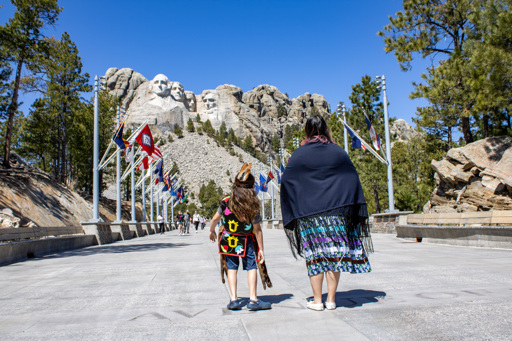

This story is part of ICT’s series on the 250th anniversary of the United States of America, a nation built on the backs of enslaved people, genocide, and stolen land.
Mary Annette Pember
ICT
Religious freedom is foundational to the United States’ origin story. After all, it was the freedom to worship God in their own way that brought the Pilgrims to America’s shores.
That righteous landing reportedly at Plymouth Rock in 1620 has come to embody not only religious freedom but also the entirety of America’s ideals of social, economic, racial equality and justice.
With the approaching 250th anniversary of the signing of the Declaration of Independence on July 4, the Pilgrim narrative is a neat, heroic story of an altruistic quest, emblematic of the patriots’ concept of the United States. It is an accepted narrative taught to schoolchildren as the existential heart of the republic.
But the real story is far more complex, messy and human. The freedom of religion narrative, for instance, not only excluded Native spirituality but sought to eradicate it.

Why were these founders so keen on denying the right to worship to the Indigenous peoples of America? And why, in the face of such fundamental exclusion, are Native Americans generally so patriotic? They serve in the military at numbers higher than any other ethnicity, proudly defending the United States.
The answers may lie in the complex, fraught history that helped draw Europeans to colonize America and the role Christianity played in their relationships with Indigenous peoples. And as is often the case for Native people, land was central to the issues.
“The founding fathers weren’t so much interested in the conversion of Native people as they were in divesting them of their lands,” Michael John Witgen, a history professor at Columbia University and a citizen of the Red Cliff Band of Lake Superior Ojibwe, told ICT. His book, “Seeing Red: Indigenous Land, American Expansion, and the Political Economy of Plunder in North America,” was a 2023 finalist for the Pulitzer Prize.
“Their rationale [for taking Native lands] was that Native peoples weren’t using the lands properly,” he said.
Religion, in fact, played a key role in some of the worst that America had to offer Native people — civilization policies that criminalized traditional spirituality and boarding schools that further prohibited speaking Native languages and undermined tribal families.
And yet the 250th anniversary also serves as a benchmark of societal values that Native Americans continue to appreciate and strive for — equality, due process, freedom of speech, assembly and protest, as well as freedom of religion and revitalization of Indigenous languages.
There is still much to fight for in Indian Country, unmet treaty obligations over education, healthcare, justice systems, land and water rights and other issues.
Native peoples, however, can also celebrate remarkable wins in the past 250 years, effectively turning the power of the federal government to support voting rights, citizenship, passage of the Indian Self-Determination and Education Assistance Act, the Indian Child Welfare Act, The Violence Against Women Reauthorization Act of 2013, and The American Indian Religious Freedom Act.
Whose land?
For the founding fathers and earlier European settlers, proper land use was at the heart of civilization.
Although Indigenous peoples were engaged in agriculture, settlers didn’t consider their methods to be civilized. To them, civilized people used land in a settled fashion, as individually owned family farms, cutting down trees, planting crops, fencing off the land and damming up waterways.

People worship to Christian music at Rededicate 250, a mostly conservative Christian prayer gathering in honor of the United States’ 250th anniversary, on the National Mall, Sunday, May 17, 2026, in Washington. (AP Photo/Julia Demaree Nikhinson)
The vision of America as unsettled wilderness to which Europeans had a right of discovery was central to both the founding fathers and Puritans’ global views, Witgen told ICT.
That right to take the land, he said, “was like the call God put to Adam and Eve when they left the Garden of Eden to cultivate and subdue the earth.”
But the unsettled wilderness ideal is linked less to Christianity than to philosopher John Locke, an English philosopher and physician in the 1600s, according to Witgen. Locke’s theory of private property, uncultivated or “unimproved” land existed in a state of nature, making the uncultivated land in America used by Indigenous peoples for hunting and gathering available for appropriation by White settlers. Colonists who could put the land in cultivation had a superior right to it and were further supported through scripture.
Witgen writes about a party of European settlers arriving in the newly discovered Northwest Territory in 1788. The territory included all land west of Pennsylvania, north of the Ohio River and east of the Mississippi.
“They imagined their enterprise, the settlement they planned to build, to be part of a civilizing mission,” Witgen wrote in his book. “They came to claim their land, to make their fortune, but they also came to bring civilization to a continent that remained in a state of nature.”
Although, according to Witgen, the founding fathers utilized Christian missionaries, even allocating federal funding in support of their schemes, Christian conversion of Indigenous peoples was not their primary concern. They wanted land and they wanted it as cheaply and peacefully as possible.
“This was the promise that America represented — the idea of free land, or at least unsettled land, that could be improved and claimed as private property,” he wrote.
And what of Indians in the face of this massive civilization plan? Although America’s founding fathers such as George Washington, Thomas Jefferson and Benjamin Franklin promised to treat tribes as sovereign, independent nations, they did so under the assumption that Native peoples were destined to surrender their lands and cultures and embrace civilization.
The alternative was destruction.
Although the term “Manifest Destiny” was not officially coined until the early 1800s, the belief that settlers were destined to expand westward across America consistently fueled and legitimized White settler incursions in the New World. The crucial element of destiny imbued Indigenous land theft and assimilationist policies and programs with a Christian mandate from God.
A divine mission
It turns out that religious freedom for America’s forefathers didn’t mean freedom to worship God; it meant freedom to be Christian. And the duty of Christians was to convert pagans — Indians — whether they liked it or not.
Moreover, settlers interpreted that directive as imbuing them with a divine mission to carry out their version of God’s will for themselves and the New World, that of total domination. And conveniently, the institution of Christianity provided settlers with permission to resort to violence in their mission and absolution from any suffering those efforts may have caused the Native peoples.
In the end, it was the notion of a God-given Christian mission that informed not only waves of expansion including the appropriation of Indigenous lands and resources, but also a national philosophy guiding America’s moral principles and creation of government guidelines.
The mission also helped drive waves of assimilationist policies. They included the Civilization Act of 1819; the 1887 Indian Allotment Act which diminished tribal lands through individual ownership; the 1883 Code of Indian Offenses, which forbade Indigenous spiritual practices; and Ulysses Grant’s Peace Policy of 1869, presented as a kinder, gentler imperialism that provided a morally defensible answer to the country’s “Indian problem.”
The Peace Policy, described by historians as “peace by choice or force,” required Indians to remain on reservations and send their children to Indian boarding schools.
The remnants of those policies remain today in the form of generational trauma that has contributed to high rates of shared physical and mental health disparities such as substance abuse, violence, diabetes and suicide among Native Americans.

The National Native American Boarding School Healing Coalition held an event and candlelight vigil for the National Day of Remembrance at the Indian Gaming Association in Washington, D.C. on Tuesday Sept. 16, 2025. They honored U.S. Indian boarding school survivors and the children who never returned home. Credit: Charles Fox for ICT
Native culture
The so-called ”Indian problem” began at first contact with Europeans, when Indigenous people presented a barrier to settler expansion and exploitation of resources. Early on, with the philosophical support of Christian missionaries, settlers identified Native language, culture and spirituality as the root of the problem.
Although European forays in the New World were primarily profit-driven, Christian missionaries consistently accompanied the journeys. They functioned as agents of empire, providing providential protection against any sins explorers may have committed against Indigenous peoples along the way, clouding depredation as sacred duty.
The missionary components predated the American revolution by well over 100 years. Formal missionary efforts began in the 1500s with the Catholic Franciscans and the Spanish in California and the Southwest, the Catholic Jesuits with the French in Canada and the Great Lakes region, and later with various Protestant missionaries from Great Britain, including the Puritans and Pilgrims in the North American colonies.
The history provides essential context to Lt. Richard Pratt’s infamous motto, “Kill the Indian, save the man,” in describing the mission of the Carlisle Indian Industrial School, which he founded in 1879. Carlisle, the first federal Indian boarding school, was endorsed by generations of coercive Christian proselytizing.
From Christopher Columbus onward through his successors, the European explorers and settlers brought along a narrow view of acceptable human society to the New World. For them, the pinnacle of human development reflected their own cultures defined by their notions of spirituality and civilization.
Civilized people were Christian, lived settled lives in villages or cities, adhered to European social and economic mores, and were educated in the written word in Western schools.
The Indigenous cultures of the New World fell decidedly outside those measures on almost every count. Europeans dismissed Indigenous ways as inferior and worse, considering them as pagan, evil expressions of the devil, something to be despised and eliminated.
But as civilized people, the settlers apparently concluded, Native people would no longer need large swaths of land to conduct their lives and feed their communities. With Indians settled — separately from Whites, of course — as servants or yeoman farmers in villages, lands could be freed up for settler expansion.
Thus began centuries of wholesale assault, often framed as benevolence, on Indigenous ways.

Three bibles sit on a couch Monday, Nov. 24, 2025, in Brooklyn, New York. (AP Photo/David Crary)
Beginning with the Catholic papal laws created in the 1400s to the Protestant Calvinist doctrine of predestination in the 16th century, the notion of a divine mission was — and remains — at the heart of the United States’ national calling.
From the Catholic Doctrine of Discovery, the Protestant’s concept of their providential ‘Errand in the Wilderness,’ and later the ideas of Manifest Destiny and American Exceptionalism, the hegemony of Christian religion continues to influence U.S. identity and origin stories.
In many ways, descendants of White colonists today are still engaged in following the biblical mandate to Adam and Eve to cultivate and subdue the earth through an economy built on the extraction of earth’s nonrenewable resources.
‘Divinely inspired arrogance’
And what about that famous Pilgrim narrative?
The uplifting Thanksgiving story has been conflated to create the public gestalt framing America’s beginnings as built entirely on respect and cooperation between settlers and Native peoples. The truth is decidedly less inspiring and far more complicated.
The Pilgrims, who didn’t call themselves Pilgrims, by the way, were actually a tiny subset of the Puritans. Michael Carrafiello, professor of history at Miami University in Ohio, refers to Pilgrims as “Puritans with a vengeance.”
Both groups formed in response to the 16th century Protestant Reformation, a religious and cultural reform movement in Europe that challenged the authority of the Roman Catholic Church and the Pope, encouraging a return to Christianity’s biblical roots by urging believers toward a more direct relationship with God.
The people we now call Pilgrims embraced ”extreme separatism,”’ a more radical twist on the Reformation that had forced the Church of England to distance itself from Papal authority.
Only about half of the 100 or so people who sailed on the Mayflower in 1620 were aligned with the Separatist movement. Since failure to belong to the Church of England was illegal, the little group of Separatist Puritans embarked on their now-famous voyage.
Citizens of the Wampanoag tribe helped the Pilgrims survive, teaching them to fish and farm, resulting in the Thanksgiving feast. Since half of the Pilgrims died during that first winter, however, the feast must have been a very small gathering.
Later, in 1630, the Puritans began their Great Migration to the New England colonies. By 1640, their numbers had grown to 20,000. Less radical than the Separatists, the Puritans believed they could reform the Church of England from within, forwarding an austere, strict moral take on Christian worship and life.
These are the people who helped form the concept of a Protestant work ethic as proof of their predestination for salvation. Puritans embraced John Calvin’s teachings of predestination and accumulation of wealth as a sign of God’s approval, and it was this spirit of Calvinism that influenced the rise of capitalism in America.
Unlike the Separatists, the Puritans traveled to the New World prepared to realize Calvinist teachings.
“They came with money and resources and divinely ordained arrogance,” according to Dave Roos, a writer for History.com. “The Puritans and their City on a Hill explicitly rejected religious freedom and never attempted to adopt the Pilgrims’ initial, fleeting cooperation with Indian peoples.”
Puritan views
European Christians were unable to grasp the nuanced Indigenous relationship with the divine since it was so unlike the structured, institutional nature of Christianity. From the settler perspective, Native spirituality, embedded in everyday life, simply didn’t represent an authentic religion.
ICT research into the Indian Boarding School legacy in the United States, for example, uncovered numerous historical references from Christian missionaries affirming that they regarded Indigenous people as savages without any connection to God and therefore fair targets for conquest.
A 17th century Jesuit missionary, for example, described the spiritual world of Indigenous peoples he encountered.
“Their religion consists only of superstitions,” he wrote. “There is among them no system of religion or care for it. They honor a deity who has not definite character or regular code of worship. They have no temples, sacred edifices, rites, government, save certain customs and traditions of which they are very tenacious.”
Puritans shared similar views and worse. Since Native Americans occupied the wilderness, the retreat of the devil, they were viewed as servants of the devil. Although Puritans worked to convert Indigenous peoples to Christianity, they rejoiced when large numbers died as the result of disease or wars with the colonists.
When an epidemic devastated Native communities near the colonies but spared the Puritans, William Bradford described the outcome as a reflection of God’s approval for their mission and a judgment upon the Indians.
Puritans set up “praying towns” in the 1640s and 1650s, where Native converts were isolated and coerced into dressing and behaving like English colonists.
Indigenous peoples’ reasons for embracing Christianity varied. Some historians speculate that Native people accepted Christianity after massive population losses, as examples of accommodations made to settlers in order to survive. These conversions preceded waves of European missionaries that swept through the American colonies between 1730 and 1770.
Spurred by The Great Awakening, an evangelical movement with origins in Europe, various Protestant denominations created “a flurry of experiments in schooling for Indian youth,” according to Margaret Connel Szasz, author of “Indian Education in the American colonies 1607-1783.”
Those missionaries believed not only in conversion to Christianity, according to Szasz, but also in total immersion in White, Christian culture, including changing their tribal names to English after Baptism.
The basis for federal policy
These efforts had a powerful impact on emerging and ongoing federal Indian policies.
George Washington had a complicated relationship with Native Americans. The Haudenosaunee people called him ”town destroyer” as president, but he urged restraint in settler interactions with Indians, supporting civilization and Christian conversion policies over violence.
AMERICA 250: How the Haudenosaunee shaped America’s democracy
Although the French and Indian War was viewed as a success for the 13 colonies, it created massive debt for the British, a debt that the colonies were expected to pay in the form of taxes. That “taxation without representation” helped ignite the American Revolution.
Thus, mindful of the economic impacts of ongoing war with tribes, Washington authorized an annual payment of $1,500 to Samuel Kirkland of the Society in Scotland for Propagating Christian Knowledge in order to establish the Hamilton-Oneida Academy, a boarding school for both Indian and White students in New York. And later, in the first years of the 19th century, the federal government funded the American Board of Commissioners for Foreign Missions, which established schools to civilize and educate Native children.
Washington wrote that the schools would be “teaching them the great duties of religion and morality, and… inculcate a friendship and attachment to the United States.”
Washington was famously private regarding his own spirituality. He was an Anglican but seldom referenced it in public. A 1976 painting “Prayer at Valley Forge,” by Arnold Friberg, depicts Washington on his knees in prayer, but there is little evidence that this actually happened. Historians lump it with the unverified story of the nation’s first president as a young man chopping down a cherry tree.
According to The New York Times, the image of Washington in prayer was used to promote “Rededicate 250,” a White House-backed event held on May 17 aimed at evangelical Christian leaders that elevated claims that the U.S. was founded as a Christian nation. Doug Bradburn, president of Washington’s Mount Vernon estate, told the Times that Washington was not an evangelical but a deist who believed that God created the world but did not intervene in human affairs.

Micki Larson-Olson, who was convicted on a misdemeanor charge for her actions on January 6, 2021, when supporters of President Donald Trump stormed the U.S. Capitol, touches a Qanon patch on her outfit, during Rededicate 250, a mostly conservative Christian prayer gathering in honor of the United States’ 250th anniversary, on the National Mall, Sunday, May 17, 2026, in Washington. (AP Photo/Julia Demaree Nikhinson)
Indeed, the Mount Vernon website affirms Washington’s commitment to religious freedom. The first president viewed religion primarily as a means to an end in his plan for the country. In his 1796 farewell address, he declared that “religion and morality are indispensable supports of political prosperity.”
Thus the formula — land for civilization — became a hallmark of U.S. Indian policy for generations to come.
Holding on to dreams
And now back to the Pilgrim story.
It is believed to have been created by Daniel Webster during an 1820 speech at the bicentennial of the Separatists’ landing at Plymouth Rock, when he coined the term, “Pilgrim fathers.” Webster rebranded the Separatists in order to create a foundational pious, freedom-loving origin story for the nation.
Witgen, however, cautions against conflating Pilgrims’ actions with what America would do after the Revolutionary War.
“When you’re talking about Pilgrims you aren’t really talking about the United States; you’re talking about entirely different eras,” Witgen said.
Surely the Puritans would not have supported the clauses in the U.S. Constitution’s First Amendment calling for the freedom to establish and exercise religion. The Puritans believed only in the right to practice their religion. Not only did they not extend that right to other beliefs but also to other Christian denominations. These were the settlers who hanged people for practicing witchcraft and considered Quakers as blasphemers.
So Webster’s oration, presented 200 years later, was an early example of a wildly successful social meme of the time that grew into a textbook classic read by generations of schoolchildren.
In a remarkable, unexpected switcheroo for the founding fathers, that legendary promise of social, economic, racial equality and justice inspired students at Indian boarding schools to demand those same rights learned during their lessons in civics classes.
After all, Native Americans have long been interested in Western education. At least one-third of the more than 300 treaties signed with the United States included promises of education, a knowledge viewed as essential for navigating the settler-dominated world.
Those ideals of freedom and the promises embedded in the U.S. Constitution and the Bill of Rights of equality, due process under law and equal representation helped form generations of Native American activists, including Zitkala-Sa (Gertrude Simmons Bonnin) of the Yankton Dakota tribe. A graduate and later teacher at Carlisle Indian Industrial School, Zitkala-Sa helped found the National Council of American Indians in 1926.
Mary Louise Bottineau Baldwin, Métis and Turtle Mountain Ojibwe, one of the nation’s first Native woman lawyers, founded the Society of American Indians, a Native-run organization seeking reforms.
For Native peoples, those rousing origin stories of American freedom are more than uplifting fables. They stand as goals, dreams still worth defending today.
James LaBelle, Inupiaq, a survivor of the Wrangell Institute and Edgecumbe High School, both Indian boarding schools in Alaska, is also a veteran of the U.S. Navy, serving during the Vietnam era. LaBelle, past president of the National Native American Boarding School Healing Coalition, describes his motivations to serve in the military.
“In spite of all that happened to us as Native people in the U.S., we still love our country,” LaBelle told ICT via telephone. “In some strange way, boarding schools helped create generations of Native activists by bringing us together, helping us come together over larger issues facing us all.”
Indeed, after years of advocating for U.S. recognition of its assimilative boarding school policies, LaBelle was present in 2024 at the Gila River Indian Community when then-President Joe Biden delivered an historic apology on behalf of the country for the nation’s dark past with boarding schools.

President Joe Biden, left, and Gila River Gov. Stephen Roe Lewis greet the crowd on Friday, Oct. 25, 2024, at the Gila Crossing Community School in Laveen, Arizona, where Biden delivered an historic apology on behalf of the United States for its ugly boarding school history. (Mark Trahant/ICT)
LaBelle now jokes that after years in boarding schools, the military was “a piece of cake.”
“We were already seasoned to life in a barracks,” he said.
But it was the love of the land as much as anything that motivated LaBelle to join the military, and he notes that America’s founders were influenced by federalist principals of the Iroquois or Haudenosaunee Confederacy, an alliance of six tribal nations united by the Great Law of Peace, one of the oldest participatory democracies in the world.
“That still resonates with me as we celebrate 250 years of this democracy,” he said. “Our country has forgotten the Indigenous role in its founding; this anniversary is a good reminder.”
As the country’s principles of freedom and democracy may seem to be threatened, LaBelle said, Americans need to be vigilant in defending those rights.
“Our form of democracy has always been moving forward but we need to reclaim those founding principles in our 250th year by voting and participating in the process,” he said. “And when we finally return to some kind of normalcy in this country, we need to strengthen those principles so this doesn’t happen again.”
The post AMERICA 250: Religious freedom, but not for everyone appeared first on ICT.
From ICT via This RSS Feed.