

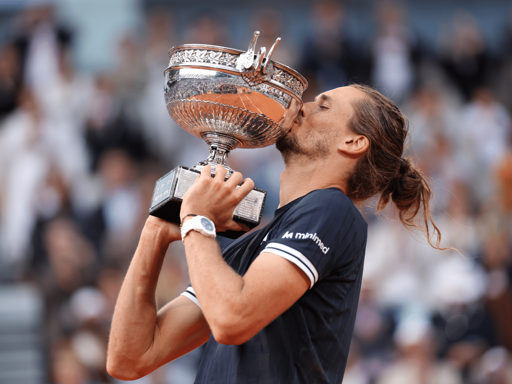
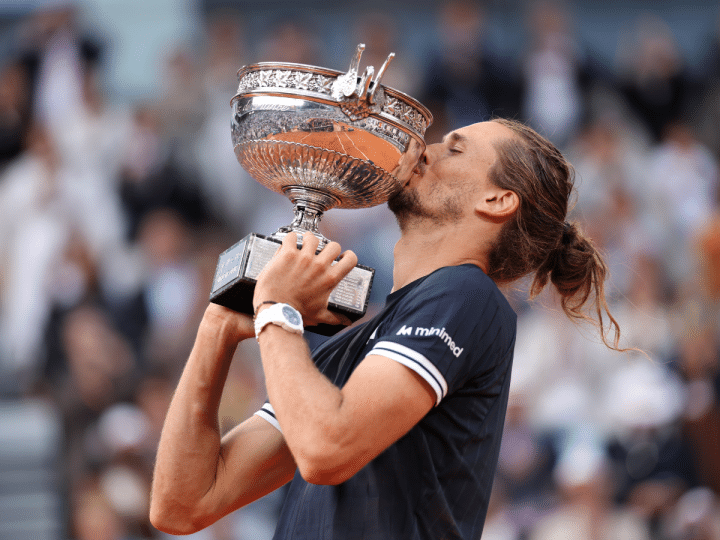
Alexander Zverev is no longer the nearly‑man of men’s tennis. After years of close calls, heartbreaks and three previous failed attempts on the sport’s biggest stages, the German has finally claimed his first Grand Slam title.
And he did it the hard way, outlasting Italy’s Flavio Cobolli in a dramatic five‑set French Open final.
On a sun‑soaked Philippe‑Chatrier, Zverev delivered the performance he has spent more than a decade chasing. The scoreline — 6‑1, 4‑6, 6‑4, 6‑7, 6‑1 — tells the story of a match that swung wildly, demanded nerve, and ultimately crowned a player who refused to let another opportunity slip away.
Alexander Zverev has a lightning start
Zverev opened like a man determined to end the narrative that had followed him for years. He tore through the first set 6‑1, dominating from the baseline and punishing Cobolli’s second serve. The Italian, playing in his first Grand Slam final, looked tight, tentative and overwhelmed by the moment.
The match flipped quickly. Cobolli settled, found his rhythm, and began to match Zverev’s weight of shot. A break midway through the second set gave him the foothold he needed, and he rode the surge of energy from the crowd to level the match at one set apiece. Suddenly, Zverev was no longer cruising. He was in a fight for the title.
Trading blows in a tight third set
The third set became a test of margins, it had long rallies, heavy hitting, and both players refusing to blink. Zverev edged ahead with a crucial break, leaning on his serve to keep Cobolli at bay. The German’s composure returned, and with it, the sense that he was beginning to reassert control. He took the set 6‑4, moving one away from the title.
Cobolli’s surge and a tense tie-break
The fourth set was chaos with momentum swings, missed chances, and a rising Italian who refused to go quietly. Cobolli, who had benefitted from extra rest after receiving a semifinal walkover earlier in the week, looked fresher as the set wore on. He broke Zverev twice, surged to a 5‑3 lead, and seemed poised to force a decider.
Zverev, battling visible discomfort in his lower body, clawed back to 5‑5. The tension was suffocating. Every point felt decisive. The set spilled into a tie-break, where Cobolli was fearless, aggressive, and riding the moment, he struck the decisive blows. He took it 7‑5, sending the final into a fifth set and igniting the Parisian crowd.
For Zverev, it was familiar territory, another Grand Slam final, another lead slipping away.
Career-defining set
Zverev came out for the fifth set with a clarity and conviction that had eluded him in previous finals. He broke Cobolli immediately, then again, racing to a 4‑0 lead. The Italian’s legs, so lively in the fourth, began to betray him. The German’s experience, power and poise took over.
At 5‑1, Zverev earned championship points. On the second, Cobolli pushed a return long, and Zverev collapsed onto his back, hands over his face, overwhelmed by the moment he had chased for so long.
This was not just a match. It was the culmination of a journey defined by near misses and painful memories.
Zverev had lost Grand Slam finals in 2020, 2024 and 2025, each in its own agonising fashion. He had suffered a devastating ankle injury on this very court in 2022, leaving in a wheelchair and unsure if he would ever return to the same level.
He had been labelled the best player never to win a major. Now, that label is gone.
His triumph also marks a historic moment for German tennis, the first men’s Grand Slam singles title for the country since Boris Becker won the Australian Open in 1996.
Though defeated, Cobolli leaves Paris transformed. The 10th seed had never been this deep in a Slam before, but his run aided by a semifinal walkover yet defined by fearless shot‑making, has announced him as a rising force in the sport.
He pushed Zverev deeper than many expected, matched him physically for long stretches, and showed a competitive edge that suggests this will not be his last appearance on a major stage.
His fourth‑set surge, in particular, electrified the crowd and turned the final into a genuine spectacle.
A tournament of opportunity
This French Open was wide open from the start. Carlos Alcaraz withdrew with injury. Jannik Sinner suffered an early exit. Novak Djokovic was eliminated before the second week. The draw cleared, and Zverev, who has long been burdened by expectation suddenly had a path to greatness.
He beat Benjamin Bonzi, Tomáš Macháč, Quentin Halys, Jesper De Jong and Jakub Menšík en route to the final, navigating the chaos of an upset‑filled tournament with a steadiness that had often deserted him in the past.
What does this mean for Alexander Zverev?
This title changes everything. It validates years of work, silences doubts, and resets the trajectory of his career. He now becomes part of a rare group of players who won their first major in their fourth final, joining names like Andre Agassi, Goran Ivanišević and Dominic Thiem.
With Wimbledon looming, Zverev enters the next phase of the season not as a contender searching for a breakthrough, but as a Grand Slam champion with the confidence to chase more.
A classic French Open final
This was a match that had everything: dominance, collapse, revival, tension, and ultimately, redemption.
Alexander Zverev’s maiden Grand Slam title wasn’t handed to him. He had to fight for it, suffer for it, and steady himself when the ghosts of past failures threatened to return. Cobolli pushed him to the edge, but the German found the resolve that had eluded him in previous finals.
In the end, he lifted the Coupe des Mousquetaires high above his head. A trophy 13 years in the making, earned on the court that had given him both his darkest and now his brightest moments.
Featured image via Clive Brunskill/ Getty Images
By Faz Ali
From Canary via This RSS Feed.