

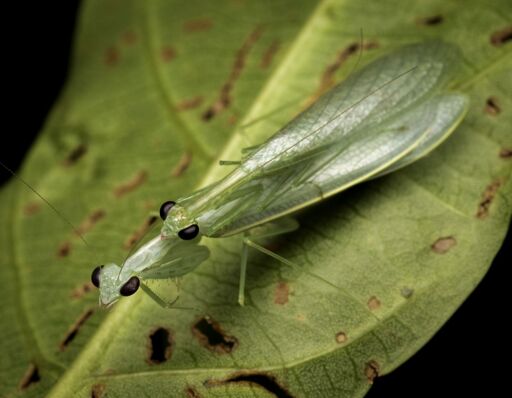
Researchers have identified three new-to-science species of snake mantises, two from Australia and one from Papua New Guinea, and figured out their distribution and behavior with the help of citizen scientists. Matthew Connors, a Ph.D. candidate at James Cook University in Australia, led the effort to revisit the taxonomy of Kongobatha, a little-studied group of praying mantises known as snake mantises for the snake-like patterns on their wings. They’re also referred to as leaf-planking mantises, because they press their bodies against leaves to camouflage. The blending in helps because they are both predators of insects, including flies and mosquitoes, and prey themselves. “They have this special organ right on their chest that is a sensory thing, and it helps them flatten themselves down really nicely against a leaf, so that they’re really hard for a predator to see,” Connors said in a news release. Previously only two species of Kongobatha were known: one from Australia and another from Papua New Guinea. Now, there are three more, named K. serpens, K. spinosistyla and K. rufilinea. To describe these three species, Connors collected new specimens of the mantises and sourced others from Australian and international museums and private collections. He examined them under a microscope, focusing on male anatomical features called styli, which are a pair of small appendage-like structures located on the end of the abdomen, and may function in mating, although this remains a “mystery,” Connors told Mongabay by email. The styli of snake mantises have many spines on them,…This article was originally published on Mongabay
From Conservation news via This RSS Feed.