


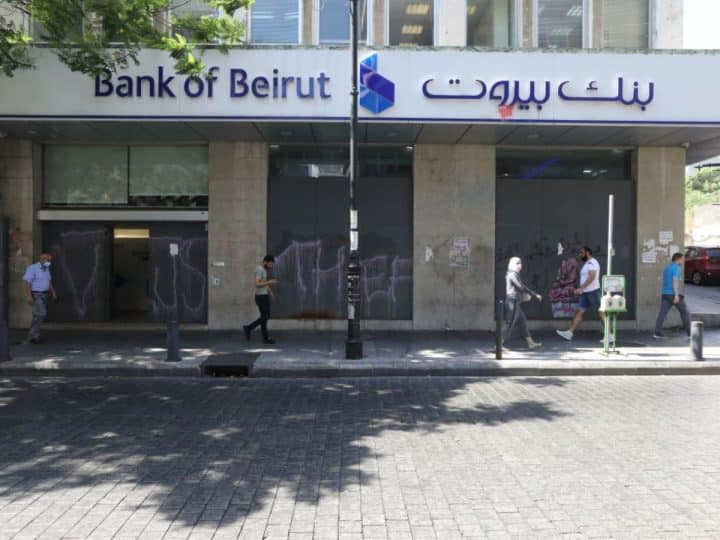
In the current negotiations over Lebanon’s borders, the United States does not sit at the table as an impartial broker of peace, but as the orchestrator of a calculated financial siege.
The Trump administration is utilising underhanded economic warfare, targeted banking blockades, and weaponising the global dollar system to deliberately starve the Lebanese state into a position of absolute geopolitical capitulation.
Lebanon — Weaponised interdependence
As formal diplomatic delegations gather under the polished chandeliers of international summit rooms to debate lines on a map, an ordinary Lebanese citizen stands in a dim Beirut neighbourhood, calculating whether their remaining cash can cover both a gallon of generator fuel and tomorrow’s bread.
Six years into an unprecedented financial collapse, the average Lebanese family does not experience geopolitics as an abstract chess match of border demilitarisation or sovereign decrees; they experience it as a crushing, daily struggle against acute inflation, a worthless currency, and a state that has systematically evaporated their life savings. It is precisely within this landscape of exhaustion and human despair that the true nature of modern diplomacy reveals itself.
This is not a failure of diplomatic mediation; it is the deliberate application of what political scientists call “weaponised interdependence” — the exploitation of a weaker state’s reliance on global financial networks to force geopolitical compliance.
This financial warfare translates into concrete reality through a dual-track strategy of surgical exclusion and conditional lifeline dependency, transforming the U.S. Treasury’s Office of Foreign Assets Control (OFAC) into an auxiliary wing of military command.
On the first track, Washington aggressively suffocates domestic liquidity by targeting Lebanon’s highly vulnerable, post-collapse cash-and-carry economy. By blacklisting government-licensed financial entities — such as the recent sanctions levelled against widespread exchange houses like Jood SARL — and threatening to sever the country from the global SWIFT banking network, the U.S. creates a profound chilling effect.
Because the Lebanese banking sector is effectively comatose, this threat of secondary sanctions forces surviving local financial agents into a state of structural hyper-compliance, blockading the nation from the inside out and cutting off access to the global dollar system unless Beirut adheres to American political dictates.
US finances the Lebanese Army
On the second track, the United States exercises direct leverage by financing the daily operations of the bankrupt state apparatus itself, weaponising Lebanon’s institutional paralysis at the negotiating table. Recognising that the severe depreciation of the Lebanese Lira had reduced a soldier’s monthly wage to a fraction of its original value, Washington stepped in with $230 million in massive “livelihood support” programs.
This funding directly bankrolls the salaries and cash stipends of over 70,000 Lebanese Armed Forces (LAF) and internal security personnel. Far from a gesture of pure “selflessness”, this direct dependency ensures that when the LAF is tasked with securing southern borders, its soldiers fuel their patrols and feed their families using money provided by the very “mediator” demanding their strategic compromise. This multi-million-dollar lifeline is explicitly tied to geopolitical benchmarks, heavily pressuring the Lebanese cabinet into adopting secret disarmament timelines and enforcing UN Resolution 1701 on Western terms.
By simultaneously choking the private financial sector and directly paying the state’s defenders, the United States forces Lebanon to enter high-stakes negotiations not as a sovereign peer, but as a financial dependent unable to separate its national defence doctrine from its immediate fiscal survival.
Financial blackmail
By withholding structural IMF packages and essential reconstruction funds, the U.S. ensures that every diplomatic demand — be it the surrender of territory or the granting of Israeli operational freedom — is framed as a necessary transaction for a loaf of bread or a pack of medicine. In this environment, the “negotiating table” is merely an ultimatum disguised as a choice: Lebanon must either trade its foundational security for a respite from manufactured poverty, or face total economic liquidation.
This financial extraction reaches its peak in the post-war reconstruction framework, where the U.S. and its Gulf allies have transformed humanitarian recovery into a tool of political blackmail. While basic emergency aid is permitted to trickle in to keep the country on high-stakes life support, the multi-billion-dollar funding required to rebuild shattered towns and vital civil infrastructure is being explicitly withheld behind a wall of geopolitical conditionalities.
Lebanon — the ultimatum
Lebanon is presented with a calculated ultimatum: it will receive no structural economic relief, no international sovereign loans, and no capital to resurrect its obliterated border-region economy unless it capitulates to sweeping security concessions that compromise its territory and disarm its defensive capabilities.
By weaponising the very devastation of the landscape, this strategy ensures that the physical rubble of Southern Lebanon remains a permanent economic monument of punishment, forcing a starved population to choose between the immediate necessity of a roof over their heads and the abstract principle of a compromised national sovereignty.
In conclusion, evaluating these critical diplomatic talks through the lens of traditional conflict resolution is a deliberate act of blindness. When a nation enters negotiations with its financial sector structurally blockaded and its national army dependent on its mediator’s payroll — just to feed its soldiers, the results will more than likely be dire.
By weaponising Lebanon’s engineered poverty and conditioning its post-war reconstruction on sweeping security concessions, the United States and Israel have fundamentally altered the landscape of modern diplomacy. They have demonstrated that a dominant superpower no longer needs to achieve total military victory on the battlefield to rewrite a country’s geography or displace its population; it merely needs to starve its institutions into submission.
If the international community continues to celebrate these predatory agreements as triumphs of peace, it will codify a dangerous global precedent: that true sovereignty is a luxury reserved for the affluent alone, and that for the broken and bankrupt, stability will always come at the price of capitulation.
Featured image via Marwan Tahtah/Getty Images
From Canary via This RSS Feed.