

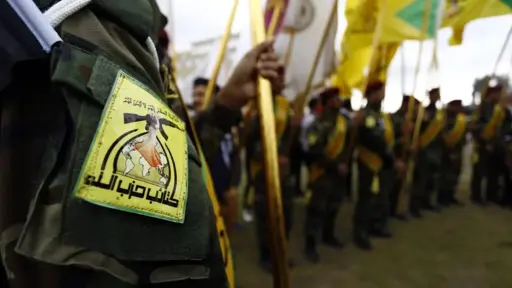
The Iraqi resistance faction Kataib Hezbollah confirmed that five of Iraq’s Shia resistance factions will not hand over their weapons to the state at present, stressing that such a move would occur after “achieving their goals,” Shafaq News Agency reported on 4 June.
Abu Mujahid al-Assaf, a Kataib Hezbollah security official, said in a statement that the current stage requires more awareness to avoid “attempts to incite strife among the people of the country.”
The five resistance factions include Kataib Hezbollah, Harakat al-Nujaba, Kataib Sayyid al-Shuhada, Kataib al-Imam Ali, and Asaib Ahl al-Haq.
Both Asaib Ahl al-Haq and Kataib al-Imam Ali previously announced their willingness to hand over their weapons to the state. Asaib Ahl al-Haq declaredon Tuesday that it had formed a committee to oversee the move.
Over recent months, the White House has placed significant pressure on the Iraqi government to dismantle the Iraqi resistance and its state-affiliated umbrella group, the Popular Mobilization Units (PMU).
Iraq’s new Prime Minister Ali al-Zaidi vowed to bring the resistance’s weapons under state control.
Last week, prominent Shia cleric Muqtada al-Sadr of the Sadrist Movement announced that the movement’s armed wing, Saraya al-Salam, would incorporate its weapons into the Iraqi state.
Israel’s Secret Bases in Iraq: A New Phase of Shadow Warfare in the Middle East
Sadr called on the rest of the factions to move away from “partisan and sectarian frameworks” and come under government control, a step that Prime Minister Zaidi welcomed and urged the other factions to follow.
However, the Kataib Hezbollah spokesman stressed that the resistance factions will continue their work and retain their weapons as long as Iraq endures a foreign military presence and violations of its airspace and national sovereignty.
Some 2,500 US troops remain in Iraq, largely in military installations in Baghdad and in the Kurdish autonomous region in the country’s north.
The US and Israeli air forces used Iraqi airspace to bomb both Iran and Iraqi resistance factions comprising the PMU as part of the war launched against Iran on 28 February.
Last month, two Israeli military bases were discovered in the Iraqi desert. They were reportedly used to support the war against Iran.
The current US troop presence is a remnant of the 2003 invasion, which, along with occupation and sectarian civil war, killed hundreds of thousands of Iraqis and nearly divided the country.
The US later backed ISIS, prompting resistance factions to form the PMU and fight to keep Baghdad from falling in 2014.
On Wednesday, the Al-Nujaba Movement also expressed its firm rejection of disarmament and its commitment to resistance.
“The position of the Islamic Resistance Movement, Al-Nujaba, is firm and has not and will not change regarding the sacred, disciplined weapon that was created to defend the holy sites of Iraq and its people,” a statement from the faction said.
Akram al-Kaabi, the leader of Nujaba, called the effort to disarm the resistance factions a US-Israeli project.
“A few (Iraqis) have become mouthpieces for these people,” Kaabi stated, while calling on Iraqi armed factions to “reject the very idea of talking about this subject.”
“The resistance’s weapons are a red line… and we protected Iraq with them from the defilement of ISIS and their American masters,” he added, stressing that these weapons “will not be surrendered as long as we have breath, and will not be taken even if lives are sacrificed.”
From Orinoco Tribune via This RSS Feed.