

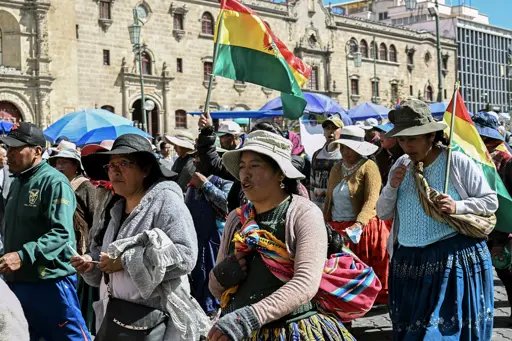
The popular rebellion against the government of Rodrigo Paz has lasted for over a month, with tens of thousands of workers, residents, union members, transport workers, farmers, miners, women, and Indigenous peoples leading massive mobilizations, marches, and more than 90 road blockades across the country. Protesters are demanding the president’s resignation and the repeal of the neoliberal austerity policies that are devastating the people. Paz is threatening a state of emergency while militarizing the country, attempting to tip the precarious balance between the government and the rebellion in his favor.
This comes amid a surge in imperialist interference in the region following the U.S. military attack on Venezuela, where the president was kidnapped and a de facto protectorate was imposed, and the threat of an attack on Cuba. Meanwhile, the Trump administration has been supporting the austerity government of Paz and labels the protests as a “coup.”
Rodrigo Paz recently sent a bill to the Legislative Assembly to push for the declaration of a state of emergency. Under the guise of humanitarian rhetoric, the president is attempting to give the police and armed forces carte blanche against the blockades and protests — that is, against the ever-growing rebellion. His administration calls for dialogue while effectively kidnapping protesters, including Justino Apaza, one of the leaders of the Departmental Federation of Neighborhood Councils of La Paz and El Alto.
We are facing a political operation that seeks to “negotiate” under extreme conditions, thus achieving a “controlled” state of siege. It is a dangerous gamble. The rural and urban worker working classes have repeatedly reaffirmed their willingness to fight. The massive protests have been joined by an indefinite transportation strike, and self-organized blockade and mobilization committees have spread, calling for a radicalization of the struggle and the organization of an indefinite general strike until the government falls. State repression has already claimed six lives in the course of the conflict, but the grassroots remain steadfast and are strengthening the self-organization of the blockades despite the government’s attempts to clear them.
The government of Rodrigo Paz and Edmand Lara came to power with the votes of a significant portion of the popular sectors, who trusted their promises to defend the gains of previous struggles and to stop the racist right wing of Jorge “Tuto” Quiroga and the Santa Cruz oligarchy. However, as soon as they took office, they made a right-wing turn and implemented policies favorable to imperialism, hiking gas prices and passing laws benefiting big land owners at the expense of the working, popular, peasant and indigenous sectors who today demand that the president and vice president step down.
The government aims to roll back even the limited concessions granted by the Plurinational State. At the same time, the ruling party and the media are trying to delegitimize the protests by denouncing them as maneuvers by former president Evo Morales, concealing the fact that what is erupting in the streets is a profound popular discontent and massive anger against the government. While the government and the entire right wing are attempting to criminalize the protesters, claiming they want to destabilize the country and stage a coup, the demonstrators view these reactionary sectors as the true coup plotters and vandals.
Rodrigo Paz faces the contradiction that the repression and militarization of the country could further radicalize the protests. He has failed to contain the popular mobilization, and the conciliatory sectors of the COB, Bolivia’s largest trade union federation, and the peasant organizations that betrayed the struggle against the gas price hike in January are now under scrutiny from the mobilized and self-organized masses.
The Bolivian popular rebellion opens a path to confront the austerity plans of both right-wing governments and the self-proclaimed “progressive” ones, which remain subservient to Trump’s imperialism, seeking to implement a plan of plunder across Latin America by reinstating the Monroe Doctrine. The Paz government concentrates capitalist interests in Bolivia; if it falls as a result of these popular mobilizations, it will be a warning sign for all governments subservient to imperialism and an inspiration for the working class of Latin America.
Coordinating Committees Must Unify the Struggle
The spread of blockades, strikes, and marches across the country urgently underscores the need for grassroots workers, peasants, neighborhood associations, Indigenous people, and other popular movements to advance toward higher forms of self-organization. Faced with the passivity of the trade union bureaucracies and some peasant organizations, which refuse to implement the general strike, it is the self-organized blockade and mobilization committees, neighborhood and community assemblies, students, and grassroots community members who are showing the way. In the city of El Alto alone, seven blockade committees have already emerged, initially rejecting their neighborhood and local leadership.
As stated in bulletin No. 3 of the D8 Blockade Coordination Committee:
Let us elect and appoint essential committees for the grassroots to address the immediate needs of the struggle in El Alto and provinces: a communal kitchen and supply committee to sustain the struggle with food, medicine, and manage supplies for the most needy sectors of the population; an independent press committee to combat the media blackout and amplify the voice of thousands of blockaders; a self-defense committee to organize aid for those injured in mobilizations, prevent arrests, and demand the release of detainees.
The betrayal by the COB leadership in January, who accepted the terms of the gas price hike, has amplified anti-bureaucratic sentiment. Since May 1, this same union has called for an indefinite general strike, but has failed to take the necessary steps to implement it, starting with a work stoppage. Since then, miners, factory workers, and those in other sectors have been mobilizing alongside neighbors, teachers, and farmers. However, they have done so without halting operations, allowing the government to capitalize on the attrition caused by the blockades while attempting to divide them through piecemeal negotiations. The union bureaucracy fosters a corporatist and union-based approach that prevents thousands of miners and factory workers from decisively joining the struggle, effectively sabotaging the very call to action made by the leaders. The self-organized committees demand it: General strike for the fall of Paz!
National coordination of these organizations — through democratically elected delegates at each point of struggle — would allow for a unified program, centralized forces, and consistent direction for the uprising. These committees must transform into grassroots power structures, capable of organizing supplies, defending against repression, and leading the overall mobilization of workers, Indigenous people, and peasants against the Paz regime.
General Strike For the Fall of Rodrigo Paz! For a Provisional Government of Workers’, Indigenous, and Peasant Organizations to Defeat Austerity
The government of Rodrigo Paz is in a deep crisis. Negotiated solutions have not yet succeeded in dividing the mass organizations, but they are actively seeking conciliatory leaders to reach an agreement that will preserve their interests. The Bolivian state’s institutions enjoy the support of imperialism and the governments of the region. Paz has already announced that he may sign a $5 billion agreement with the IMF, deepening national dependence and perpetuating his program of plunder.
Therefore, it is urgent to say: Out with the IMF from Bolivia and Latin America! Progressive taxes on the wealthy and nationalization of strategic resources under workers’ and people’s control. No negotiations behind the people’s backs! Down with Edmand Lara’s dialogue commission and the parliament! Our dead are not for sale!
The continuation of the uprising requires moving towards an indefinite general strike, paralyzing production, transport, and services nationwide as a decisive show of force to fulfill the mandate of the rank and file: that the government resign.
The rebellion has already demonstrated its power in the streets, but to defeat the austerity measures and dismantle the state apparatus that sustains them, the entire country needs to be brought to a standstill under the control of the working class, both rural and urban. The general strike must be organized in every workplace, coordinating with blockade and mobilization committees, and uniting miners, peasants, community members, students, residents, and shopkeepers. This will allow for the construction of an alternative leadership to the bureaucracy that is willing to engage in “dialogue” but has thus far failed to take the lead in guaranteeing the strike they themselves called. Only the unified and centralized action of the workers’, peasants’, Indigenous, and popular movements can force the president’s resignation and pave the way for a workers’ solution.
The only progressive alternative for the majority is for workers’, peasants’, and Indigenous organizations in struggle to take the reins of the country through a provisional government of these organizations, based on coordinating committees, grassroots unions, and popular assemblies. Such a government could repeal all austerity measures, nationalize strategic resources under workers’ and community control, guarantee bread, work, land, and democratic rights for the people, and initiate a truly free and sovereign constituent process from below to break the dependence on imperialism and the domination of big business. The Bolivian rebellion can become a continental turning point if it advances toward this revolutionary perspective.
It is also important to note that the fall of the Paz government cannot be expected to resolve the crisis through new elections. On the contrary, calling for elections would channel the struggles of workers, peasants, and other popular sectors through institutional means, diverting them from the fact that they are the ones who must decide the country’s future. Paz’s fall should not simply replace one government with another within the confines of the same regime.
Therefore, presenting elections as a solution to the crisis is a political trap. As long as the current economic and political structures remain intact, exploitation, oppression, hunger, and the surrender of common natural resources will continue. The true way out lies in the direct intervention and independent organization of workers, peasants, and popular sectors in struggle, through a provisional government of those who are currently confronting the crisis in the streets.
A great example is being set by the women who not only uphold the blockades and mobilizations but have also displayed a great strategic and fighting instinct. On May 27, Mother’s Day, the massive march of working and peasant women was clear: “We must withdraw our sons from the barracks because we cannot allow them to kill their fathers, mothers, brothers, uncles, and grandparents.” They are calling on their sons to join the popular rebellion and not repress the people. From the blockades, a massive agitation must be organized among the troops, in their neighborhoods and in the barracks. Division of the army ranks for the defense of the popular rebellion!
If the repression continues, the peasant movement and the blockades cannot be left alone to fight. That includes the workers of El Alto, who have resisted for over a month by organizing the blockades and confronting repression. The general strike must be implemented immediately, and all the forces of the working class must be mobilized to defend the popular rebellion. Mine workers, both from private and state-owned mines, must immediately halt operations and lead a massive mobilization against the coup attempt that, with the recent moves toward declaring a state emergency, the government intends to impose on the working people.
We Reject the Complicity of Both Right-Wing and Self-Proclaimed “Progressive” Governments that Support Rodrigo Paz and His Supposed “Humanitarian Mission”
The recent joint declaration promoted by the right-wing governments of Chile, Argentina, Costa Rica, Ecuador, Honduras, Panama, Paraguay, and Peru regarding the crisis in Bolivia constitutes a political operation aimed at delegitimizing the popular rebellion against the austerity measures and growing authoritarianism of Rodrigo Paz’s government. In the name of a supposed defense of “democratic order,” these governments seek to criminalize the blockades and protests that express the legitimate discontent of workers, peasants, youth, and impoverished sectors in the face of deteriorating living conditions. In response, it is essential that labor, social, and left-wing organizations in each country not only take a stand against these governments, but also actively demonstrate solidarity with the rebellion.
The neoliberal offensive sweeping across Latin America is part of a regional strategy coordinated by right-wing governments and supported by “progressive” sectors that manage the same economic architecture of dependency. From Bolivia to Argentina, Chile, Peru, Ecuador, and Honduras, the adjustment packages — privatizations, budget cuts, tariff hikes, precarious employment, and environmental deregulation serving transnational corporations — seek to shift the burden of the capitalist crisis onto the shoulders of workers, peasants, and Indigenous peoples. Javier Milei became one of the main international backers of Rodrigo Paz’s government. The Argentinian government sent some of the first Hercules aircraft to Bolivia, a clear signal of political and logistical support for the Paz government against the mobilizations. This stance was subsequently echoed by José Antonio Kast in Chile and by other governments in the region, which have joined the campaign to criminalize the blockades and popular protests.
These governments act as veritable colonial managers of U.S. and Zionist interests, guaranteeing the continued plunder of natural resources and subordinating all national policy to the demands of imperialism, which is determined to reinforce its influence in the region through diplomatic alliances, the plunder of strategic resources like lithium, and security agreements that strengthen the repressive capabilities of states. The most dramatic examples of this situation are Venezuela, transformed into a protectorate, and Cuba, subjected to a criminal imperialist blockade and under constant threat of U.S. military attack.
On the other hand, so-called progressive governments, like President Lula’s in Brazil, have shown solidarity with Paz. Lula not only spoke by phone with the Bolivian president, but also immediately arranged for a plane carrying humanitarian aid to be sent to the country at Paz’s request, while simultaneously condemning the “recourse to violence” and appealing for respect for state institutions. In the name of “social peace” and dialogue, what Lula is proposing is the defense of the government and the established order against the mobilization of the Bolivian people, which reveals the true nature of these governments in the face of popular mobilizations.
In contrast, the Bolivian rebellion demonstrates that the working class and oppressed sectors have the strength to confront this continental order of austerity. The process of popular rebellion in Bolivia is part of the working-class resistance that has been emerging in Latin America, along with the mass mobilizations and strikes in Argentina against Milei’s attacks and the student mobilizations in Chile against the Kast government. Therefore, it is crucial to promote an internationalist perspective that unifies the ongoing struggles: from the general strikes in the Andean region to the mobilizations against precarious work in the Southern Cone.
We call for the defense of the general strike and the popular rebellion in Bolivia. The victory of the Bolivian uprising would open a new perspective for millions, showing that it is possible to defeat austerity measures and advance toward a solution for the workers and the oppressed throughout the continent. Bolivia can be the spearhead for bringing down the austerity plans of pro-imperialist governments.
Down with the state of emergency and the repression of social protest!
For coordination committees for the general strike, until the government falls and a provisional government of workers’, peasants’, indigenous and popular organizations in struggle is imposed!
Down with the colonial adjustment of right-wing governments in Latin America and the Caribbean!
For the internationalist unity of the working class in Latin America!
Trump out of Latin America and the Caribbean!
Originally Published in Spanish on June 6 in La Izquierda Diario
The post International Declaration: Long Live the Workers’, Peasants’, and Indigenous Rebellion in Bolivia! Down with the Austerity Government of Rodrigo Paz! appeared first on Left Voice.
From Left Voice via This RSS Feed.