

Noblefranca said that the healthcare system is affected by the stigma associated with trans healthcare, aside from medical inaccessibility, the societal prejudice embedded within institutions must be taken into account.
By Cris Fernan Bayaga
Bulatlat.com
Related story: Drag affirms trans identity amid absence of nat’l pro-LGBTQIA+ laws
CEBU CITY —Nearly 95 percent of the transgender women who visit a community-led clinic in Metro Manila seeking gender-affirming hormone therapy (GAHT) have already started taking hormones on their own without any medical and professional monitoring due to inaccessibility.
In 2023, a study conducted at LoveYourself Inc., one of the leading non-governmental organizations (NGOs) in the Philippines providing free sexual health, mental health, and trans health services, found that most transwomen individuals who previously self-transitioned resorted to using daily oral contraceptive pills (OCPs), typically used for pregnancy prevention.
This alternative practice is driven by the unavailability of estrogen and testosterone medications for GAHT over the counter in Philippine pharmacies, making them inaccessible for transgender individuals to purchase safely.

Trans woman and TRANScend by LoveYourself advocate Zoe Black discusses barriers to accessing GAHT during the Polytechnic University of the Philippines College of Social Sciences and Development Student Council Women’s Month celebration (Photo courtesy of Zoe Black)
GAHT is a therapy intended to be medically supervised for transgender people who choose to undergo hormonal changes, such as the intake of estrogen for transwomen undergoing feminizing hormone therapy, testosterone for trans men masculinizing hormone therapy, and hormone blockers.
These hormonal therapies are administered through oral prescriptions or injectable medications that influence physical appearance that align with one’s Sexual Orientation, Gender Identity, Gender Expression, and Sex Characteristics (SOGIESC).
After looking into trans individuals who sought clinical services at Victoria by LoveYourself (VLY) from 2017 to 2019, the results of the study revealed that 138 out of 146 transwomen and transfeminine individuals had self-transitioned. Among transmen, 96 out of 107, or around 89 percent reported similar experiences.
Both communities resort to OCPs and the grey market, including unregulated sources, overseas providers, and online platforms that sell GAHT products, as these medications are not approved by the country’s Food and Drug Administration (FDA).
GAHT gray market
Medical professional and transhealth specialist at Loveyourself Inc., Dr. Lou Anthony Noblefrancanca said that transwomen who resort to self-prescribed GAHT without proper medical assistance are victims of the country’s public healthcare gap.
Noblefranca said that these “micro-pills” or OCPs are not recommended as GAHT alternatives because of the compound combined with the pill’s estrogen. He noted that this compound with the estrogen can cause heart attacks, blood clots, or stroke.
“I think around 2023, I saw a rise in cases among clients concerned over their over the counter pills because there were reports that a transwoman died because she overdosed on this kind of pill,” he said.
He also said that GAHT regimens for transitioning are not illegal, but trans-specific medications are only FDA-approved abroad, pushing his clients to resort to alternative sources such as international and online sellers.
“Buying online tells you a lot. The fact that it’s hard to have access to these meds locally, is an issue already. Due to this inaccessibility, some have to change regimen because there are no stocks available, but this would affect their routine,” he said.
Klies*, 20, is a Cebu-based drag queen who prefers to use her professional drag name as her lived name. She works as a drag performer to fund the hormonal transition journey she began on her own.
For nearly a year, she has relied on self-administered hormonal therapy using estrogen pills and injectable hormones sourced from fellow transwomen, online sellers, and local resellers within the city.
Aside from the risks of purchasing from the gray market, she also faces the financial burden of maintaining her GAHT regimen. Disagreeing with the use of OCPs due to their health risks, she instead opts to spend more on gray market sources.

Klies shows her newly purchased pack of GAHT estrogen pills (Photo by Cris Fernan Bayaga/Bulatlat)
Klies said she spends around P900 ($15) monthly for GAHT, P370 ($6) for three weeks’ worth of daily pills and P250 ($4) twice a month for injectable hormones, though she admitted that she only “eyeballs” the dosage for her intake.
She admits feeling anxious about missing even a few days of her hormone intake, fearing it may affect the progress of her transition and feminizing changes.
Filipina transwoman and registered psychologist Dr. Brenda Alegre said that the limited medical support systems for transgender individuals is a systemic issue that pushes many transpeople to transition on their own, as socioeconomic barriers leave them reliant on unsupervised and often unsafe practices, while others seek care abroad at higher cost.
Noblefranca said it also becomes financially inaccessible for many transpeople because maintaining hormonal regimens requires long-term financial commitment, making transition expensive for trans communities over time.
“It’s expensive to be frank, apparently. You buy GAHT needed regimen like pills or injectables, the shipping fee from international sellers or from the international market,” he said.
In 2023, Asia Pacific Transgender Network (APTN) reported that there’s no insurance coverage for hormonal therapy in the Philippines, pushing many transgender individuals to rely on unsafe and unmonitored means of accessing hormones, which increases the risk of adverse health effects and improper dosing, among the key hazards of self-transitioning.
One thing Noblefranca also noted is that transgender healthcare practices are often centered on Western settings and standards, but many of these approaches are not fully applicable to Filipinos due to biological and physiological differences, particularly in body build. This means that following such dosage regimens may result in incompatible hormonal therapy.
“We are not as tall and built the same way as caucasians, so adjustments must be made to Southeast Asian trans communities who want to seek similar healthcare,” he said.
Facing a health crisis
Klies said that her first three months of transitioning were challenging, physically and emotionally, as she navigated hormonal therapy without professional guidance and only relied on a fellow drag queen and close friend whom she considered an older sister who has undergone the feminizing transition for years.
“I felt insecure, not with her, but with my identity of becoming a transwoman, so one day I mustered up the courage to ask her what pills she was taking and injecting and I followed her regimen,” she said.

Klies checks her remaining pills for the month and plans to get her injectable hormones this month of June (Photo by Cris Fernan Bayaga/Bulatlat)
She also noted two non-physical side effects she experienced: becoming “too emotional,” where she would feel the urge to cry more than usual over inconveniences; stressing over the slow-paced process of seeing physical changes in her body. During the first three months of her feminizing hormonal therapy, she also experienced intense headaches after taking her daily estrogen pill.
Watching someone she admired slowly embody the femininity she also desired intensified Klies’s own gender dysphoria, a condition in which a person experiences distress or discomfort because their gender identity does not align with the sex they were assigned at birth.
This mismatch made her feel that “something was missing” within herself. At first, she hesitated to ask about GAHT, worried she would be judged or denied support.

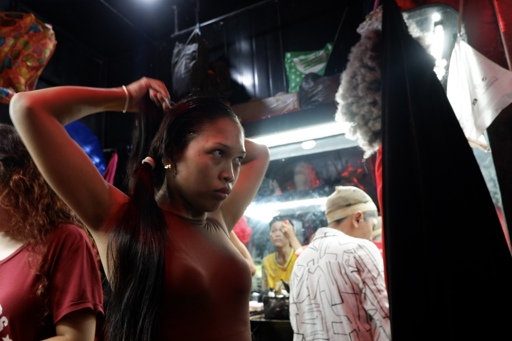
Klies styles her hair as she prepares for a drag performance (Photo by Cris Fernan Bayaga/Bulatlat)
Noblefranca said that even the term “treatment” in addressing hormonal transitioning can already reflect prejudice in the medical field, because it implies that “there is something wrong with a person.”
Instead, Noblefranca emphasized the word “therapy” in gender-affirming hormone therapy (GAHT), explaining that the process is meant to help a person physically align with the gender identity they already recognize within themselves and affirm their gender expression.
In the Philippines, he said there is no denying the existence of a huge gap in the medical field, as even endocrinologists, specialists in body hormones, are generally not trained to address transgender healthcare needs.
Noblefranca said that there is still no formal education or specialized training for trans healthcare in the country. If there is no available specialist in one’s area, patients can still seek help from an endocrinologist, even without prior training in trans healthcare, for concerns related to the post-transition effects of GAHT regimens.
However, he noted that there are cases where doctors may hesitate to provide medical support due to the specialized nature of trans healthcare, as well as differences in willingness in accommodating clients from the LGBTQIA+ community.
Even at LoveYourself White House Cebu, he said there is currently no in-house medical doctor due to the limited number of physicians equipped with proper transhealth training and background.
Initially, Noblefranca had to self-study to familiarize himself with existing transgender healthcare practices abroad and prepare for formal training in transhealth.
“To be honest, there’s no mention of transgender health in medicine books in the Philippines. During my time in 2006 to 2010 in med school, only a few sentences talked about transgender health,” Noblefranca said.
He later trained in Thailand at Pribta Tangerine Clinic, the first transgender-led clinic in Southeast Asia specializing in healthcare services for the transgender community and run by medical experts experienced in gender-affirming care.
‘Nanay-nanayan’ referral approach
Noblefranca said that these shortcomings in transgender healthcare have normalized self-medication among trans communities, leaving them with no choice but to seek help from each other.
“What is usually taught to trans women and trans men comes from their ‘nanay-nanayan’ and ‘tatay-tatayan’ or those who came before them, transitioned on their own, and self-medicated who then teach the younger generation what hormones to take,” he said.

Klies collaborates with other drag queens in preparing her look (Photo by Cris Fernan Bayaga/Bulatlat)
This kind of support from older queer and trans individuals guiding younger trans people through transition is often rooted in personal experience rather than formal medical training.
Noblefranca said that there is no “one-size-fits-all” in GAHT or a “cookie cutter mold to follow,” but these informal support systems emerged not because trans communities reject healthcare, but because healthcare institutions have largely left them to navigate transition on their own.
For Klies, transitioning became a process of “trial and error” as she tried to determine which hormonal regimen or “combo” would work for her body. For three months, she took Diane 35 daily, a commonly recommended pill among transwomen that can easily be purchased online.
However, the medication eventually affected her health negatively, causing dizziness, emotional instability, and persistent fatigue.
“What I did was just observe what changes I can see within a few months and if my body will not reject this kind of hormones, but I figured that I was struggling every day because of my previous pill,” she said.
Algorithm as the doctor
Klies said her first understanding of hormonal transition came from watching other trans women online. With no accessible medical guidance and no one professionally trained to help her understand what would work best for her body, social media became her primary source of information about transitioning.
Through videos and online groups among trans women, she was introduced to different hormonal “combos,” dosage routines, and feminizing regimens commonly shared within trans communities.
“I would always search on TikTok and look up ‘combos’ with pills and injectables, but I realized these videos could be misleading because bodies are different and manifestations of pills and injectables also take effect differently,” she said.
On TikTok, Klies said she followed two Cebu-based trans women content creators who openly sold GAHT pills and shared recommended hormonal regimens online.
For her, with hundreds of thousands of followers and visible transition results, these influencers appeared “trustworthy” enough for many young trans women seeking guidance on how to begin transitioning.
She also previously took “pampafresh” vitamins and collagen supplements purchased online in hopes of improving her appearance, but eventually stopped after experiencing nosebleeding and fever-like symptoms.
Noblefranca said he has observed a shift in recent years, as many trans women who once relied mainly on referrals within trans communities now increasingly turn to online influencers and social media personalities for guidance on GAHT.
“There are many trans women who are also influencers, so I tell my clients that they have to be careful and critical of the kind of media you consume on TikTok, Facebook, Reddit or whatever social media platform because what might work for some will not exactly work for you,” he said.
However, he said these online influencers are often simply trying to help other trans people in the only ways they know how, and that the growing reliance on social media for transition guidance reflects a deeper systemic failure in healthcare access, not something they should be “villainized” for.
Risk reduction
Noblefranca said that NGOs like LoveYourself Inc. aims to help bridge this gap between the trans community and the healthcare industry and this by giving them completely free access to services for their journey.
“Most of the time, the people who come to me wanting to transition have already started self-transitioning. But I tell them not to be scared to consult because there’s no need to apologize for doing it on their own,” he said.
He said that their role as medical practitioners is to help remedy or lessen the risks that trans people might have gotten from self transitioning. Given the limited number of their clinics, he said that online consultations are also a choice.
“I do get online consultations from Cebu, Davao, and northern parts of the Philippines, usually. So, the consultation is free. The initial and follow-up consultations are also free. Most of the time, they just have to struggle with booking appointments due to the influx of requests,” he said.
Noblefranca said that these consultations require laboratory tests which the clients need to shoulder on their own to properly assess their current status, if they have self-transitioned or just starting.
“We give them forms to fill up and email it to us to assess their biological and physiological development, alongside their personal observations after their transition, and cross-check their laboratory results for better understanding of their case,” he said.
He said that their clinics require their clients to conduct these laboratory tests to check for other possible health issues that might affect their transition journey like high blood pressure, diabetes, or other underlying conditions.
Noblefranca added that after assessing a person’s capacity and readiness to undergo GAHT, he does not impose a rigid hormonal regimen on them, but instead allows trans individuals to decide what best fits their lifestyle and transition goals, while his role is to guide them toward safer and medically appropriate intake.
“I don’t choose for them. I ask them, which of the methods are financially viable for their budget and lifestyle and if they can sustain it because they can’t forget or miss any scheduled pill or injectable because it will slow down your process and see its effects,” he said.
He said that this is what sets trans healthcare clinics different from the stereotypical hospital setting because a community-based organization clinic does not dictate but it’s a collaborative process.
“If you’re in a hospital, this is the diagnosis and doctors tell you what to take and what to do with your medicine. In LoveYourself, I and my fellow doctors who are trained in TransHealth, we adjust according to their needs based on the effects of their regimen,” he said.
Klies said she has long been hesitant to visit a trans healthcare clinic because she had already been self-transitioning for over a year, though she hopes to eventually gather the courage to seek professional medical consultation.

Klies walks along Colon Street to look for materials for her drag look after purchasing her estrogen pills (Photo by Cris Fernan Bayaga/Bulatlat)
Noblefranca said that the transition journey also involves counseling services that address concerns such as body dissatisfaction and gender dysphoria, which may arise throughout the process of transitioning.
In 2015, according to a psychiatric study, body dysmorphia is the persistent anxiety and distress over one’s appearance. Among transgender individuals, these feelings may be heightened by societal expectations surrounding how a person’s gender expression should physically manifest during hormonal transition.
For Noblefranca, these concerns show the need for clinics not only to address hormonal treatment and physical changes but also the psychological and emotional challenges that may accompany transition.
Life beyond transition
For Noblefranca, transgender healthcare extends beyond prescriptions and hormones, emphasizing that trans individuals also need safe spaces, as many of his clients become more confident and comfortable with themselves through holistic gender-affirming care.
Klies said that prior to transitioning, what helped her was her friend who was also a transwoman and a drag queen for emotional support and advice about navigating transitioning amid doubts to enter womanhood.
Noblefranca said that the healthcare system is affected by the stigma associated with trans healthcare, aside from medical inaccessibility, the societal prejudice embedded within institutions must be taken into account.
“In 2026, there are still mindsets rooted in discrimination. We should educate people first, especially about our SOGIE. It’s not just for queer people, but it’s a basic human right to be recognized for your lived gender identity. SOGIE is for everyone,” he said.
Read: After 25 years, SOGIESC Bill still awaits passage
For Klies, she hopes the next generation of trans individuals will grow up in a country where transgender healthcare is accessible and where communities no longer reject their existence.
“At a young age, I already knew I wanted to be a woman. I want younger kids to have families willing to accept them because hormonal transition is one thing, but the psychological support from people willing to acknowledge these changes is vital to one’s womanhood.”

Klies calls her mother before her performance to seek support (Photo by Cris Fernan Bayaga/Bulatlat)
She emphasized that acceptance is often the first step toward meaningful change, saying that when trans individuals are free from pressure, stigma, and discrimination, they are more capable of transitioning safely and confidently with the support they need.
Noblefranca shares the sentiments and agrees that there’s no such thing as “pushing the gay agenda” which is the assumption for opening clinics like LoveYourself because they’re just humans too.
“We have no agenda at all. Our agenda is to live, to live safely and to make others feel that it’s okay to live. Our agenda is to live without being shamed, catcalled, physically abused, killed, or threatened,” he said.
He said that once acceptance is slowly being part of Filipinos’ daily lives, then the education system can hopefully change and gradually introduce trans healthcare in medical education.
“Hopefully in the coming years, we have a society that is open to allowing those who are interested to practice transgender medical help like Philippine Professional Association for Transgender Health, not just doctors but also nurses and community health workers,” he said.
Noblefranca said that until the Philippine healthcare system recognizes transgender healthcare as essential public healthcare, the Filipino trans community will continue risking their bodies simply to become themselves. (AMU, DAA, RVO)
*Editor’s Note: “Klies” is the Cebu trans woman’s lived name and not her legal name, in accordance with editorial policy recognizing a person’s preferred name in published releases.
The post Limited trans healthcare compromises safe hormonal therapy — medical expert appeared first on Bulatlat.
From Bulatlat via This RSS Feed.