

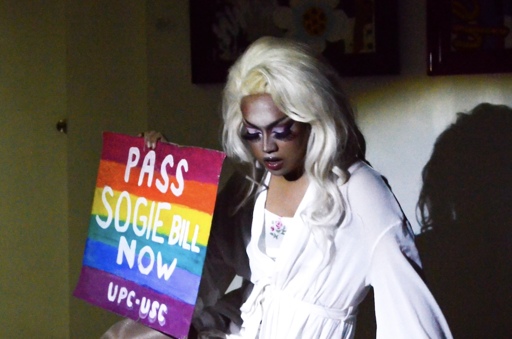
Creative and performance spaces like drag also become avenues for trans people to safely explore and affirm gender identity.
Read also: Limited trans healthcare compromises safe hormonal therapy — medical expert
By Cris Fernan Bayaga
Bulatlat.com
CEBU CITY — Twenty-six years after it was first filed at the Senate, the sexual orientation, gender identity, gender expression, and sex characteristics (SOGIESC) equality bill remains in limbo.
Despite repeated attempts to push the bill forward in Congress, the Philippines still lacks a national law that protects Filipinos from gender-based discrimination.
At the 13th Session of the UN Human Rights Council Universal Periodic Review in 2010, the Society of Transsexual Women of the Philippines (STRAP) reported that the trans community remains among the most marginalized groups in the country, citing gaps in labor protections and gender identity rights.

Members of the Society of Transsexual Women of the Philippines (STRAP) pose for a group photo during their 23rd anniversary (Photo courtesy of STRAP)
The Asia Pacific Transgender Network (APTN) said that pre-colonial Philippines already had trans identities through the “babaylans,” queer spiritual shamans, including transwomen regarded as traditional healers who dressed and lived as women.
Amid such early acceptance, the country has become increasingly unsafe for trans women, with killings being reported annually, including the death of an 18-year-old transwoman in 2025, prompting progressive LGBTQIA+ organizations to call for the immediate passage of the SOGIESC bill.
In 2023, the Philippines was among the 10 countries with the highest number of documented killings of transgender people, ranking eighth globally.
The Commission on Human Rights (CHR) of the Philippines issued a statement condemning the deaths of transwomen on June 23, 2025. Former journalist Ali Macalintal was shot in her workplace in General Santos City while student Gian Molina was found lifeless in a river in Cagayan Province.
CHR urged the government to pass the SOGIESC Equality Bill and the Comprehensive Anti-Discrimination Bill because such laws “ensure a safe and just environment where they can live and thrive without fear.”
In 2025, the United Nations (UN) released a statement saying that lack of acknowledgement for gender equality and recognition for one’s SOGIE is against the international human rights law.
According to STRAP, the lack of institutional protection leaves transgender individuals vulnerable to potential legal repercussions under Republic Act No. 6085 or the Anti-Alias Law, Commonwealth Act No. 142, which regulates the use of aliases, and Article 178 of the Revised Penal Code concerning the use of improper names.
These laws not only create legal risks but also prevent trans individuals from formally affirming their identities, leaving them unable to change their names or gender markers despite using lived or drag names every day.
Without such protections, transgender individuals are forced to compromise their lived identities. But amid such barriers, drag remains one of the few spaces where trans women can fully express themselves without apology.
While the fight for the SOGIESC approval continues, drag serves as an act of resistance and a source of recognition for Klies*, a 20-year-old trans woman and drag queen from Cebu City who uses her professional drag name as her lived name. Despite persistent discrimination, she calls drag her “bridge to understanding womanhood.”

Klies prepares her wig for a drag performance, her main source of livelihood (Photo by Cris Fernan Bayaga/Bulatlat)
She started doing drag in 2023 after encountering drag queens through a school event. For Klies, seeing drag performers in person for the first time initially became a source of artistic inspiration as a former Fashion and Design Technology student, where she looked to drag as a creative reference for future design projects.
However, such exposure eventually became the gateway and means to physically affirm the womanhood she had long carried and suppressed within herself.
“During that event, that’s where I experienced really dressing up, putting on makeup and I felt comfort and felt seen in doing drag and also exploring my womanhood,” Klies said.

Klies sets up her makeup station to prepare her drag look (Photo by Cris Fernan Bayaga/Bulatlat)
For her, drag was never detached from her trans identity even before she began hormonal transition. She said that it is her first step of social transitioning to becoming a transwoman.
The World Health Organization defines the mismatch between a person’s gender identity and their sex assigned at birth as gender incongruence and recognizes that gender-affirming health care includes “social, psychological, behavioral, or medical interventions” intended to support and affirm an individual’s gender identity.
In 2025, according to a sociological study from the Journal of Creativity in Mental Health, participating in drag performances helps in affirming a transwoman’s gender identity because of the psychological benefits in allowing one to embody and express her chosen gender identity.
Before doing drag, Klies struggled with gender dysphoria (GD) because she could not see the physical manifestation of her womanhood. In a 2022 sexual medicine study of trans women and trans men at Victoria by LoveYourself, a transgender-led community clinic in Manila, GD was found to be common among trans communities.
The study showed that about 95 percent of participants experienced GD as a feeling of distress and discomfort due to gender incongruence, where their lived identity does not align with their outward appearance.
Klies said that drag helped validate her identity by allowing her to embody her womanhood in a visible and expressive form, offering a space where her internal sense of self could be affirmed externally. “Before, when I look in the mirror, I feel a gap between what I see and what I feel and this makes me feel bad about myself. There are also days where I dislike seeing a reflection of me due to this mismatch.”

Klies looks at her doll as she prepares, a gesture that reflects her womanhood while doing drag (Photo by Cris Fernan Bayaga/Bulatlat)
For Klies, drag gave her the space to begin understanding her identity. It became a formative environment where she could explore her sense of self without fear of judgment. Over time, this experience extended beyond personal affirmation, allowing her to see drag as both a source of empowerment and a platform for visibility within her community.
“I became more confident because drag was my way of seeing it physically manifest at first and during my performances in drag I feel my womanhood and doing drag allows me to become who I am inside,” Klies said.
Gender experts recognized social affirmation like changes in clothing, hairstyles, names, pronouns, makeup, and gender expression as important aspects of gender affirmation that contribute to the mental well-being of transgender individuals.
Lou Anthony Noblefranca, a medical doctor specializing in transgender health, said that medical transition is only an aspect of the transitioning process, stressing that social and psychological transitions are equally important in a trans woman’s journey. He said that social transition involves presenting oneself in everyday interactions according to one’s lived identity while psychological transition entails mentally preparing for the physical and emotional changes that accompany the process.
At LoveYourself PH, a non-governmental organization that provides free transgender health services and counseling, clients are guided through these stages of transition through regular consultations. These sessions allow healthcare providers to monitor their experiences, address concerns, and offer psychosocial support throughout their gender-affirming journey.
In many cases, creative and performance spaces like drag also become avenues for trans people to safely explore and affirm gender identity. Klies said that she found a community through drag. “I initially left home because of the lack of acceptance from my family but when I pursued drag full-time, I found sisters and allies who made it possible for me to find myself even after experiencing discrimination and transition in a supportive environment.”
She said that her drag community allowed her to embrace her identity by giving her the freedom to wear the clothes she wanted, put on makeup, and express herself in ways that represented who she truly is.

Klies asks her close friend, Joesah Marie Posa, also known as Miss Joesah, a Cebu-based drag queen and trans woman, for help braiding her hair (Photo by Cris Fernan Bayaga/Bulatlat)
During the thesis exhibit on May 11, Ehd Aiken Calaguas, a Studio Arts major from the University of the Philippines Cebu’s Fine Arts program, showcased what Klies described as the “little queer community” that sees the value of performativity as gender expression.

Calaguas, also known in drag as Aixis, finishes his makeup for a “After Hours” thesis performance alongside Klies (Photo by Cris Fernan Bayaga/Bulatlat)
In his written work for the exhibit, Aiken said that “drag is a gender-bending performance that fosters community, expands queer possibilities, and counters political erasure. It becomes an assertion of visibility for those rendered invisible, and drag becomes a transformative practice that critiques structures of patriarchal power.”

Aixis, in a black dress, poses with fellow drag queens during his thesis exhibition (Photo by Cris Fernan Bayaga/Bulatlat)
Among the five drag performers in the exhibit was Klies. For her, joining her friend’s exhibit is a form of solidarity to the cause, a safer space for transwomen like her.
In 2022, Cebu City passed the Ordinance No. 2660, also known as the SOGIESC Ordinance, which aims to prevent and penalize discrimination and violence, including all forms of harassment and the deprivation of basic human rights, access to government services, and economic opportunities, based on a person’s gender identity and expression.
A similar city-wide initiative was done in 2024 by Mandaue City after implementing an Anti-Discrimination ordinance citing drag as a form of expression that must be acknowledged as one’s valid expression of their SOGIESC.
Read: [LIST] PH local government efforts advancing LGBTQIA+ inclusion

Cebu-based drag queens pose beside their float during the 2025 Mandaue City Pride March (Photo by Cris Fernan Bayaga/Lanog)
In 2024, STRAP and Global Action for Trans Equality (GATE) forwarded a situationer to the UN Special Rapporteur on freedom of opinion and expression on the Situation of Trans People in the Philippines, citing the unjust arrest of drag queen Pura Luka Vega.
Vega portrayed the image of Jesus Christ during a drag performance and was later detained for allegedly violating Article 201 of the Revised Penal Code on obscenity and “offending religious feelings.”
Vega was declared persona non grata by several local government units across the country and faced three counts of violating the Cybercrime Prevention Act of 2012 over the online posting of performances. Charges against Vega were later dismissed due to insufficient evidence, highlighting how drag can challenge the assumptions and prejudices often directed at LGBTQIA+ individuals.
Noblefranca, who is also part of the queer community, said that many Filipinos still need to unlearn discrimination and become more open to queer existence, shifting the narrative from villainizing their presence to recognizing their humanity, a change he said must begin at home. “We live in a country that’s very conscious about being morally correct. So, anything that does not fit into the cisgender heteronormative narrative is considered immoral. At an early age, we need people to understand that there’s nothing wrong about being queer.”
For Klies, drag serves as a collective form of advocacy for her fellow trans women whom she refers to as her “trans sisters” and who aspire to live in a society free from prejudice. She said that performing in drag is a way to introduce their existence and amplify their call for visibility, with the hope that one day they will no longer need to confine themselves to small spaces or live in fear of being seen.
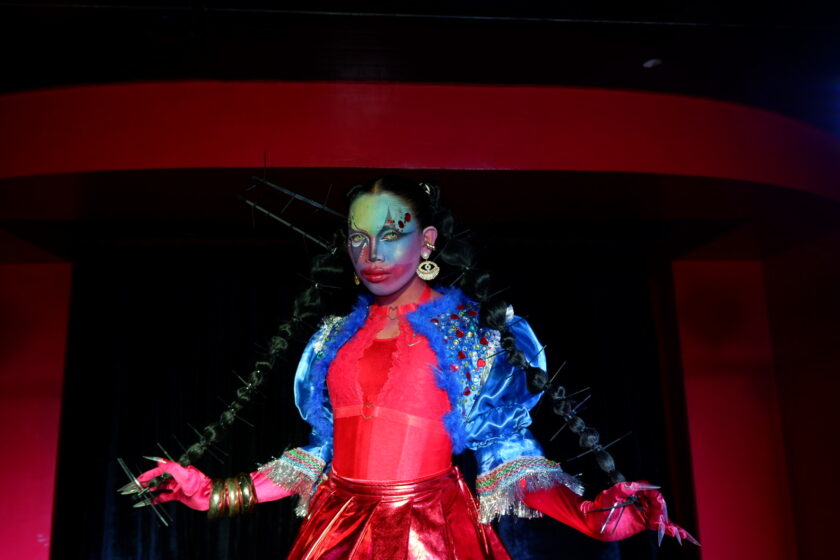
Klies performs during Aixis’ Fine Arts undergraduate thesis exhibition (Photo by Cris Fernan Bayaga/Bulatlat)
As a form of performance art, drag challenges social norms by placing gender diversity in public view. Through creative expressions of identity, drag creates opportunities for audiences to engage with experiences of LGBTQIA+ members who are often remain marginalized.
Klies said that fighting for her identity and claiming space through drag is her form of advocacy, as expressing identities historically excluded from mainstream representation fosters greater understanding of gender expressions beyond heteronormative norms. (AMU, DAA)
*Editor’s Note: “Klies” is the Cebu trans woman’s lived name and not her legal name, in accordance with editorial policy recognizing a person’s preferred name in published releases.
The post Drag as affirmation of trans identity appeared first on Bulatlat.
From Bulatlat via This RSS Feed.