

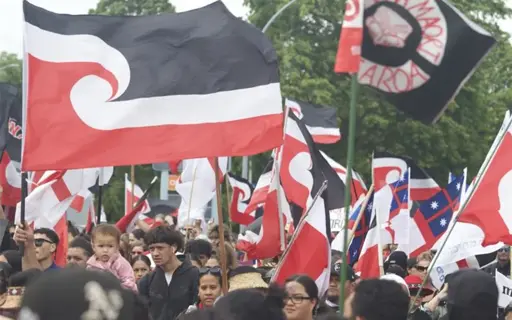

The Māori electoral roll grew by more than 3000 people after organisers of the hīkoi mō te Tiriti promoted a switch from the general roll. But it may make sense for some to switch back again, argues Katrina Smit, to enable more strategic voting. (Photo: Layla Bailey-McDowell/RNZ)
When it comes to choosing an electoral roll, there might be a surprising strategic choice for Māori this election, writes Katrina Smit.
In the early 1990s, when I was flatting in Grey Lynn, I voted for Sandra Lee in the general election and felt the power of my vote when she was elected to parliament. I then decided to move to the Māori roll to help increase the number of Māori seats.
The Māori seats and the existence of a parallel electoral roll are unique features of our electoral system. Legislation to create four seats to represent Māori was passed in 1867, although, based on the population at the time, true representation would have meant up to 20 seats.
Since then, there’s been ongoing debate and several changes to the legislation regarding the seats and the Māori roll. In 1986, the Royal Commission on the Electoral System recommended abolishing the Māori seats if the Mixed Member Proportional (MMP) voting system was adopted, believing that MMP would inherently produce a more representative, diverse parliament. But when MMP was introduced after a binding referendum in 1993, the Māori seats were retained.
Three years later, a fifth Māori seat was added to reflect the growing Māori population, in time for the first MMP election in 1996. By 2002, in line with population growth, there were seven Māori seats.
That number hasn’t changed since then — it remains at seven for the 2026 general election.
Once on the Māori roll, I never thought about changing. It made sense to me that the more the Māori population grew, the more seats we’d have in parliament. So having a separate Māori roll felt like something we had to protect. Until last week, I’d spent the past 30 years on the Māori electoral roll.
A couple of things have happened that make me believe that switching back to the general roll is an opportunity to make better use of my vote.
Firstly, the number of Māori seats is fixed at seven until at least 2032, regardless of how many voters are on the Māori roll. That’s because the government has changed the way the census is done, and the census survey had previously been the trigger for calculating the number of Māori seats.
With the approach to the census changing, new legislation decouples the calculation of Māori seats from the census process. The planned Electoral (District Boundaries) Amendment Bill requires a review every six years, starting in 2030.
This provides us with an opportunity.
The changes mean that even if enrolment numbers change, there will still be seven Māori seats in the 2026 and 2029 elections. The number of seats won’t go up, but importantly, it won’t go down either, regardless of how many people are on the roll. (Even if the bill did not pass, the existing census is not due until 2030, so the number of Māori seats for the next two elections is fixed at seven either way.)
Secondly, a law change in 2023 means the choice to change rolls can now be made at any time. The Māori Electoral Option gives all enrolled voters of Māori descent the option to choose which electoral roll to be on — the general roll or the Māori roll. It used to be that this choice could only be exercised every five years, during a four-month period after the census.
Now, if you’re Māori, you can change rolls at any time, except in the three months before a general or local body election. There’s also no limit to the number of times you can change. No matter which roll you’re on, you still have only two votes, like all New Zealanders — your electorate vote and your party vote.
So, to make my electorate vote count this election, I’m switching from the Māori roll to the general roll and staying there for the 2026 and 2029 elections. I’ll then probably switch back to the Māori roll for the 2032 election to ensure we increase the number of Māori seats. But I can make that decision closer to the time to ensure I use my electoral option strategically.
Why change now? I believe the way I vote in this election can and will affect the future of Aotearoa. To quote Barack Obama: “Cynicism is the guardian of the status quo — organising is the antidote.”
I’ve lived in the Hutt Valley for 24 years, and during that time I’ve voted in the Ikaroa-Rāwhiti electorate because I was on the Māori roll. At the last election, the main contest was between Labour and Te Pāti Māori candidates, with a few thousand votes separating them. If you voted for either candidate, the result, as in all the Māori seats, would be a victory for the left.
But in the general electorate I live in, Hutt South, it’s a completely different story. Here, it’s a two-horse race between the National and Labour candidates — and at the last election, National won by only 1332 votes.
The number of voters who live in the Hutt South electorate who are on the Māori roll is 4416 (maybe 4415 since I shifted). That number is a lot higher than the 1332 votes that separated the National and Labour candidates in the last election. Because I can now change my electoral roll at any time, I’m able to vote more strategically. If enough Māori do the same, it could significantly affect the outcome in my area at the next election.
It’s important to remember that whatever roll you’re on, your party vote isn’t affected. This is about strategically using your ability to choose between rolls in the general electorates.
And it doesn’t just apply to Hutt South. It’s worth taking the time to understand the contest in each electorate. Other electorates where the margin between National and Labour was less than 5 percent in the last election include Mt Roskill, West Coast Tasman, New Lynn, and Banks Peninsula. Slightly bigger but still marginal were East Coast (8 percent) and Wairarapa (6.4 percent).
Making this decision is about being organised and mobilising to support the things we care about. For me, the change is about using my vote to try to secure a government that might honour Te Tiriti and enable an equitable Aotearoa where everyone has enough to thrive.
The key date this year is August 6. After this date, you won’t be able to switch before the election. So if you want to switch, you’ll need to do it now.
Enrol or update online | Vote NZ
Katrina Smit (Ngāti Kahungunu ki te Wairoa) is the co-director of a newly established social innovation agency, Future. By Design. Her work champions Indigenous ways of doing and being to create equitable outcomes. She has a master’s degree in social change leadership from Melbourne University and is a global fellow of the Atlantic Institute, a fellowship focused on social justice and based at Oxford University.
The post I’m Māori and switching back to the general roll appeared first on E-Tangata.
From E-Tangata via This RSS Feed.