

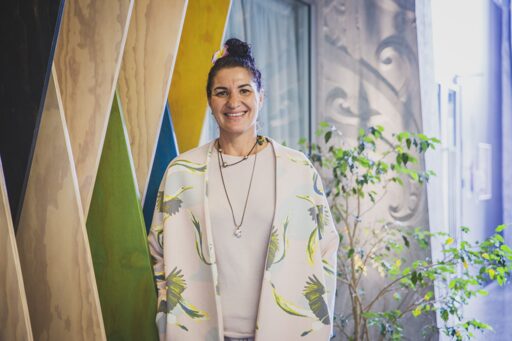

Dr Tania Mullane, head of Pacific nursing at Whitireia and WelTech polytechnic in Porirua, Wellington. (Photo supplied)
Tania Mullane was adopted by a loving Pākehā family and grew up in a community where, as the only Pacific child, she naturally gravitated towards Māori. She’s now head of Pacific nursing at Whitireia polytechnic in Porirua, Wellington — and here, she talks to Dale about how that experience has shaped her identity and her ideas about belonging and finding her place in the world.
Kia ora, Tania. I always start with names, and then I invite you to share a bit about your whakapapa lines.
My name is Tania Mary Mullane, but I’m not sure that name really reflects who I am. I was born with another name, Tracy, but then I was adopted, and my adopting family already had a daughter named Tracy. So they had to change my name. The story goes that my older sister, Tracy, got to pick my new name, and she chose Tania, which makes it special.
So my whakapapa isn’t reflected in my name, and I’ve often thought about changing my middle name to Makatalena, which is one of my birth mother’s names, though I haven’t done it yet.
My maternal line hails from Fiji, from a village called Nacekoro in the province of Cakaudrove, on the island of Vanua Levu. My grandmother is also from that village, and my great-grandmother was originally from Lau, in Tonga. So we have a mixed whakapapa of Fijian and Tongan, and my mother is also what they call kailoma, meaning she’s half Kaviti or iTaukei Fijian and half white Fijian. On her father’s side, she’s from a white Fijian family that’s been in Fiji for many generations.
My birth father is from an island in Greece, and that’s whakapapa that I’m not familiar with yet.
I was adopted in the 1970s into a Pākehā family, like many other “mixed race” babies, as we were called back then. In those days, not many Māori or Pacific families formally adopted babies, so it was common for babies to be adopted into families that weren’t culturally aligned to theirs.
My mum migrated to Aotearoa when she was 16, had me out of wedlock, and then, because there was no DPB back in those days, proceeded to put me up for adoption. She went to a Salvation Army hospital in Auckland. It was where you had your baby, and if you decided to adopt, then I suppose the old Social Welfare took the baby, and you were placed for adoption.
When I was adopted, so the tale goes, there were six or seven mixed-race babies in this one house in Māngere, and my mother and sisters literally came and picked me out from all the others.

Tania (far right) with her adoptive sisters Donna, Joanne and Tracy. (Photo supplied)

Tania Mullane as a girl. (Photo supplied)
I have three older sisters who are my parents’ biological children. It was a very loving, lovely family, and I grew up in rural Bay of Plenty, in Te Puke. I feel very privileged to have had access to everything and a family who loved me.
I think the biggest challenge was being in a cultural abyss, growing up in a little rural town, where I was the only Pacific brown kid who wasn’t Māori. And although my family were very loving, they didn’t recognise colour, so I grew up quite adrift in terms of understanding who I was and where I was from.
I was seeking cultural connection, and I gravitated towards Māori. Many of my friends were Māori — it was where I felt comfortable and accepted.
Then, in my early 20s, I reconnected with my birth mother. That started a journey of self-discovery, trying to fit who I am into my experience as a mother and into my personal, professional and academic life.
I’m forever grateful not only to my parents who adopted me and my sisters who loved me unconditionally, but also to my birth mother, Pamela Vikoca Makatalena Webb. She opened a cultural door for me to walk through, giving me the opportunity to better understand who I am and where I’m from.
I’ve had the absolute privilege of being able to travel back home with my birth mother, and to stand on the land I come from. And even though I don’t look like my other family members and I don’t understand my mother tongue, I feel and know with absolute certainty that this is where I come from.

Tania (third from right) on her first trip back home to Nacekoro in 2005, being welcomed into her grandmother BuBu Nai’s house. With her aunties, sister Annette, her daughter Nai-Vikoca and first cousin. (Photo supplied)

Tania (second from right) with her tamariki, Nai-Vikoca, Te Kokiri, Ngatoa-Kelemete, and Maraea-Tracy. Their village, Nacekoro, is in the background. (Photo supplied)
Can you speak more about your adoption experience and whether the identity issues you had could have been handled differently or better?
To be fair to my Pākehā parents, there was little support or guidance for adopting a child from outside your own culture back then. There was no internet advice or playbook for them to follow. So they were seeking to understand it as much as I was. They did the best job they possibly could with what knowledge they had, and they always had the best intentions.
And my goodness, there are so many adopted people who had a terrible experience, whereas I’m absolutely privileged and blessed that I had a fantastic upbringing. I can’t say I needed or wanted for anything.
I suppose, in hindsight, what I’ve gained is an understanding and empathy for what my parents did. It wasn’t perfect, but I appreciate the things I gained from them — how to work hard, how to be diligent, and how to code-switch. I can easily code-switch between Pākehā and Pacific, and because I grew up with so much Māori influence, I feel comfortable in that cultural environment and always feel welcome.
In a sense, you don’t belong anywhere, but you belong everywhere.
There’s a narrative that says we’re all Pacific in Aotearoa, regardless of our ethnicity, so there’s a place for people like me. We often don’t look like how we feel, but I think there’s an inherent need in us to seek out that cultural knowledge, so we can understand and be confident in who we are.
And I’m finding that as I get older, there are more opportunities for me to contribute to the community I come from.
For instance, at Whitireia, where I’m head of Pacific nursing, I’ve been able to offer programmes for the Pacific nursing workforce, and I’m developing Indigenous models that reflect the growing population of Pacific people in Aotearoa.
The combined Māori and Pacific populations are projected to be around 50 percent of the country’s population by about 2050, according to Stats New Zealand — so understanding this growing population is becoming increasingly important.
This population is also the youngest, and they’re having babies at the highest rate. As I say to people, if you don’t identify as Māori or Pacific, or as Māori and Pacific, there’s a really high chance that your children or grandchildren will.
This population isn’t talked about as much as it should be, but they are our future workforce. They’re our future prime ministers, our future leaders and decision-makers, and they’ll be supporting our ageing population.
So we need to get our heads around this growing population who identify as Māori or Pacific, or as both. How do we support this group to do better?
I’m contributing in any way I can, but also being mindful of the “give way rule” that Pacific academic Sereana Naepi talks about. That means, whenever there’s a need for cultural expertise, I seek it out, whether it’s Māori, Tongan or Fijian. I don’t see myself as an expert. I’m really clear about what I know, but I’m even clearer about what I don’t know.

Tania at her PhD graduation with (left) her adoptive mother, Jan Mullane, and her birth mother, Pam Webb. (Photo supplied)
Talk with us about health and nursing, and studying to get your qualifications to be involved in these sectors. I notice that you did some Plunket work early on. Did you always want to be a nurse, and why was that?
I really struggled at school. I got 49 percent for maths in the old School C. I was below average, so I never really liked school. And I can’t remember anyone ever really inspiring me or giving me good guidance about what to do after I left school.
So, there wasn’t any big passion to be a nurse. But I knew I had to do something, and I had an older sister who was doing nursing, so I was like: “Okay, I’ll do nursing.” I applied to do nursing after sixth form, and luckily, I got into Waiariki polytechnic in Rotorua and somehow managed to get through my nursing training.
I don’t even know how. I was a mediocre student, but I knew to just keep going, and keep turning up, and luckily, I managed to get through and pass.
Then I decided I didn’t really want to work in hospitals or with sick people. I got hapū not long after I graduated, and then was lucky enough to get a job at one of the programmes that Social Welfare used to run.
I ended up teaching a foundation health course at Moko marae in Te Puke, and I was able to take my firstborn to mahi with me, and then my second baby as well. My children are Ngāti Moko hapū, Tapuika iwi, on their father’s side.
That’s how I got into education. I really enjoyed it, and then I moved into Plunket nursing, which is all about community education and engagement. From there, I went on to teach at various polytechs.
So I’m a nurse, but I prefer to say I’m an educationalist.
I love the transformational power of education. As I got into it, I realised that I not only enjoyed it but was quite good at it.
As a teacher, I realised very quickly that I could contribute, especially to wāhine who’d decided to re-enter education as adults. My own experience in the education system had taught me what hadn’t worked for me.
Perhaps the biggest lesson for me was that you’re never going to feel like you’ve got this, but you keep going, and you don’t give up. I think imposter syndrome is something that we impose on ourselves. And if you can overcome that feeling that you can’t do something, and don’t give in to it, and just keep turning up, you’ll build the resilience you need to have a real chance of succeeding.
I taught at the Bay of Plenty Polytechnic and then at Waiariki, as they were known then, and later at MIT (Manukau Institute of Technology) before I came to Whitireia here in Porirua.
The path I took kept leading me to work with community groups and iwi, setting up partnership programmes.
And when I finally got my master’s, I went back to Waiariki as the head of a nursing programme there, and I thought: “Okay, this is somewhere where I can contribute.” I used the same partnership model with different iwi to deliver programmes that supported Māori and Pacific students to pursue higher study.
I got this job at Whitireia six years ago. When I saw it, I thought: “Wow, to be able to do a job that not only professionally aligns with my nursing training, but also culturally.” So I moved the family down to Wellington, and I see it as a real privilege to be supporting the Pacific nursing workforce. Since I’ve been here, we’ve doubled the number of students graduating.
After Covid, I specifically wrote a programme to support Pacific Island-trained nurses to get their New Zealand nursing registration, which I’d identified as a big gap. They had moved here for a better life, and they were very experienced nurses in their Pacific home countries. But they weren’t able to put that expertise to use here because they couldn’t afford to study to pass the requirement for New Zealand registration.
Thanks to scholarships from Te Whatu Ora, which paid their living and other course-related costs while they studied with us, we’ve had 65 Pacific Island-trained nurses graduate. And now they’re out there in the workforce. They’ve achieved their goal of being a nurse in Aotearoa, and they’re contributing to our Pacific health outcomes. So I’m very proud of that achievement.
Alongside that work, I was completing my doctorate, and out of that fell Tangata Hourua (people together), a framework I developed that puts core kaupapa Māori values and Pacific values into a cultural model that can be applied if Māori and Pasifika are on the receiving end of a service, be it education or health.
It also gives non-Māori and non-Pacific people a cultural framework they can use or refer to when working with Māori or Pacific patients.

Tania (right) at Whitireia with Bachelor of Nursing Pacific students and 2026 scholarship recipients Alana Nia and Paige Raemaki. (Photo supplied)
The one-size-fits-all approach might have been the norm in generations past, but we now have an expectation of culturally appropriate staffing perspectives, and we see that as a very important aspect of how future nurses and medical professionals are taught. You’re part of this vanguard of change, and I wonder how important you think it is.
The health workforce needs to reflect the demographics of those who need health care. That’s certainly true in nursing, but we need to support that in all areas to ensure that our non-Māori and non-Pacific colleagues have the confidence to meet the cultural needs of our Māori and Pacific communities — and know where to go for advice or support, too.
We have a non-Māori, non-Pacific workforce that has what’s called “Pākehā paralysis”. They’ve become so scared of doing the wrong thing that they do nothing, which is almost as bad, if not worse, than doing the wrong thing.
If you look at the stats, Māori and Pacific people are more likely to see a non-Māori or non-Pacific health professional than a Māori or Pacific health professional. So we need to make sure that whoever they’re seeing has the right cultural competence and confidence to safely meet their needs.
I was down in Christchurch Hospital with my moko Keneariki last year, who became very unwell very quickly, and I didn’t see one Māori or Pacific health professional down there, not one. The cleaner was Māori. She was lovely, but that was it. But we were able to receive some really culturally safe, culturally competent and confident care, which was amazing, and we’ve given that feedback back to them.
So what it reinforced for me is, yes, best practice is to have culturally aligned health professionals for individual whānau, but in places like Christchurch, it’s possible to deliver care that feels culturally safe even when there isn’t a Māori or Pacific health professional available.

Tania (third from left) with her children, Maraea-Tracy, Te Kokiri, Nai-Vikoca, and Ngatoa Kelemete; sons-in-law Dakota and Steve; and mokopuna Kaiawa and Keneariki. (Photo supplied)
I’m very pleased that you touched on that delivery experience in Ōtautahi, because we spend a lot of time saying what’s wrong, but we don’t hear enough of what’s right — and the fact that Pākehā nurses were mindful and cognisant of your whānau needs is encouraging.
And really, that’s what we’re trying to do collectively, to normalise aspects of our cultural ways. And I love the way that you don’t distinguish between Māori and Pasifika, because Māori are Pasifika, and we all are. So, embedding these cultural norms into the way that we roll out care makes sense, and obviously, it means a great deal to those you’re working with. I believe you work with Dr Matire Harwood, a leader in clinical research. Tell us about that.
She was my supervisor, and she’s someone who has just the right approach. She’s academic, she’s a researcher, but she’s kept her clinic. She still works at the Manurewa marae. I think she’s managed to create a cultural balance, a professional balance, an individual balance. She’s also a good friend, and we paddle waka ama together. I often phone her when I need cultural advice — she’s someone I seek out and really respect.
We’ve done a few waka ama world championships together. We went to the worlds in Hawai‘i, and we’ve competed in many nationals over the years. We’ve won medals together and lost races together, and I often fill in for her.
That’s how our friendship started. It’s been a 25-year friendship rooted in waka, but it’s morphed into an academic collaboration. That’s the reason I could develop the Tangata Hourua framework. She and Isaac Warbrick were my supervisors. It was unusual in that I was Pacific but had two Māori supervisors.
We went into it very hesitantly, realising that combining kaupapa Māori and core Pacific values could be controversial.
I wanted a model where both sets of values, Māori and Pacific, sit alongside each other but have their own space. So it’s a model that combines our strengths as Māori and Pacific, and acknowledges our connections while respecting the uniqueness of all Pacific peoples and the rights of Māori as tangata whenua.
Tongan academic Tevita Ka‘ili uses the term “trans-Indigeneity”, which so beautifully describes the concept of Indigenous people moving outside of their homeland and coming into contact with other Indigenous people. There’s a phrase “Tulou, tulou”, which is used by Fijians, Tongans and Sāmoans to show respect when moving through or past someone else’s space. I liken this to the way that I think we Pacific peoples should move among tangata whenua in Aotearoa.
When I was developing Tangata Hourua, I was working at a prison in Auckland, and there was an art class being run in the education block. I knew the tutor, so I asked if I could go in and run the model past the inmates. Over time, I’d pop in and talk to them about this Māori and Pacific approach. And you know what? They recognised I was onto something.
So many of our men in prison aren’t confident about who they are or where they’re from, so they could see how connecting to their cultural selves would help them to find themselves and find their way in life.
I also talked to the officers. Many of them were Māori or Pacific, and had grown up in South Auckland.
My impression from talking to them was that they connected as strongly with the suburb they grew up in as with their ethnicity, and this was true for both Māori and Pacific. They were part of a hybrid “Polynesian” culture that was evolving through contact with each other and their environment. What that showed me was how strongly we’re influenced by the environment we’re exposed to, which informed my thinking and creation of the Tangata Hourua framework.

Dr Tania Mullane, head of Pacific nursing Whitireia, Porirua, Wellington. (Photo supplied)
I’d like to leave the last word to you, Tania. If somebody was reading about you, what’s something that you’d like them to know?
I suppose it’s having the curiosity to navigate unknown territory to find who you really are.
And it’s knowing that, even though you don’t look a certain way, or act a certain way, or speak the requisite language, with grace, love, and the acceptance of yourself and those you love, you will find that there is a place for you. And actually, you’re the author of that place.
I’m still a cultural work in progress. The first person I met who shared my whakapapa was my firstborn, my daughter Maraea-Tracy. The feeling of holding her and knowing that we shared whakapapa was culturally transformative.
The last four generations of women on my mother’s side have been separated from their firstborn for various reasons, so I’m the first not to repeat this intergenerational pattern. I’ve created my own whānau, and I am a very proud mother to Maraea-Tracy, Te Kokiri, Nai-Vikoca and Ngatoa Kelemete, who all carry tupuna names from their Māori and Fijian whakapapa. And I’m now a proud nana to my two moko, Kaiawa and Keneariki.
If I look at my life from five-year-old Tania to 56-year-old Tania, there’s no way I could have predicted my life. But would I change anything? Not one thing, because it’s contributed to the person I am today.
(This interview has been edited for length and clarity.)
The post Tania Mullane: A cultural work in progress appeared first on E-Tangata.
From E-Tangata via This RSS Feed.