

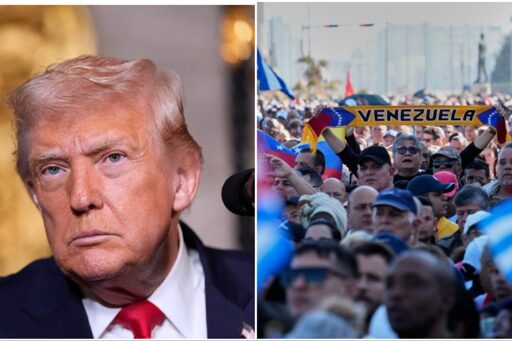
We have repeatedly denounced the broader imperialist strategy aimed at disciplining Latin America and reconfiguring the region under the U.S. imperialist interests. This strategy includes escalating sanctions, blockades, and military threats against Cuba, as well as the infamous night of January 3 in which the U.S. military attacked Venezuela, kidnapped President Maduro, and imposed a protectorate on the country with imperial tutelage over strategic areas of the country.
We must strengthen the anti-imperialist struggle against the siege and military threat to Cuba and against all forms of neocolonial domination over Venezuela. We must do so with complete political independence from the governments of the region, and from a working-class and internationalist perspective.
Here are ten ten urgent reasons why.
- Because the Right Self-Determination Is at Stake
No people should accept a foreign power deciding their destiny. U.S. imperialism seeks to claim for itself the right to determine who governs in Latin America, what economic model should be adopted, and where the limits of national sovereignty lie. The threat against Cuba and the political and military tutelage imposed on Venezuela express precisely this: the denial of the right of peoples to decide their own future.
Defending self-determination does not imply political support for any government. It is a principled stance against imperialist interference. When Washington intervenes, it does not do so to liberate peoples, but to subjugate them. Venezuela is the military laboratory for what awaits Cuba if we do not stop this offensive.
Defending the self-determination of peoples is a fundamental democratic task that the working class must undertake with complete independence from governments and national ruling classes.
- Because the Threat of an Attack on Cuba Aims to Complete a Neocolonial Capitalist Restoration
The economic, financial, and energy blockade imposed by the United States is not aimed at improving the living conditions of the Cuban people. Rather, the strategic purpose is to provoke an economic and social collapse that facilitates a transition controlled by the interests of U.S. capital — a transition with which the island’s restorationist sectors are willing to cooperate.
President Trump and Secretary of State Marco Rubio make no secret of their pursuit of “regime change” to serve these interests. The Pentagon and the hawks in Washington seek to dismantle what remains of the gains of the 1959 revolution and recolonize the Caribbean island, implementing a protectorate modeled on Venezuela.
Defending Cuba against this aggression is defending the right of a people not to become a colony at the disposal of the United States again.
3. Because the Protectorate Imposed on Venezuela Sets a Dangerous Precedent for All of Latin America
To normalize any form of neocolonial protectorate in Venezuela means accepting that the United States can establish tutelary regimes in Latin America whenever it deems it convenient. The January 3 attack is a demonstration of brute force that seeks to normalize the use of direct military violence in the hemisphere to depose governments or force political transitions to suit Washington’s interests. Through the control of assets abroad, the control of resources, and direct tutelage, Washington currently dictates the country’s economic and social policy. The kidnapping of the Venezuelan president through a foreign military operation and the installation of a government that collaborates with Washington politically, economically, and militarily constitute an extreme expression of this logic of neocolonial domination.
This imperialist tutelage aims to plunder Venezuela’s energy and strategic resources, degrading the country to a modern colonial status that erases historical gains of sovereignty in one fell swoop. The message is clear: any nation that comes into conflict with U.S. strategic interests can be subjugated through economic pressure, political operations, military intervention, or mechanisms of neocolonial tutelage. Accepting that would open the door to a new era of imperial protectorates on the continent.
- Because Trump Is Pushing a Return of the Monroe Doctrine Under His Imperialist National Security Strategy
For decades, Washington attempted to disguise its interventions under multilateral and humanitarian rhetoric. Now, Trump openly asserts that Latin America is an exclusive sphere of influence for the United States. Under his administration, the old pretensions of the Monroe Doctrine have returned unabashedly, cloaked in the geopolitical design of Greater North America. The “Donroe Doctrine” is a plan of absolute subordination that seeks to transform the entire region into a disciplined backyard.
The threat to Cuba, the neocolonial protectorate in Venezuela, and the growing militarization of the Caribbean are all part of this strategy. It is a comprehensive project of hemispheric domination, a scheme of complete recolonization to compete more effectively against powers like China or Russia, at the cost of the misery and subjugation of the Latin American peoples.
But neither do capitalist powers like China or Russia represent an emancipatory alternative for the Latin American peoples. Their relations with both Cuba and Venezuela align with their own geopolitical and economic interests, and we have seen that neither of them raises their voice against U.S. imperialist actions.
- Because Behind the Rhetoric of “Democracy,” Drug Trafficking and Its Imperialist Aggressions Serve Capital
Every imperialist intervention is accompanied by big business deals. Multinational energy, financial, technological, and agribusiness corporations view Latin America as a source of strategic resources that must be kept under secure control for U.S. interests. Venezuela’s energy reserves, and the continent’s mineral resources, trade routes, and markets are all part of this quest for political, economic, and military control.
When Trump talks about “security” and “stability,” he really means guaranteeing favorable conditions for imperialist capital. That is why his rhetoric on “democracy” is a farce. Added to this is the militarization of the continent under the pretext of combating drug trafficking, where military expansion is legitimized under the guise of fighting drug trafficking and “regional terrorism.”
The direct U.S. military presence is also evident in the direct agreements with the Noboa government in Ecuador and the Arévalo government in Guatemala, also under the pretext of combating drug trafficking. More recently, the U.S. State Department announced that the Brazilian crime organizations, First Command of the Capital (PCC) and the Red Command (CV), are now considered “Specially Designated Global Terrorists,” creating a pretext for expanding political and military intervention in Brazil.
Experience shows that these policies do not reduce drug trafficking or violence, but rather expand the repressive mechanisms of states and strengthen U.S. military presence on the continent. The working class and the peoples of the continent have the right to live without the constant threat of foreign military aggression.
- Because the Offensive against Cuba and Domination of Venezuela Are Threats to All of Latin America
History demonstrates that every imperialist victory over a Latin American nation strengthens imperialists’ capacity for intervention across the rest of the continent. What is happening today in Cuba with the military threat and the growing siege, as well as what is happening with the imposed protectorate in Venezuela, could be replicated tomorrow against any other country that comes into conflict with Washington’s interests. It’s a warning directed at all of Latin America: no people are beyond the reach of the economic, political, or military pressures of U.S. imperialism. Therefore, the defense of Cuba and the struggle against the protectorate in Venezuela are not merely a matter of internationalist solidarity; they are a strategic necessity for the working class and all the peoples of Latin America.
- Because Imperialism Also Imposes Its Dominance through Tariffs, Economic Blackmail, and Debt
The imperialist offensive does not operate solely on the military front. The Trump administration uses tariffs, economic sanctions, blackmail, and financial mechanisms as instruments of subordination for Latin American countries.
Mexico is a prime example. Under the threat of new tariffs, Claudia Sheinbaum’s government reinforced the militarization of the southern border and tightened immigration control policies toward Central America, responding to pressure from the United States. This subordination is also expressed through the reorganization of supply chains, the industrial relocation driven by Washington, immigration control, and the militarization of borders to serve U.S. strategic needs. We have also seen this in Brazil and Colombia.
At the same time, the United States openly intervenes in the political life of Latin American countries, financing, supporting, or promoting right-wing sectors aligned with its interests. In Argentina, with Milei’s campaign, it did so blatantly, threatening that if Milei did not win, the $40 billion in funding would not be released. It did the same in Honduras with the far-right candidate Nasry Asfura, linking its support to economic aid, which was contingent on the candidate’s victory. This offensive is also expressed through multilateral organizations like the IMF, which are a central mechanism of subordination. Each renegotiation or refinancing is tied to new demands for austerity, structural reforms, privatizations, and attacks on the rights of the working class and popular sectors.
- Because the Advance of Imperialism Feeds Back into the Far-Right Governments of the Region that Have Been Attacking Workers
One of the most serious aspects of the current situation is the alignment of numerous Latin American governments with U.S. strategy. The region’s right-wing governments act as direct agents of U.S. policy and openly support the aggression against Cuba and the attack on Venezuela. From Milei in Argentina, Noboa in Ecuador, and Bukele in El Salvador, to figures of the continental Far Right such as Kast in Chile, Bolsonaro in Brazil, Keiko Fujimori in Peru, and De la Espriella and Uribismo in Colombia, they submit to Washington’s demands, legitimize sanctions, remain silent in the face of military threats, or actively collaborate with Washington’s plans.
The government headed by Delcy Rodríguez operates under the protectorate imposed after the imperialist intervention in Venezuela. Its collaboration with Trump is particularly reprehensible in that it contributes to the strangulation of Cuba within a framework of complete submission to Trump’s objectives. This position has been applauded by opposition leader María Corina Machado. This is reminiscent of the worst moments of continental subordination and demonstrates the limitations of ruling classes incapable of defending even the most basic aspects of national sovereignty. Unfortunately, governments that call themselves progressive, such as those of Claudia Sheinbaum in Mexico, Lula in Brazil, and Gustavo Petro in Colombia, ended up subservient to the oil blockade against Cuba.
- Because the Anti-Imperialist Struggle Is Inseparable from the Struggle of the Working Class Against Its National Bourgeoisies
Sanctions, blockades, and interventions primarily affect workers, the popular sectors, and youth. Historical experience demonstrates that it is the working masses who pay the price for imperialist aggression through poverty, unemployment, scarcity, and the erosion of social rights.
Therefore, the anti-imperialist struggle cannot be separated from the struggle for the interests of the working class and the exploited sectors. Trade unions, social movements, and student and popular organizations have a crucial role to play. True anti-imperialist resistance is built from the ground up, through the independent mobilization of the working masses.
The struggle against imperialism can only be consistent if it simultaneously confronts the national bourgeoisies that act as junior partners of imperialist domination. The only force capable of effectively confronting imperialist aggression is the independent and internationalist mobilization of the working class and the peoples of the world. For this anti-imperialist struggle, workers, peasants, youth, and indigenous peoples must draw inspiration today from the extraordinary struggles of the Bolivian masses who are resolutely rebelling against the plans of adjustment, scarcity, and misery dictated by big capital.
- Because Only International Solidarity Can Defeat the Imperialist Offensive
It is necessary to launch a major international campaign of solidarity with Cuba and against all forms of neocolonial protectorate over Venezuela. Labor unions, peasant, indigenous, and popular movements, student centers, human rights organizations, women’s movements, militant youth, and all organizations that identify as anti-imperialist must embrace these banners and actively join this struggle.
The call is to reject Trump’s offensive, the restoration of the Monroe Doctrine, and the recolonization plans promoted by Washington in Latin America and the Caribbean. Workers, the Left, and popular movements within the United States must struggle against their own imperialist government, taking up this fight as their own. After all, a victory for imperialism against oppressed peoples strengthens the exploiters of the world, and represents a defeat for the working class and oppressed sectors of the United States itself. Likewise, the working class and youth of Europe must confront the complicity of their governments with imperialist aggression and the policies of subjugation of our peoples.
Intensifying the anti-imperialist struggle internationally allows us to unite the battles we wage in our own countries with the resistance movements emerging in the heart of imperialist nations, breaking isolation and strengthening an internationalist struggle capable of defeating the White House’s plans for domination. The defense of Cuba and the fight against all forms of imperialist control over Venezuela are part of the same battle: the struggle for a Latin America free from foreign interference, blockades, sanctions, military occupations, and all forms of neocolonial domination.
This struggle against the imperialism that oppresses our countries is inseparable from the struggle against the national bourgeoisies that act as its partners and local administrators. Only a perspective of social, political, and economic emancipation for the working class and the exploited sectors can definitively end dependency, oppression, and capitalist exploitation, paving the way for the true liberation of our peoples.
No to military intervention against Cuba! Down with the U.S. imperialist blockade and siege!
No to energy strangulation! Oil for Cuba now!
No to the neocolonial protectorate imposed on Venezuela!
Yankee imperialism out of Cuba, Venezuela, and all of Latin America and the Caribbean!
For a great international mobilization of the working class and oppressed peoples against imperialism and its recolonization plans!
This article was first published in Spanish on June 2 in La Izquierda Diario
The post Ten Reasons to Strengthen Our Opposition to U.S. Imperialism in Cuba and Venezuela appeared first on Left Voice.
From Left Voice via This RSS Feed.