

By Margaret Kimberly – Jun 3, 2026
The U.S. regime change plot against Venezuela succeeded and created a puppet state. Anti-imperialists must admit this reality and forge plans for fighting against it.
The January 3, 2026, kidnapping of Venezuela’s president, Nicolas Maduro, and his wife, first combatant Cilia Flores, was carried out with the express purpose of turning that oil-rich nation into a vassal state whose resources would become the property of the United States. There would have been no reason to undertake such an act if ending that country’s socialist experiment wasn’t on the agenda. The United States created not only an act of aggression against a sovereign nation, but also confusion among anti-imperialists that lingers long after that dirty deed was done.
The coup was carried out quite shrewdly. There was no invasion or military action that would create protests or demands for congressional action. For four months before the kidnapping, the United States began the process of delegitimizing the Venezuelan state in the eyes of millions of people, thereby reducing opposition when the final blow came. The extrajudicial killings of fishermen in the Caribbean were done under the guise of making the case of drug trafficking. The repeated narrative that President Maduro and other leaders were drug traffickers was a cynical selling point that stuck in the minds of all but the few who have any awareness about U.S. foreign policy. Maduro had been under U.S. indictment for years, and several U.S. presidents had maintained a bounty on his head. The Bolivarian revolution, like the states of Syria, and Libya, had been picked apart methodically, and experienced death by 1,000 cuts.
In the intervening months since January 3, there has been great debate about the state of the Venezuelan state. The hope that the Bolivarian project can continue is understandable, but the reality tells a very different story. After months of speculation that he was in custody, Alex Saab was turned over to the U.S. on May 16, 2026. This columnist viewed the act as one that settled the ongoing debate. The state had been completely subverted. Not only was his sacrifice and his suffering already made on behalf of the Bolivarian revolution disregarded in order to make a legal case against Maduro, but even some staunch anti-imperialists were prepared to overlook an obvious sign that Venezuela is no longer the nation they defended for so long.
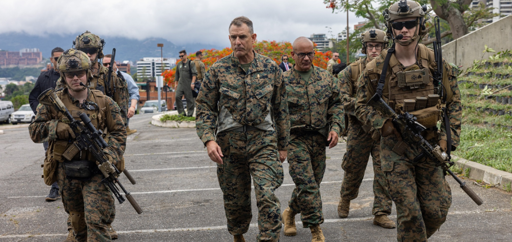
Not only was Saab sent back into the maw of U.S. injustice, but his wife was deported back to her native Italy. While hope sprung eternal and some defenders refused the evidence before their eyes, the U.S. disabused anyone of the idea that Venezuela was still sovereign by dispatching two military helicopters into Caracas, ostensibly to train for “emergencies” at the United States embassy, and the commander of the US Southern Command (SOUTHCOM) emerged as a passenger, just in case anyone needed proof of who is in charge.
But there are many people who still need proof. The most blatant acts of U.S. control do not end their denial. Even U.S. Secretary of State Marco Rubio announcing Interim President Delcy Rodriguez’s travel itinerary doesn’t persuade them to face the hard and sad reality: “We want to sell them [India] as much energy as they’ll buy. We also think there’s opportunities with Venezuelan oil. In fact, it’s my understanding that the interim president of Venezuela will be traveling to India next week as well.”
And she will travel to India, as she was ordered to do, and she is in Washington’s good graces as a result. It was an open secret that, like Maduro and Saab, Rodriguez also had an indictment hanging over her head. She no longer has that worry, as federal prosecutors were told to stand down and not pursue any of the U.S.-ginned-up criminal investigations against her.
While the SOUTHCOM commander struts around Caracas at will and airlines are directed to pay the U.S., not Venezuela, for fuel, all Venezuelan oil revenues are placed in a U.S. treasury account. Yet the denial goes on, and usually with the continued existence of the communes given as proof that there is still a glimmer of sovereignty in Venezuela.
On ‘Leftists’ Seeking to ‘Liberate’ Cuba & Venezuela with Help of US
The communes do not confer state power. In the absence of the Bolivarian revolution, their connection to the state is performative. Their existence does not prevent Washington from stealing oil money. It doesn’t matter if Delcy Rodriguez visits a commune if she also acts on Washington’s orders. In fact, giving the appearance of communal power that doesn’t exist is one means that Washington uses in its two-faced policy of pretending there is a sovereign government while also showing that it is no longer an independent state.
U.S. regime change in Venezuela is part of a larger strategy to control the world’s oil supply. Seizing Venezuela’s oil deprived China of an oil source, and gave the U.S. control of one of the largest reserves in the world. Communes will not stand in the way of giving the U.S. dominance over energy supplies around the world.
The role of the anti-imperialist is to be truthful about Venezuela, to condemn the decades-long U.S. attack that deprived that country of food, medicine, and the ability to benefit from its own oil resources. We must condemn this new strategy of snatching Greenland, Iran, and Venezuela in order to further U.S. strategic interests. Pretending that communes can thwart this plan is to have a deep misunderstanding of how major power politics works.
Elías Jaua is a former Venezuelan minister and vice president in the Hugo Chávez government. He gives a very clear directive to anti-imperialists about how we must respond in this moment.
“Now, four months later, the Venezuelan government and all political forces should clearly denounce to the international community the coercion to which we are being subjected. On the one hand, as a public denunciation, but also to have it formally recorded before international bodies such as the International Commission on Human Rights. What occurred in January were war crimes, a factsupportedby United Nations rapporteurs. Next, a complaint should be filed with the International Court of Justice to restore control over national revenues to the Venezuelan state. . . Finally, it is important to reach out to the international community, and above all to the peoples of the world, so that they know there is a nation that refuses to be placed under tutelage and subjected to these conditions, in order to build international solidarity. An internal political stance must also be established, because this attempt to conceal the gravity of the coercion to which the country is being subjected numbs popular consciousness, undermines patriotic morale, and that is contrary to what is expected of the leadership – not only of the government, but of the entire political leadership of the nation.”
Jaua clearly spells out our task. As painful as it is to acknowledge the U.S. crime, it is vital that the crime be reported, and not to turn a blind eye by behaving as if communes prevent SOUTHCOM from landing in the middle of Caracas. There will be more political struggles ahead for us all, and those cannot and should not be avoided. But at this juncture, truth cannot be avoided either. Regime change took place on January 3, and those who have been in solidarity with Venezuela must speak to that crime and condemn it with all the force that coercive measures and lawfare were opposed for many years.
The peoples of the world are in great danger because of U.S. actions, and the danger must constantly be exposed. That cannot be done with wishful thinking, which, while understandable, is a grave error. The U.S. carried out a long-desired plot against Venezuela on January 3, 2026. Stating that it occurred is essential to undoing the aggression.
From Orinoco Tribune via This RSS Feed.