

By Klein Fausto EmperadoIglesia Filipina Independiente/Aglipay Central Theological Seminary
Deuteronomy 8:2-3, 14b-16a
Psalm 147:12-13, 14-15, 19-20 1
Corinthians 10:16-17
John 6:51-58
The Feast of Corpus Christi invites us to reflect not only on what we receive at the altar but also on how that gift transforms the way we live in the world.
The readings today remind us that God’s saving presence is never detached from the concrete realities of human life. The God whom we worship is the God who journeys with the people through history. The God of Sarah and Abraham, the God who accompanied Israel through the wilderness, the God who inspired our forebears in their struggles for freedom and dignity, and the God who continues to walk with all who long for justice, truth, and peace.
In the first reading, Moses calls the people to remember their long journey through the desert. The wilderness was a place of hunger, uncertainty, and testing, yet it was also the place where God’s faithfulness was revealed. God did not abandon the people in their suffering. God heard their cries, fed them with manna, and brought forth water from the rock. The lesson of the wilderness was clear: life is sustained not merely by material bread but by the living Word of God who accompanies and nourishes God’s people.
This ancient story continues to speak to us today. Many among our people still wander through deserts of poverty, injustice, displacement, insecurity, and hopelessness. Many families struggle to place food on the table. Many workers labor tirelessly while receiving less than what their dignity deserves. Many communities continue to suffer from violence, corruption, deception, and the misuse of power. Yet the God who sustained Israel in the wilderness remains present among the people. God continues to act wherever compassion overcomes indifference, wherever communities share what they have, and wherever people courageously stand for truth and justice.
The Gospel deepens this message. Jesus declares, “I am the living bread that came down from heaven.” Unlike the manna that sustained the people of the Biblical Israel temporarily, Christ offers himself as the bread that gives eternal life. The gift of God is no longer simply food for the journey; God gives God’s very self. In Jesus, God enters fully into the human condition, sharing our struggles, our suffering, and even our death, so that humanity might share in God’s life.
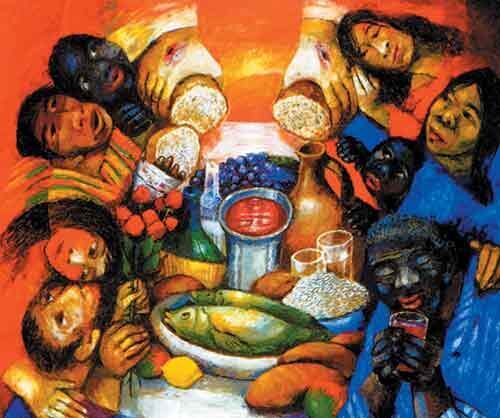
The image of Christ offering his body and blood reveals the depth of divine love. The Eucharist is God’s solidarity with humanity made visible and tangible. In every celebration of the sacred meal, Christ gives himself anew for the life of the world. The bread is broken, the cup is shared, and through these sacred signs we encounter the One who remains with us in our joys and sorrows, our victories and failures, our hopes and struggles.
Saint Paul reminds us in the second reading that “because the loaf of bread is one, we, though many, are one body.” The Eucharist is never merely a private act of devotion. It creates a community bound together in Christ. To share in the one bread is to recognize our responsibility toward one another. The table of God leaves no room for indifference toward the hungry, the oppressed, the forgotten, and the excluded. Communion with Christ necessarily leads to communion with our neighbors.
This truth challenges the Church in our present moment. We live in a time when misinformation clouds public discourse, when truth is often distorted for political gain, when many remain trapped in systems that perpetuate inequality, and when the voices of the poor are too easily ignored. The Eucharist calls Christians to become witnesses to another reality. The reality of God’s “kindom” where truth prevails over deception, justice over oppression, and love over fear.
To receive the Body of Christ is to commit ourselves to becoming the Body of Christ in the world. The bread we receive must become bread shared with the hungry. The cup we bless must become a commitment to those whose dignity is denied. The Christ we encounter at the altar must be encountered again in the poor, the suffering, the marginalized, and all who bear the wounds of society.
The Feast of the Corpus Christi therefore asks a simple but demanding question: What happens after we receive the bread and wine?
Our answer cannot end with personal piety alone. The Eucharist is meant to be lived. The sacrament sends us back into the world to embody the compassion, courage, and self-giving love of Christ. Having received the One who gave himself for the life of the world, we are called to offer ourselves for the life of others. Having been nourished by the Bread of Heaven, we are called to become bread for a hungry nation.
May this feast renew our commitment to walk with Christ beyond the walls of the Church, to stand with those who suffer, to speak truth amid falsehood, and to work for the transformation of society according to God’s justice and peace. For the Body of Christ is not only received. It is also lived. Siya Nawa!
The post Balik-Tanaw | Called to become bread for a hungy nation appeared first on Bulatlat.
From Bulatlat via This RSS Feed.