

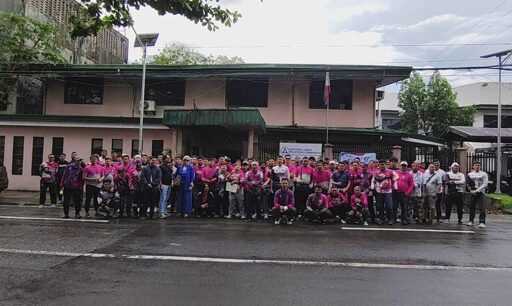
“Only through collective struggle can workers break free from the chains of oppression.”
TACLOBAN – “This is a monumental victory not only for Food Panda riders, but also for all exploited workers in Eastern Visayas.”
Normito Ragasa, union president of the Food Panda Riders Region 8, stressed this point after the National Labor Relations Commission (NLRC) recognized 126 Food Panda riders as regular employees on April 21, 2026.
The ruling comes after the legal battle initiated by the union in August 2025. Riders welcomed this decision as they have struggled with worsening working conditions from the COVID 19 pandemic to the current oil crisis. Ragasa, however, said that the ride to justice is just starting.
The union started as a simple aspiration by a small number of Food Panda riders led by Ragasa, initiating its collective framework around July 2025, structurally operating under the name Food Panda Riders–Region 8 Union. “With rigorous discussions and conversations with fellow riders our numbers eventually grew prompting us to seek legal action on the common exploitation that we experience,” Ragasa said.
The case filed by the union to the NLRC covered three main complaints, which are Food Panda’s denial of an employer-employee relationship, unexplained cuts on delivery fees, and arbitrary suspension and absence of due process.
Denial of an employer-employee relationship
In an interview with Bulatlat, Ragasa said that the company relegated the riders as “independent contractors” and categorized them as freelancers instead of actual employees.
The union said that if that were the case, then the riders can freely go to work whenever they want to, and can decline orders freely without any fear of sanctions. He said that in reality, “riders are subjected to stringent schedules, and are often suspended if they choose to cancel an order even when necessary as in cases where customers are not responsive.”
The union president said that they are not freelancers because of the company’s application and screening process where they handpick who they want to hire, the company’s control over delivery fees, and Food Panda’s oversight on driver’s performance, including the authority to suspend and deactivate a rider’s access to their account. In extreme cases, they can even be removed from the company.

Normito Ragasa, union president of the Food Panda Riders Region 8 delivers a talk during a discussion on labor rights spearheaded by the National Union of People’s Lawyers (NUPL) Tacloban Chapter. (Photo by Veronika Barbosa/Bulatlat)
“While the company only considers us as ‘freelancers’, riders are compelled to shoulder operational expenses such as motorcycle maintenance, fuel, cellular data plan, uniform, and specialized insulated delivery bags,” Ragasa said.
He said, “The delivery bag costs around P2,000 (around $33) and is a company requirement. The absence of which may lead to immediate restriction on app access.”
Despite shouldering all operation expenses, the riders were also not entitled to any additional compensations and benefits.
“We do not have any night differential even when we do graveyard shifts. We also do not have any holiday pay, overtime pay, and even 13th month pay,” he said.
Ragasa added that despite their rather hazardous work, especially that they are on the road for more than eight hours or more every day, they have little to no assurance that they can rely on the company should unforeseen accidents happen. “There was one regional member of the union whose motorcycle was struck from behind by a car while on duty last year. Thankfully he was able to recover and is now back, but he has yet to receive actual insurance disbursements from the company despite submitting all the documents he was asked to comply with.”
Pay cuts
Another complaint raised in the NLRC case was the unexplained cuts on delivery pay. Upon starting in 2020, riders are able to receive a base rate of P55 for every five-kilometer delivery with an additional P15 allocated per subsequent kilometer. Over the years, the company implemented gradual rate cuts devoid of any official notice, documentation, and consultation, dropping the base pay to P25 and succeeding kilometer rate to P10.
“Under the initial pricing system, riders would earn more or less P1,000 ($17) within a six to eight-hour shift. Now, riders have to do a 12-hour shift or more than that, requiring up to 25 completed deliveries, just to take home the same amount,” Ragasa said.
Ragasa said that a major issue in their delivery fee complaint is the huge cut in terms of double-booking. When they are handling simultaneous or consecutive orders across vendors in a single trip, the fee for the secondary delivery is deducted heavily and no longer rely on the actual base rate.
On top of the major cuts in the delivery fees, riders also bear the brunt of oil price hikes with their daily earnings dropping down between P300 ($5) to P500 ($8 USD).
No due process
The union lamented the arbitrary suspension of riders without due process. If a rider declines orders two to three times even if justifiable, the system automatically truncates remaining active shift slots. An example is that when a customer remains unreachable for 20 to 30 minutes, the rider must cancel the order but the system still counts this as a voluntary cancellation.
“Even after returning the items to the vendors and uploading photos and documentation as proof that the items were returned, the app would still issue an immediate two to three days suspension on the account. It is only run by an AI chatbot and the suspension has no human review whatsoever. It also does not help that Food Panda does not have any physical regional offices which usually means that channels for grievances are solely at the mercy of an AI chatbot,” Ragasa said.
While the NLCR recognized a legitimate employee-employer relationship between Food Panda and the 126 riders, the commission is yet to decide on the other complaints. Ragasa said that “only through collective struggle can workers break free from the chains of oppression.” He encouraged workers to unionize and fight for their rights as workers.
However long and bumpy the ride may be, Ragasa and the union of Food Panda riders in the region promise to continue the fight until they arrive at the destination that is just, safe, and favorable for delivery riders. (AMU, DAA)
Author’s note: $1 is equivalent to P61.
The post Hundreds of Eastern Visayas delivery riders now regular employees appeared first on Bulatlat.
From Bulatlat via This RSS Feed.