

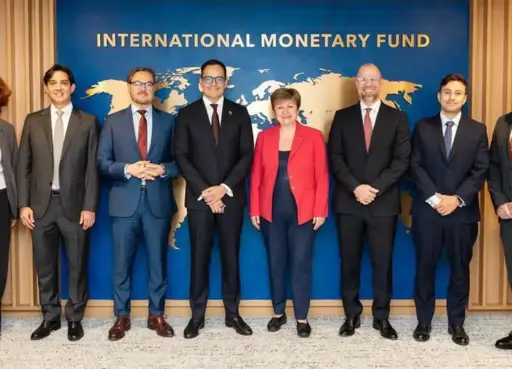
Caracas (OrinocoTribune.com)—On Thursday, June 4, the International Monetary Fund (IMF) provided additional details regarding its May 30 meeting with a Venezuelan delegation in Washington. The technical session focused on strengthening Venezuela’s institutional capacities and evaluating the process for resuming regular bilateral consultations to review the country’s economic health as a member state.
On the same day, the Central Bank of Venezuela (BCV) announced the meeting in a statement that did not provide significant details.
According to the BCV’s statement, “As part of the process to normalize relations between Venezuela and the international financial community, the National Executive’s economic team, accompanied by BCV officials, met with the IMF’s Managing Director and her team for the Western Hemisphere on Saturday… The meeting is part of Venezuela’s actions to restore ties with multilateral organizations after over a decade of sanctions and financial blockade that seek to stifle the Venezuelan economy.”
However, on Thursday, IMF spokesperson Julie Kozack explained during a press conference that during the meeting, “they discussed how the IMF can support Venezuela’s efforts to strengthen macroeconomic stability, and this included a path to holding an Article IV Consultation.” The high-level meeting brought together IMF Managing Director Kristalina Georgieva and Venezuelan representatives at the fund’s headquarters.
“So, on May 30, just a few days ago,… Kristalina Georgieva met with… Calixto Ortega Sánchez… The discussions centered on how the IMF can support the authorities’ priorities and areas where the Fund can provide immediate support through capacity development,” Kozack responded to a journalist’s question.
Kozack hinted that further dealings remain in progress, stating, “So, there’s the immediate leg, which is the capacity development, and the discussions focused on the path toward an Article IV.”
Article IV consultations and capacity development
The IMF’s Article IV consultation is the legal mandate that allows the US-controlled organization to review the economic health of its member countries. This mechanism requires host governments to maintain stable exchange rate policies and open their internal ledgers to a thorough annual review.
Representing the IMF’s core surveillance duty, the procedure follows these foundational steps:
• Staff visit: An IMF team of economists travels directly to the member country.
• Data gathering: The team meets with officials from the Central Bank, the Finance Ministry, private businesses, and labor unions to review fiscal, financial, and monetary policies.
• Report drafting: The technical staff prepares a comprehensive assessment of the economy alongside future macroeconomic forecasts.
• Board review: The IMF Executive Board discusses the final report and issues official policy recommendations.
The Venezuelan delegation to the meeting was led by Vice President for Economic Affairs Calixto Ortega and BCV President Luis Pérez. Regarding the capacity development negotiations, Kozack explained that the technical exchange addressed several priority areas, specifically fiscal management, strengthening the monetary framework, and improving macroeconomic statistics. At the end of the meeting, both delegations agreed to continue working to deepen technical engagement and coordinate the delivery of targeted technical assistance in the near future.
Debt restructuring and political context
Responding to another inquiry regarding the IMF’s potential involvement in a Venezuelan foreign debt restructuring, Kozack did not reject the possibility, stating, “On the debt—on the DSA, the Debt Sustainability Assessment, the Fund is not yet involved in those discussions on the debt restructuring.”
This formal reactivation of bilateral channels follows the IMF’s April announcement of the resumption of relations, which was followed days later by a Venezuelan announcement concerning foreign debt restructuring. Venezuela has stated it will present an economic framework to restructure its obligations, including a public debt sustainability analysis, in June. This process is currently being executed alongside the US consulting and investment bank Centerview Partners.
These financial maneuvers unfold amid a highly volatile political landscape following the January 3 US military invasion of Venezuela. The imperialist aggression resulted in the kidnapping of Deputy Cilia Flores and President Nicolás Maduro, alongside the murder of over 100 people, including 32 Cuban and 47 Venezuelan soldiers. Since then, the Venezuelan government has granted a series of controversial concessions to US imperialism, prompting some political analysts to claim that the country has effectively devolved into a US protectorate—an assertion strongly rejected by many Chavistas and grassroots organizations inside Venezuela.
New mission chief and World Bank meetings
Also on Thursday, Bloomberg reported that the IMF had selected Alvaro Piris as its new mission chief for Venezuela. Piris currently serves as the IMF’s assistant director in its African Department and mission chief for Ethiopia. His prior institutional roles include leading IMF diplomatic and financial missions in Mozambique, Lebanon, and China.
Prior to the Washington-based Venezuela-IMF assembly, a World Bank delegation led by Susana Cordeiro Guerra met with Venezuela’s Acting President Delcy Rodríguez in Caracas.
Acting President Delcy Rodríguez on IMF: No Debt Plans for Venezuela, Only Recovery of Frozen Assets
The World Bank meeting, held on Friday, May 15, was framed by organizers as part of a broader strategy for Venezuela’s reinsertion into the international financial system. The primary objectives include securing direct access to $5 billion in Special Drawing Rights (SDRs) that remain frozen by the IMF, initiating a comprehensive restructuring of the country’s foreign debt, and regaining administrative control over seized state assets abroad.
Special for Orinoco Tribune by staff
OT/JRE/SF
From Orinoco Tribune via This RSS Feed.