

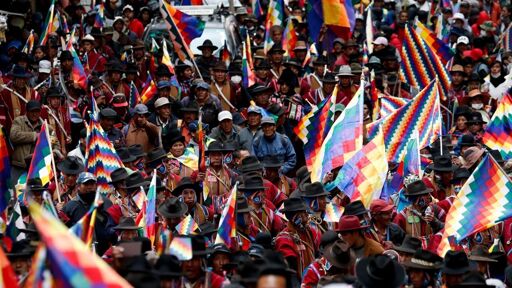
In a Black Agenda Report exclusive on May 29th, 2026, former Bolivian president Evo Morales Ayma spoke with correspondent Clau O’Brien Moscoso. They discussed the now four week long general strike and the many blockades that have brought the small Andean nation to a grinding halt. The main demand of those protesting is the resignation of Spanish born, U.S. backed, far right president Rodrigo Paz. Below is Part 1 of the excerpts of an interview with the man who was Bolivia’s first indigenous president speaking from his office in Lauca Ñ, Shinahota.
COM: We already know right now the situation in Bolivia and the crisis is currently unfolding. What can you say about what is happening right now, about the strike?
EMA: There are several components, thank you very much, sister Claudia. First, unfulfilled electoral promises, from small to very large. For example, during the campaign, Rodrigo Paz said, “We are not going to borrow money from international organizations, least of all from the International Monetary Fund.”
First, he states that without liquidity, Bolivia seeks to issue bonds and requests $3.3 billion from the International Monetary Fund, about a month ago. And now, Paz is negotiating credit programs with the International Monetary Fund for $5 billion, and the IMF conditions to avoid lowering taxes on energy. And not only that, but it also imposes three requirements to access credit from the International Monetary Fund.
First, eliminate all subsidies, eliminate the subsidy for bread. Second, fuel.
A request from the International Monetary Fund, for devaluation, the exchange rate. And third, the worst for me, privatize all state-owned companies.
On November 8th, Rodrigo Paz is sworn in as president. In December, he issues a Supreme Decree 5503. This is almost the same as Supreme Decree 21060 of 1985 to implement the neoliberal model. But this supreme decree is so that the wealthy, the big businessmen, don’t pay taxes. And in this supreme decree, I only mention three important things. Free hiring for the working class. Free importation of agricultural products. And finally, gradually eliminate the simplified tax regime for small merchants, for the small informal vendor. In December, the people rise up, mobilizations, Christmas, New Year’s, we spend as a state of emergency.
The crisis hit a boiling point to repeal Supreme Decree 5503. But afterwards, with other decrees, he continues implementing it. April arrives, Law 1720 is approved, where the small producer becomes a medium agricultural producer.And the small producer, I repeat, by national law, is now a medium producer, therefore has to pay taxes. The small producers rise up with marches, blockades.
But who defends the law? The law is defended by the agro-industrialists of Santa Cruz, the landowners, in other words. They defend the law, not the small producer. Finally, they had to repeal the decree.
Another setback for them. Teachers marched for a salary increase. This salary increase, well, inflation is quite high.
The International Monetary Fund projects that the Bolivian economy will fall by 3.3% in 2026, and inflation will reach 20.7%. And the CAO requests a 20% salary increase just to compensate for the inflation rate. And there was no salary increase, instead they gave a one time bonus of 2,400 Bolivianos to each teacher. And what happens? They say starting in 2027, this bonus will be paid by the departmental governments. But the departmental governments have no money.
But the worst, after removing the fuel subsidy, Rodrigo said during the campaign, “the day after I take office, there will be no fuel shortage”. There was a great fuel shortage, a lot of corruption. But the first lie, the day after his inauguration, Rodrigo Paz goes to the border. According to them, 900 tanker trucks of gasoline came in. But what was it bought with? If that existed, it was from Lucho (Luis Arce, the previous president) and not from Rodrigo Paz. But the worst is, what do the tanker drivers or truckers say? Half of the trucks were empty.
What a lie! Finally, the fuel from Rodrigo Paz’s administration arrives. In February, March, gasoline fuel arrives looking like Coca-Cola, of poor quality, called garbage gasoline. It starts to ruin all the cars. For me, my little car broke down twice. There is so much corruption.
How do I see it? Hunger drives this mobilization; unemployment, the loss of purchasing power, the lack of dollars, the issue of inflation, the lack of food, the lack of medicines – a convulsion.
I see a rebellion, therefore, against the neoliberal model and the neocolonial state. Why do I say neocolonial state? To the small producers, the 5% tax – it’s bringing back the indigenous tribute from colonial times and the colonial state. Although we had Decree 1720 repealed, which turned small property into medium property, it didn’t stop. So, lie after lie. The people rise up and now they can’t stop, the mobilizations continue.
COM: Thank you very much for that economic and historical context. How do you see the role of the United States in what is happening now in Bolivia?
EMA: Let’s see, aside from being an economic crisis, there is a political crisis, there is a social crisis. But a component has been added for me, which is a sociological issue.
That’s why I say, this is no longer just a class struggle, but a struggle for identity. And now, the people are realizing that Rodrigo Paz, born in Spain, and in his messages, in his conferences he says, I was exiled in Colombia, Mexico, China, Argentina, I was in 10 countries, but he never said his father was exiled and he was born in Spain, he never said that. His identity background from birth is Spain; he has dual nationality.
And the Aymara brothers say, no, just like Christopher Columbus, a Spaniard is going to dominate us. I see it as a sociological issue, not just a political issue, not just an economic issue. That’s how I see it.
Bolivians Demand Immediate Resignation of President Paz at Open Assembly
But here we can explain to them, the intervention, as always, of the United States. Last week, the United States Secretary of State, Marco Rubio, said on his Twitter, “Make no mistake, the United States firmly supports the legitimate constitutional government of Bolivia. We will not allow criminals and drug traffickers to overthrow democratically elected leaders in our hemisphere.” He calls us drug traffickers and criminals. But also, a military leader says on his Twitter, the leader of the largest private army in the world, Eric Prince, asked the Donald Trump government to “prevent the pedophile Evo Morales from carrying out a coup d’état. Bolivia had elections. Rodrigo Paz won. Don’t let the drug dealers overthrow it. It is an open intervention.” As far as I know, the US embassy, the chargé d’affaires, instructed “Rodrigo has full support. We cannot lose Bolivia. We cannot lose lithium.” Therefore, a state of siege until two, three days ago. But the supposed aid from (Argentinian president Javier) Milei arrives – tear gas canisters, rubber bullets. Another from the right arrives, from Chile, Peru. Today a plane from Paraguay arrived. I think it’s a plane from the US military base in Paraguay. But the day before yesterday, a plane from the United States arrived with more than 100,000 cartridges of tear gas. Yesterday, from Santuario, they took boxes of rubber bullets from Galapagos.
We see full support for repression of the popular movement. And the Armed Forces, by order of their commander, are organized into two anti-riot command teams although the Armed Forces do not want to participate in the repression. They already sent the Armed Forces to the streets and they were defeated by the social movements.
And the military doesn’t want to get involved, a good part of the army especially. So, however, here comes the commander of the United States Southern Command (SOUTHCOM) giving orders. A few weeks ago, three members of SOUTHCOM were visiting barracks. I said, what do they want? Why are they visiting barracks; is it to give equipment to repress the people? And what does SOUTHCOM teach the Armed Forces? That the internal enemies of the Bolivian Armed Forces are the indigenous people. They are the workers. They are the popular element. So, it is a total foreign intervention, including the Drug Enforcement Agency (DEA). But Rodrigo Paz says the DEA comes to fight drug trafficking.
You, as a journalist and communicator, are informed. Rodrigo broke the record for involvement in drug trafficking. Why the record? First time we hear that a state plane, the TAP (Bolivia’s DEA) of the Air Force, arrives from Miami to Guirubiru with liquid marijuana. Some police officers said it wasn’t the first flight. It brought marijuana from the United States to Bolivia. I ask the specialists, why do they bring it? Oh, there’s a big marijuana market in neighboring countries. That is, Bolivia distributes marijuana to neighboring countries. I say, where is the DEA then? That is, it’s surprising. I say, no, we have arrested a ringleader, a drug trafficking boss, Sebastián Enrique Marset, and it appeared in the newspaper.
The government had a meeting with Marset, ten days before his arrest. I don’t know who he met. This arrest was prepared, negotiated, and planned.
The worst is, sister journalist Claudia, in his testimony, not a single dollar in his suitcases. Not a dollar. There in another of his departments, they find nothing. It’s funny. Who is going to believe that? Where is the DEA that fights drug trafficking? People no longer believe Paz. He has lost authority.
Here comes a fundamental issue – the US Embassy says, we cannot lose the lithium. Paz already signed memorandums with the United States and Canada to generate rare earths, lithium. And the people are defending lithium, natural resources, and rare earths. They are defending the homeland. They are defending Bolivia. Really, I am very surprised by this rebellion of my sisters leading the countryside. The red ponchos, Aymaras from the Department of La Paz, were at the forefront.
When I was a youngster, after leaving the barracks in 1979, a coup d’état, the Unique Union Federation of Workers, Peasants of La Paz, the press said, declared a road blockade against the coup d’état. In two weeks, they brought down the dictator. With his chancellor, Guillermo Bedreal, a trusted figure of Víctor Paz. This story is repeating itself.
In colonial times, Tupac Katari and Bartolina Sisa continued to approach peace. Not only for cultural vindication, but for the defense of territory, of our identity. And Tupac Katari also asked the whites to organize themselves to defend (the homeland) together. It is as if Tupac Katari has returned to bring peace now, to defend his territory, the territory of Bolivia, as millennial natives of this noble land. So, all that struggle, previously against the European invasion, now against US intervention.
Clau O’Brien Moscoso is an organizer and co-coordinator of the Black Alliance for Peace Haiti/Americas Team. Originally from Barrios Altos, Lima, she grew up in Kearny, New Jersey. She attended college, lived, and organized in New York City for 15 years, and is now based in Lima, Perú, writing about Latin America and the Caribbean for the Black Agenda Report.
From Orinoco Tribune via This RSS Feed.