

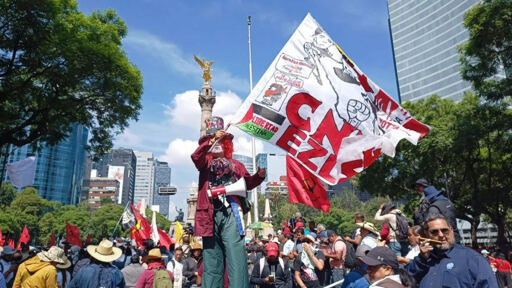
This Monday, thousands of teachers from the National Coordination of Education Workers (CNTE) launched an indefinite national strike in at least ten Mexican states — Oaxaca, Chiapas, Guerrero, Morelos, Michoacán, Zacatecas, Chihuahua, Sonora, Sinaloa, and Quintana Roo. They have blocked major roads, occupied the Ministry of Education headquarters in Mexico City, set up camp in the Zócalo (Mexico City’s main square), and blocked the Nogales border crossing into the United States. Statues of footballers erected by the state for the World Cup have been toppled, a symbolic gesture that carries a clear message: no World Cup as long as Mexican workers endure austerity.
The movement stems from a contradiction that has become unbearable for Mexican workers. The government of Claudia Sheinbaum has spent at least $3 billion on infrastructure for the World Cup, which begins on June 11, while simultaneously imposing drastic budget cuts to public education. On May 15, Sheinbaum granted a 9% salary increase for teachers — a concession immediately dismissed as “crumbs” by the CNTE, which has refused to accept it. Far from appeasing the movement, this minor concession has fueled anger at the double standards faced by Mexican workers. As one protesting teacher summed it up: “Who will benefit from the World Cup? Big bosses and bankers! How is it possible that there is so much money for them while we and our children are increasingly insecure?”
The teachers’ demands are clear and strike at the heart of the neoliberal political project that has allowed the country’s bourgeoisie to further entrench exploitation. The mobilized workers are demanding the repeal of the 2007 ISSSTE law and the 1997 IMSS law, which successively privatized civil servants’ pensions by transferring them to AFORE (pension funds managed by banks). They are also calling for the cancellation of the 2012 Education Reform, which imposed a managerial evaluation system, competitive exams, and performance-based criteria on teachers, completely destroying job security for education workers. Finally, they are demanding a 100% increase in base salary and a significant increase to the education budget, which historically has been used as the adjustment variable to compensate for the economic crisis and has been a primary target of budget cuts for decades.
At the heart of the struggle is also the issue of pensions. “A decent pension is not a luxury, it’s a right,” read the protesters’ placards. Before 2007 teachers could retire after 28 years of service for women and 30 for men. The ISSSTE reform imposed a points-based system, raised the retirement age, and entrusted retirement savings to private banks. As a result, teachers now retire with only 30% of their salary, while bankers pocket the profits from managing the funds.
Claudia Sheinbaum, who had made repealing this reform a central plank of her 2024 presidential campaign, is now responding to protesters with police repression. Police were deployed in force to prevent demonstrators from reaching the Zócalo. At least five teachers were seriously injured, one of whom lost an eye after being hit by tear gas fired at close range.
Sheinbaum is now rejecting the teachers’ demands, explaining that conditions are no longer favorable for withdrawing the reform and that “there is no money,” after having allocated $3 billion for the FIFA World Cup.
The teachers are not alone. Student groups from various universities have joined the movement, as have farmers. The ISSSTE law does indeed concern all state workers — administration, justice, public services — and it is in this spirit that the striking teachers are calling on all these sectors to join the mobilization. The CNTE is now calling for an indefinite general strike ten days before the start of the World Cup. The timing is working in the teachers’ favor, as they are aware that the pressure on the government, which has invested colossal sums in the event, could force them to give in.
This movement reveals the full contradiction of Claudia Sheinbaum’s government. Presented as one of the most progressive governments in Latin America, it nevertheless responds to teachers’ basic demands with contempt, empty promises, sham dialogue, and repression. Behind the rhetoric of “transformation,” what is clearly visible is the continuation of a social model deeply hostile to workers: there is supposedly no money to repeal the 2007 ISSSTE law, nor to guarantee decent pensions, yet billions are poured into the demands of FIFA and large corporations.
The CNTE strike thus exposes a conflict that extends far beyond the teaching sector. What is at stake is not only teachers’ salaries, but the future of all Mexican workers subjected to precarious employment, the erosion of pensions, and the plundering of their social rights by banks and retirement fund administrators.
This is why the teachers’ call to extend the mobilization to students, parents, and workers in the public, healthcare, university, and private sectors is crucial. Faced with a government attempting to stall through dead-end negotiations, the only way for teachers to win their demands is by expanding the strike, organizing assemblies in workplaces, and building a genuine balance of power that can defeat Sheinbaum’s austerity program. Regardless of the immediate outcome of the negotiations, the CNTE’s mobilization demonstrates that Mexican workers will no longer settle for crumbs, and that they can pave the way for a broader struggle against all neoliberal attacks.
Originally published in Révolution Permanente.
The post Mexican Teachers Strikes Threaten Sheinbaum’s Plans for World Cup appeared first on Left Voice.
From Left Voice via This RSS Feed.