


Sandra Hale Schulman
ICT
The latest: Theater history as activist art, a community gathering place and tribal tales on film
ART: Dual theater/art shows in Santa Fe
The occupation of Alcatraz by the Indians of All Tribes in 1969 and a treatise written at the Institute of American Indian Arts that same year inspired a presentation on Native theater at two venues in Santa Fe — SITE Santa Fe and the Museum of Contemporary Native Art.
The presentation, “Indian Theater: Native Performance, Art, and Self-Determination since 1969,” is the first major exhibition that centers performance as an origin point for the development of contemporary art by Native artists, opening June 5 through September 7, 2026.

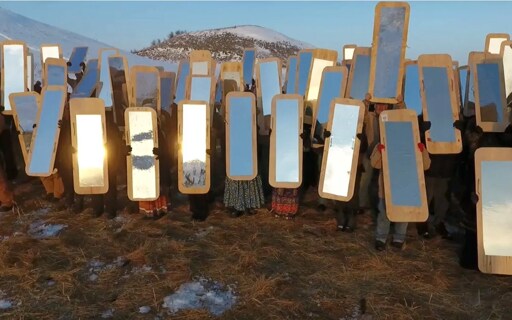
This work, “Wopila, Lineage II,” by artist Dyani Whitehawk, is featured in a 2026 exhibition, “Indian Theater,” in Santa Fe. Credit: Courtesy photo
Curated by Candice Hopkins, Carcross/Tagish First Nation, executive director and chief curator of Forge Project, the exhibition features artists who are Native American, Alaska Native, First Nations, Métis, and Inuit. It traces the history of artistic experimentation with political action, critical engagement with existing Native practices, and a reconsideration of identity.
“As a curator at the MoCNA, the document published in 1969 called ‘Indian Theater and Experiment and Process,’ was amazing to me,” Hopkins said in a statement. “It’s manifesto for a new Native theater movement that was totally contemporary, totally experimental, and was also looking to certain Native traditions to make this new movement.
“I was interested in this question of what was in the air in 1969, the beginning of what we now call the self-determination era for Native people,” she said.

Candice Hopkins, Carcross/Tagish First Nation, is executive director and chief curator of Forge Project. She curated a new exhibition, “Indian Theater,” that examines contemporary art influenced by the activism of 1969. Credit: Courtesy SITE Santa Fe
Hopkins notes that the occupiers were students from the University of California, Berkeley, testing the authority of an 1800 Lakota treaty that had promised all federal surplus land to the Lakota people.
“It was really a test of those treaty rights, but it sparked not only a national movement, but really an international movement,” Hopkins said.
“Indian Theater” brings together more than 100 works by 40 artists including Rebecca Belmore, Anishinaabe; Nicholas Galanin, Tlingit/Unangax̂; Jeffrey Gibson, Mississippi Band of Choctaw and Cherokee; Maria Hupfield, Anishinaabe, Wasuksing First Nation; and Eric-Paul Riege, Diné.
The show uses sound and instrumentation, regalia and more through theater, live performance, sculptures, public interventions, and collective actions. A highlight is the presentation of digitized footage of Spiderwoman Theater featuring Lisa Mayo, Gloria Miguel, and Muriel Miguel, Kuna and Rappahannock Nations, shown for the first time since its original live debut.
COMMUNITY ARTS: Wisdom, laughs and frybread
Los Angeles’ new Chapter House brought together some of the hippest actors, musicians, designers and media personalities for a blowout NDN Flea Market and Sage Based Wisdom show on May 30.
The Chapter House is a place for Indigenous peoples and allies to convene for art, music, food, and crafts while celebrating Indigenous cultures. With a large outdoor space and more-intimate indoor spaces, the all day NDN Flea Market took over all of it with jewelry, clothing, community activist tables, piñon coffee and frybread in several flavors served up by comedian Jana Schmeiding, Lakota, of “Reservation Dogs.”

Lakota comedian Jana Schmeiding, left, perhaps best known for “Reservation Dogs,” presents a quilt to Chapter House founder Emma Robbins at an event May 30, 2026, at the LA Chapter House. The event also included a performance by actor and musician Mato Standing Soldier, professionally known as Mato Wayuhi (“The Lowdown”). Credit: Sandra Hale Schulman/Special to ICT
After the market ended, the space was converted into a seated performance venue for Schmeiding’s “Sage Based Wisdom” show, in which she takes questions from the audience. She and her guest Memo Torres of “LATaco” — an online news site that tracks federal immigration raids and other major Los Angeles events — then attempt to give honest but funny advice.
After the funny business, Oglala Lakota musician and actor Mato Standing Soldier, professionally known as Mato Wayuhi (“The Lowdown”), took the stage for a rap performance with guest singers and musicians. Standing Soldier has been on a roll for several years releasing studio albums, his original soundtracks for “Reservation Dogs” and the upcoming Netflix release of “Free Leonard Peltier’; and his affecting turn in “The Lowdown” opposite the late Graham Greene.

Oglala Lakota musician and actor Mato Standing Soldier, known professionally as Mato Wayuhi, performs at an event May 30, 2026, at the LA Chapter House hosted by Lakota comedian Jana Schmeiding, of “Reservation Dogs.” Credit: Sandra Hale Schulman/Special to ICT
Fans lined up at his merchandise table afterwards to buy his CDs and get his autograph, including actress Cara Jade Myers (“Killers of the Flower Moon”).
The founder of the new space is Emma Robbins, a Diné artist, activist and community organizer who works to empower Indigenous women. The Chapter House plans more events in the future, including music, parades and sound baths.
FILM: Movies that sing
The Eternal Song film collective is releasing 12 documentary films that tell the stories of Indigenous traditions, with each offering ancestral wisdom and calling viewers to remember, grieve, heal, and act.
The newest film is “Little Singer,” available now through the film collective website, which tells the story of a medicine man and a small school where grief and resilience meet in song, teaching, and k’é (kinship).
“Amidst the wide horizons of Diné land, the legacy of historical trauma echoes through generations,” according to a description of the film. “‘Little Singer’ is rooted in the land and carries the vision and medicine of k’é for those yet to come.”
The film features Jeneda and Clayson Bennally, Diné, of the band Sihasin and their medicine man hoop dancer father Jones, as well as Pat McCabe and others who tell their stories of finding and advancing their cultural roots.
Other films available include ”Mauri: The Vital Essence of All Beings,”; “If An Owl Calls Your Name”; and “Haida,” which tell stories of homeland struggles and triumphs.
The post INDIGENOUS A&E: Performance theater, a new Chapter, film series appeared first on ICT.
From ICT via This RSS Feed.