

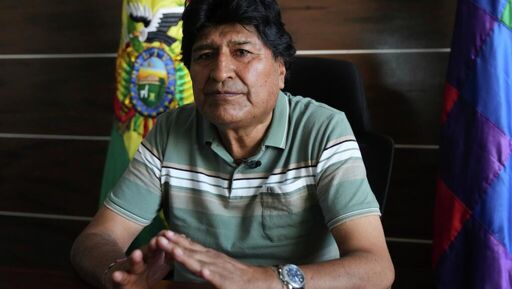
Despite the legal proceedings brought against him over many years, former Bolivian president Evo Morales (2006–2019) assured Sputnik in an exclusive interview that he has come out victorious in the judicial disputes.
“They already accused me of drug trafficking, murder, and terrorism during the government of Jorge Tuto Quiroga (2001–2002). The plan was to prosecute me, sentence me, and bar me as a candidate for 2002 and 2005. But I won every case” — including in the proceedings that have followed up to the present, he asserted.
His remarks come after authorities of the First Criminal Sentencing Court of Tarija, in the south, issued an arrest warrant against him on May 11 for failing to appear at a hearing related to his alleged involvement in human trafficking. Analysts consulted by this outlet have described the case as an example of lawfare.
During the government of Jeanine Áñez (2019–2020), Morales was investigated for alleged statutory rape, but the case was shelved for lack of evidence.
A state that is disconnected from the peopleHowever, the judicial realm is not the only arena in which the former president currently struggles. In recent weeks, Bolivia’s current president Rodrigo Paz and several of his ministers have suggested that Morales is pursuing a strategy to eventually return to power.
On this point, the politician referred to Law 1720 as the issue that ignited the struggle of social organizations. Between April and May, dozens of territories in the Bolivian Amazon, in the departments of Pando and Beni in the north, rose up against this legislation, driven by the powerful agribusiness sector of the department of Santa Cruz in the northeast.
The initiative proposed reviewing land ownership by peasant families—up to 500 hectares—to make it eligible for bank credits and, consequently, possible foreclosure.
“I know the economic situation a little, thanks to my experience,” said Morales. “The government, since the coup of 2019, has continued to follow IMF prescriptions to shrink the state, reduce it to a minimum—a state that only regulates and does not invest.”
He also criticized the government for not genuinely caring about the well-being of the Bolivian people.
“I see the state as a father figure, especially for our humble, poor brothers.” He also expressed that one of the state’s roles is “to implement programs or policies of economic promotion.”
The justified demandIn the demonstrations in Bolivia, which have endured for nearly a month, one of the most recent demands from the Bolivian Workers’ Central (COB), the Trade Union Confederation of Bolivian Peasant Workers (CSUTCB), and the Federation of Neighborhood Councils (FEJUVE) of La Paz is the resignation of the current head of state.
On this topic, Morales laid out a range of factors that justify the demand: “The loss of purchasing power, falling employment, precarious work, the rise of the dollar and consequently rising food prices. And lately, the fuel issue.”
In December 2010, when he was president, Morales removed the fuel subsidy, which at the time represented a loss of one billion dollars a year for the state. By 2025, this cost had risen to 3.5 billion dollars due to an increase in the number of vehicles in Bolivia and the rise in international diesel and gasoline prices.
In this regard, the former president assessed that it was correct for the Paz government to “lift the subsidy.”
However, in January 2025, Bolivian authorities reversed Decree 5503, which had facilitated access by transnational companies to exploit the country’s natural resources, including hydrocarbons, lithium, and rare earths. At the time, President Paz was forced to back down in the face of social protests that brought the country to a standstill for several days—just as is happening now.
“Paz has already lost all authority,” said Morales. “He has no moral standing to govern Bolivia. So it’s not Evo Morales who is responsible for the discontent, just so we are clear, nor is it Evo Pueblo. People are automatically calling for his resignation.”
Closeness to the United StatesOne of the defining features of the current Bolivian administration has been its rapprochement with Washington.
Evidence of this is that the US government made its position in favor of Paz clear through posts on X by officials, including Secretary of State Marco Rubio and Under Secretary of State Christopher Landau, who pointed to alleged groups of “drug traffickers” with intentions to destabilize the South American country’s presidency.
Months earlier, the same narrative was used in the kidnapping of Venezuelan president Nicolás Maduro.
“They say we are criminals, drug traffickers, narcos, vandals,
noted Morales. “And in passing, indirectly, I think they are calling me ‘crazy’” — for his proposal to call elections in Bolivia within 90 days, Morales said.
The road aheadThe Paz government faces the pressure of social organizations in the streets and on the highways. In the 2025 elections, the Plurinational Legislative Assembly fell into the hands of conservative and liberal parties—traditional opponents of Morales’ party, the Movement for Socialism (MAS).
Politicians from that spectrum, such as businessman Samuel Doria Medina of the Unidad Alliance and Quiroga of the Libre Alliance, are watching the conflict unfold amid the governmental crisis facing Paz as they weigh their next moves, Morales reflected.
For the former president, the MAS has a new name: Evo Pueblo. He acknowledged that the former movement “was the largest party in the history of Bolivia. But unfortunately, the Supreme Electoral Tribunal will not allow us to participate in elections.”
Despite the obstacles, in the last elections Morales instructed his followers to register with other parties, “even right-wing ones.” In this way, he holds influence over 130 of Bolivia’s 350 municipalities.
Evo Morales Claims US-Backed Military Plot To Kill or Detain Him in Bolivia
Translation: Orinoco Tribune
OT/CB/SL
From Orinoco Tribune via This RSS Feed.