


Read Part 1 here:
[San Diego Mosque Attack: What We Know So Far
Breakdown of the San Diego mosque attack, early evidence, and initial findings as investigators piece together what happened on May 18.
 We Will Free UsAlissa Azar
 ](https://www.wewillfreeus.org/sandiegomosqueattackpt1/)
The attack on the Islamic Center of San Diego did not emerge in a vacuum.
By the time investigators began piecing together what happened on May 18, numerous indicators already pointed toward a worldview rooted in neo-Nazi ideology, white supremacist violence, and the online subcultures that increasingly glorify both.
Investigators later stated that the two suspects had met online before discovering they lived in the same geographic area. That detail may ultimately prove important far beyond the immediate facts of the case.
Fragments of video footage circulating in the aftermath began to bring into focus the influence of the online spaces where the shooters appear to have met. While investigators have not publicly authenticated many of the clips that spread online, portions of the footage reviewed by independent researchers and online observers contained iconography associated with modern accelerationist and neo-fascist networks, including references linked to Atomwaffen Division, The Base, and related online subcultures.
During our research, WWFU reviewed the longest version of the video we have been able to find dozens of times. The longer versions of the footage aligned with multiple details later corroborated through police reporting, statements from one shooter’s parent, scene imagery, and publicly released information, including the attackers’ clothing, the vehicle used in the attack, portions of the mosque layout, and the deaths of both the victims and the shooters.
The imagery visible in the footage reflects an increasingly recognizable visual language of contemporary white supremacist violence. Symbols including “14” and “88,” references to “White Pride World Wide,” the Sonnenrad or “Black Sun,” SS imagery, skull masks, the Othala rune, and slogans like “Race War Now” have all circulated extensively across neo-fascist online spaces for years. References such as “Kebab Remover,” a phrase tied to anti-Muslim extremist meme culture and previously associated with the Christchurch mosque shootings, further connect the attack to a transnational ecosystem of online accelerationist propaganda.
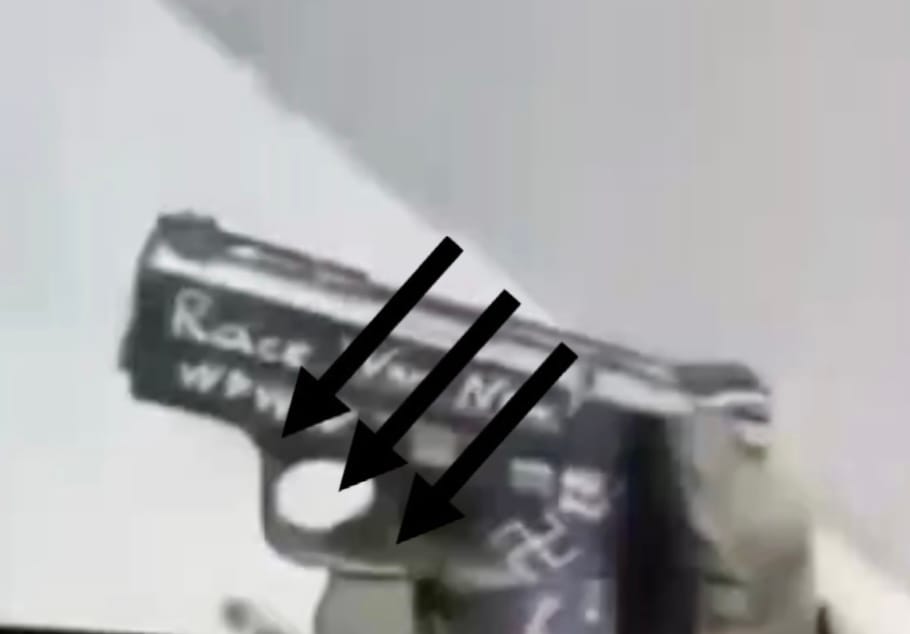
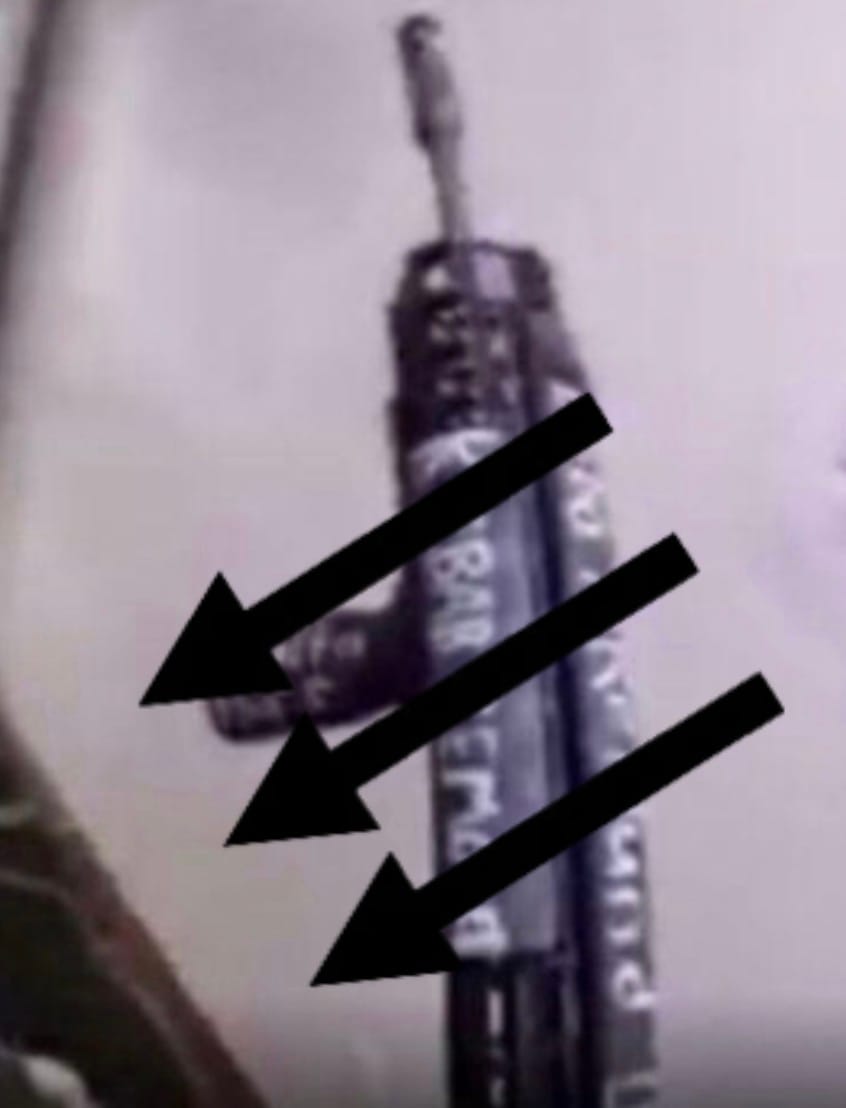
Soon after the release of the livestream footage, an alleged manifesto surfaced. While authorities have yet to authenticate it, the document and accompanying footage have been generally accepted by the research community as authentic.
Taken together, the symbolism, rhetoric, and alleged writings fit into a broader pattern that has become increasingly visible across recent acts of white supremacist violence internationally: a hybrid ideological framework combining neo-Nazi symbolism, accelerationist ideology, online propaganda culture, and the aesthetics of previous mass attacks.
These symbols are not random decorations or isolated references. They function as a shared ideological vocabulary spread across encrypted chats, propaganda channels, manifestos, forums, and various social media ecosystems.
Court records had already documented one shooter’s fascination with Adolf Hitler, mass shootings, and previous white supremacist killers. These macabre obsessions were further exemplified in the developing picture being found among the anti-Muslim writings, Nazi symbolism, and references to racial violence in the materials connected to the attack.
In the manifesto, Muslims are described as needing to be “exterminated,” using the classic neo-Nazi conspiracy of “Great Replacement” to characterize them as weapons used by a Jewish cabal to destroy white populations through immigration.
But as additional material surfaced in the days following the shooting, a broader picture began to come into focus.
Increasingly, contemporary extremist violence is not emerging from traditional organizations or local political groups, but from digital environments where far-right propaganda, irony culture, and white supremacist culture overlap and reinforce one another. The relationship between the two suspects appears to have developed within exactly that kind of online ecosystem.
Additional references included skull masks associated with AWD and The Base, both neo-Nazi accelerationist networks, as well as imagery invoking the Battle of Lepanto, a sixteenth-century battle frequently romanticized within contemporary anti-Muslim and white nationalist propaganda. Similar references have appeared in material connected to previous white supremacist attackers, including the Christchurch mosque shooter, who repeatedly celebrated historical conflicts between Christian Europe and Muslim societies.
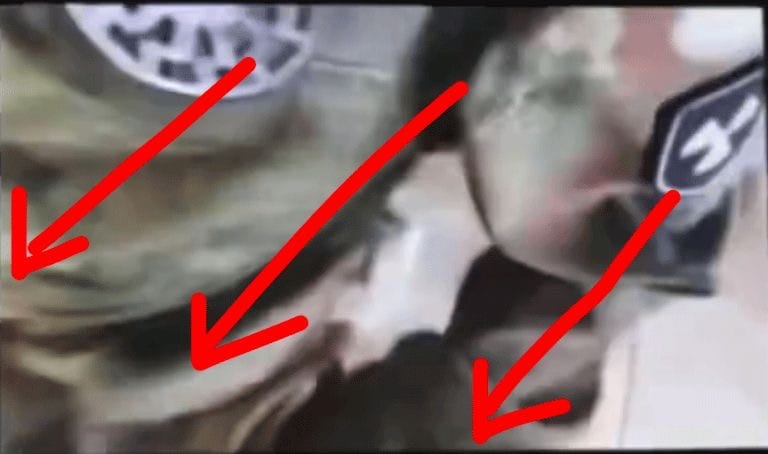
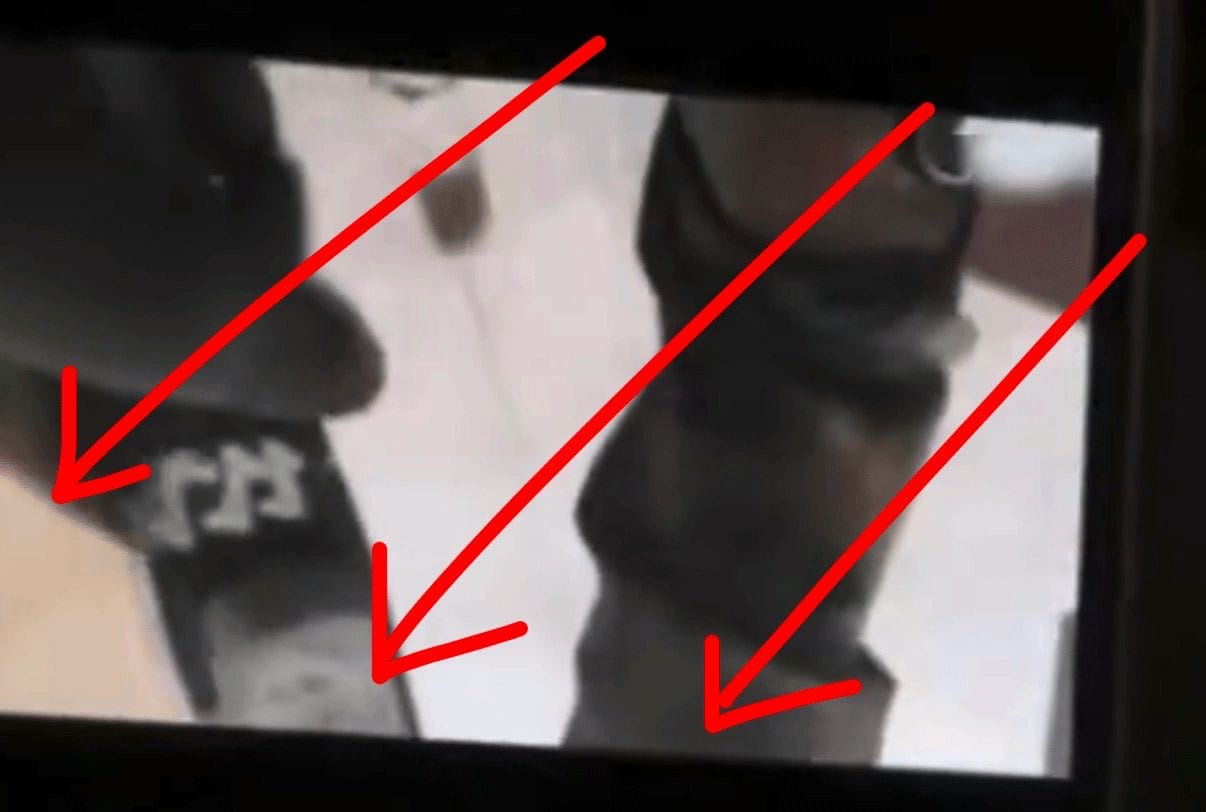
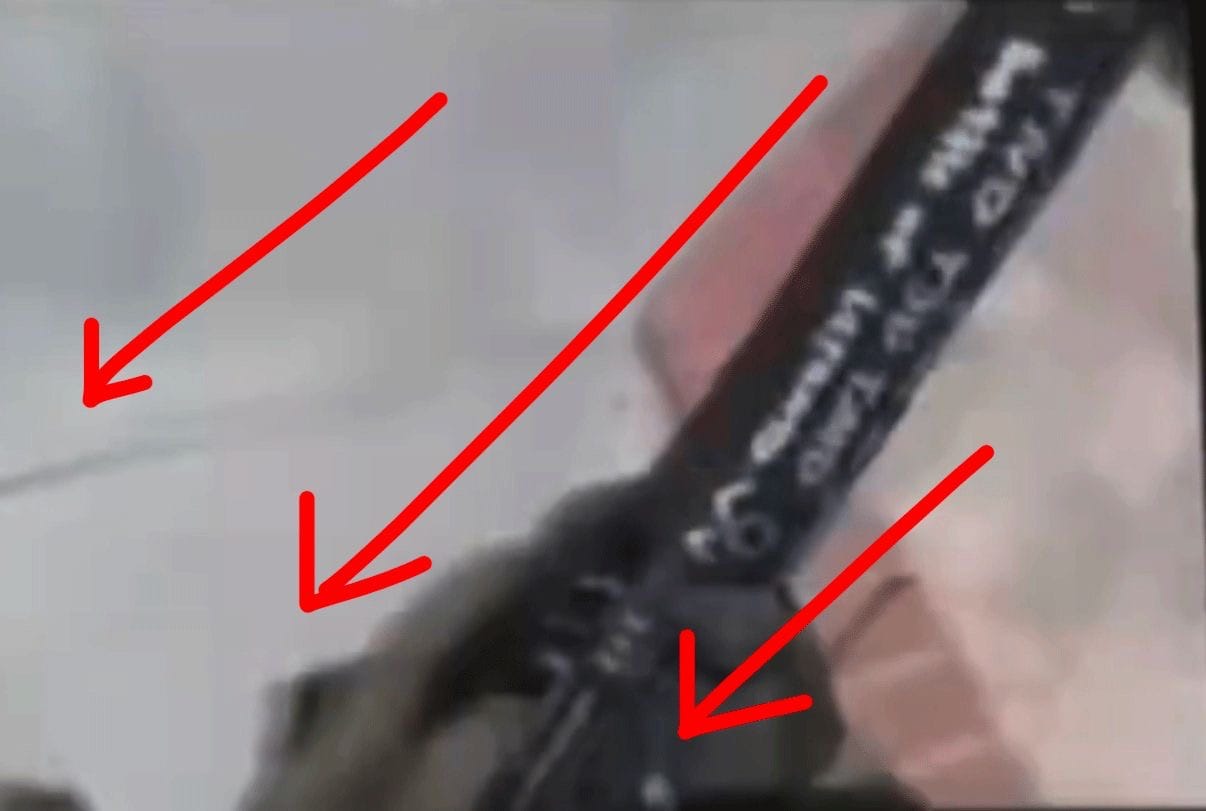
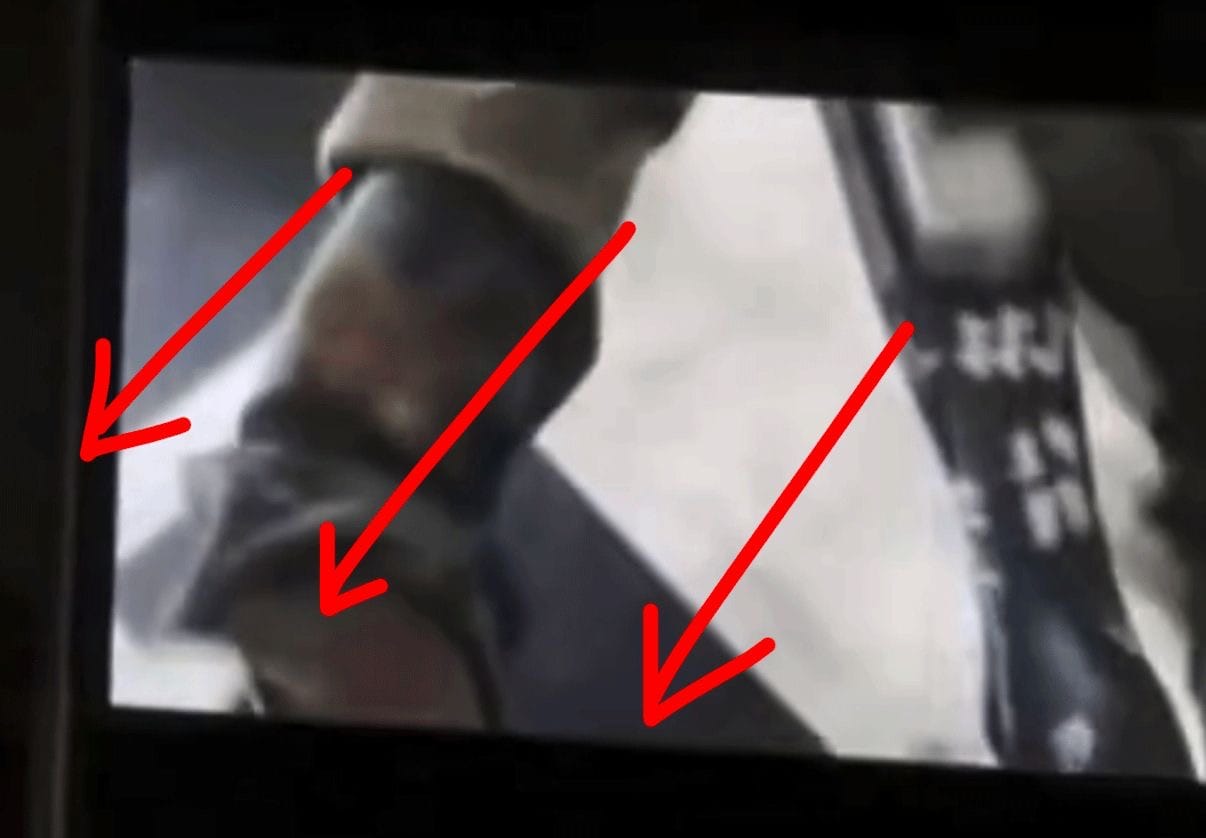
Image 1- Still from livestream showing shooter wearing a sonnenrad/black sun and an Atomwaffen patch. Image 2- Still from livestream showing the symbol for “The Base” painted on his gun. Image 3- Still from livestream showing “TND” written on the side of the gun along with an Othala rune. Image 4- Still from livestream showing The Base symbol and “14 88"
None of these references exist in isolation. They fit squarely within a rapidly expanding ecosystem of neo-Nazi accelerationist violence that has spread across online spaces over the last decade. It is an ecosystem built around the belief that mass killings, racial terror, and social collapse can help bring about a future white ethnostate.
To understand the San Diego mosque attack, it is necessary to understand that ecosystem.
Much of the white supremacist violence we face today no longer operates through a single organization, identifiable chain of command, or even a stable ideological movement. What exists instead is a sprawling online ecosystem where neo-Nazi ideology, accelerationism, internet subculture, propaganda production, and mass violence continuously feed into one another.
The San Diego mosque attack did not emerge from nowhere. Nor did it emerge solely from the actions of two individuals.
The warning signs documented before the attack (admiration for Hitler, fascination with previous mass killers, anti-Muslim and hatred towards Arabs, and Nazi symbolism) reflect ideas that have been circulating through these spaces for years.
The two teenagers who carried out the attack were not the first people to encounter these ideas online, and they will not be the last.
What researchers, journalists, academics, and investigators increasingly encounter in cases like this is not traditional political organizing, but a fluid digital environment where white supremacist propaganda moves constantly between encrypted chats, meme pages, gaming communities, Telegram channels, Discord servers, livestream clips, private group chats, and algorithmically amplified social media feeds.
The boundaries inside these spaces are often unstable. Neo-Nazi accelerationism overlaps with irony culture, trolling, misogyny, incel subcultures, school-shooter fandoms, true crime obsession, and online clout economies. What connects these environments is not formal membership, but participation.
Sign up for We Will Free Us
Independent - Antifascist - Unfiltered
Subscribe
Email sent! Check your inbox to complete your signup.
No spam. Unsubscribe anytime.
Modern white supremacist violence, particularly among the youth, increasingly functions less like recruitment into a traditional organization and more like immersion into a culture where violence is aestheticized, mythologized, memed, and socially rewarded.
In this ecosystem, visibility itself becomes a form of power.
A central ideological thread running through many of these spaces is militant accelerationism, the belief that acts of violence can hasten the collapse of society and create the conditions for a new fascist or white nationalist order. While the concept has existed in various forms for decades, contemporary accelerationism no longer functions primarily as a coherent doctrine distributed through formal organizations. Instead, it operates more like a circulating logic that appears across memes, manifestos, propaganda videos, livestream edits, and fragmented online discussions.
Violence is framed not simply as terrorism, but as catalytic action. The point is not merely to kill. The point is to destabilize, provoke retaliation, generate chaos, inspire copycats, and intensify social fragmentation.
This logic has been heavily influenced by the writings of neo-Nazi James Mason, who advocates for decentralized terrorist violence rather than mass political organizing. Mason’s work became foundational to several accelerationist movements and continues circulating heavily across online white supremacist propaganda networks. Groups such as Atomwaffen Division required recruits to read some of his work, and its influence remains visible long after many of these organizations fractured publicly.
This framework provides a useful lens for understanding many of the references reportedly connected to the San Diego attack. The Atomwaffen imagery, anti-Muslim rhetoric, Nazi symbolism, and admiration for previous mass killers do not point toward random acts of hatred. They point toward a political tradition that increasingly treats mass violence as strategy, propaganda, and performance.
But focusing exclusively on individual groups obscures how the ecosystem actually functions.
For years, Atomwaffen Division received outsized media attention because of its murders, paramilitary aesthetics, and explicit neo-Nazi ideology. The group became synonymous with modern accelerationist terror in the public imagination. Yet researchers studying these networks increasingly argue that Atomwaffen was never truly the center of a hierarchy. Instead, it functioned as one node within a much larger transnational ecosystem built around fluid participation, shared propaganda, and overlapping digital communities. That distinction matters.
Atomwaffen fractured repeatedly after arrests, internal conflict, and public scrutiny. Successor formations emerged, including the National Socialist Order and the National Socialist Resistance Front. Other organizations splintered, dissolved, rebranded, and resurfaced under different names. The Base emerged after the collapse of Iron March, the influential neo-fascist forum that helped incubate numerous accelerationist groups during the 2010s. The Order of Nine Angles, or O9A, organized itself into nexions, or small cells, which repeatedly dissolved and reconstituted itself through new formations and rebrands after attracting law enforcement scrutiny.
Yet the collapse of these organizations did not produce the collapse of the culture that surrounded them. The propaganda, aesthetics, manifestos, symbolism, and online networks all survived.
That continuity matters because modern white supremacist violence is increasingly sustained by culture as much as organization. The network survives because its infrastructure is social and digital rather than organizational.
Researchers analyzing these movements have increasingly described the modern accelerationist landscape as “multi-node.” Instead of a centralized command structure, it operates through overlapping communities that exchange propaganda, tactics, aesthetics, and ideological material across platforms. Membership fluidity is common. Individuals move between channels, chats, and subcultures without clear boundaries separating them. What persists is not a single organization, but a constantly mutating network.
This is visible not only in ideological material, but also in aesthetics. The skull mask, black tactical clothing, stylized propaganda photography, military poses, distorted Nazi iconography, and specific visual editing styles now function almost like a transnational extremist visual language. These aesthetics are repeatedly reproduced across Telegram channels, Discord servers, edits, manifesto graphics, livestream screenshots, and “fan art” surrounding previous attackers. Ideology is no longer only read. It is performed.
The visual language itself becomes participatory. Posting gear photos, sharing patches, recreating attack imagery, filming stylized videos, and circulating clips from previous massacres all function as forms of social belonging inside these spaces.
That participatory aspect is critical to understanding why modern white supremacist extremist violence increasingly resembles fandom culture as much as traditional political organizing.
Within the broader accelerationist ecosystem, one of the most influential propaganda environments to emerge in recent years has been what researchers often refer to as the Terrorgram network, a decentralized collection of Telegram channels dedicated to producing and distributing white supremacist propaganda.
"The Terrorgram network emerged on Telegram in the late 2010s, following the deplatforming of various white supremacist and neo-fascist forums like Iron March and from more mainstream social media. Initially, these channels served as hubs for far-right propaganda, where users shared memes, “Saints culture” materials (iconography that venerates past terrorists), bomb-making instructions, discussions on potential targets, and general discussions of extremist ideology. Over time, certain admins and content producers in the network became more prolific, churning out well-formatted, self-labeled “manifestos,” e-books, and e-zines designed not just for internal consumption but to recruit or incite prospective violent actors around the world.
While Terrorgram at large features hundreds of channels with varying degrees of activity, disorganization, and ideological nuance, one smaller cell within the broader ecosystem rose to prominence for its cohesive propaganda campaigns and the use of uniform branding across multiple channels and networks. This more cohesive group within the Terrorgram ecosystem came to be known as the Terrorgram Collective**:**
“The collective, comprised of a small number of transnational individuals and accelerationists, are collectively responsible for the envisioning, organizing, writing, creating propaganda, and disseminating violent ideological content (such as manifestos) across the broader ecosystem. Content created by the collective inspired the 2022 Bratislava terrorist attack and inspired several others.”” - Marc-André Argentino
The Collective produced highly polished digital propaganda designed not only to reinforce ideology internally, but to inspire future attacks. Their publications promoted decentralized terrorism, sabotage of critical infrastructure, “lone wolf” violence, and livestreamed mass killings designed for maximum media circulation. Several publications explicitly discussed the strategic importance of recording and distributing attacks online in order to inspire future perpetrators.
Understanding this circulation is important because the San Diego attack appears to have moved through many of these same dynamics almost immediately. Long before most people knew the details of the shooting, footage, screenshots, rumors, and manifesto material were already being shared, analyzed, archived, and repackaged across online spaces that have spent years treating previous white supremacist attacks as both political events and internet content.
In other manifestos belonging to the same online ecosystem that WWFU reviewed, they directly encouraged attackers to treat violence as media spectacle. Others blended accelerationist ideology with tactical advice on propaganda dissemination, operational security, and target selection.
The dissemination of these terrorist attacks and preservation of the memory of both the attack and the attacker are central to this culture. At the center of this ecosystem is what researchers call “Saints Culture.”
Within these spaces, previous mass killers and far-right terrorists are transformed into symbolic figures through edited videos, memorial graphics, iconography, anniversary posts, and quasi-religious imagery. Attackers are reframed as “martyrs” or “saints” acting in defense of race or civilization. Manifestos and attack footage are archived, repackaged, and redistributed continuously across channels and subcultures.
This process fundamentally alters how violence is understood inside these communities. Mass attacks are no longer treated simply as events. They become media artifacts, mythology, and participatory content streams. Future attackers are encouraged to see themselves not as isolated individuals, but as entering an existing historical lineage. These “saints” then continue to be referenced in other manifestos as inspiration.
The Christchurch mosque shooting represented a major turning point in this transformation. This livestreamed massacre demonstrated how modern attacks could function simultaneously as terrorism and internet spectacle. The attack’s aesthetics, manifesto structure, weapon inscriptions, memes, livestream format, and digital circulation profoundly influenced subsequent attackers, including the Buffalo shooter and numerous others referenced throughout white supremacist online culture.
This is one reason the imagery associated with the San Diego attack drew immediate attention from researchers and observers familiar with contemporary white supremacist violence. But the contemporary landscape extends beyond explicitly ideological neo-Nazi channels.
Over the last several years, researchers have documented the growth of more fragmented and hybridized online subcultures that combine elements of white supremacist ideology, internet trolling culture, shooter fandoms, incel subcultures, and true crime obsession.
One emerging framework for understanding these spaces is what online youth extremist experts Ry Terran and Jean Slater describe as the Soyjak Attacker Video Fandom, or SAVF.
SAVF is not a formal organization. It is better understood as a participatory online subculture composed largely of young users interacting across mainstream and fringe platforms simultaneously. Participants move between TikTok, Telegram, Discord, Twitter, Steam, YouTube, Roblox, Minecraft, niche forums, and encrypted chats while sharing attack edits, memes, propaganda clips, gear photos, livestream footage, and manifestos.
What makes these spaces particularly difficult to analyze is that many participants are not ideologically coherent in any traditional sense.
Some are committed neo-Nazis. Others are driven more by nihilism, alienation, misogyny, loneliness, humiliation, irony culture, or the pursuit of online recognition. These motivations overlap rather than existing separately. The result is a hybridized environment where fascist symbolism, meme culture, incel resentment, school shooter fandoms, and clout-seeking behavior reinforce one another continuously.
Researchers and journalists often struggle with where to draw the line between participation in extremist internet culture and genuine ideological commitment. That distinction matters because many of the symbols, memes, and references circulating through these spaces are frequently dismissed as jokes, trolling, or shock humor.
Ry Terran argues:
“There’s been a lot of discussion about whether participation in extremist meme culture or more nihilistic subcultures means perpetrator has “no ideology,” but usually there’s at least some ideological signaling. There’s a general atmosphere of white supremacy, antisemitism, Islamophobia, and gender discrimination in these spaces that permeates the attitudes of violent perpetrators, even if they don’t consider these concepts to be deeply held beliefs. Even when a perpetrator is primarily motivated by the possibility of internet fame, far-right messages are usually included in their posts or manifesto, and often reflected in their choice of target. If a perpetrator doesn’t sincerely hold those beliefs, the attack still spreads those messages and influences others who may later want to emulate the violence.”
This observation speaks to a broader reality of contemporary extremist subcultures. Participation is often not an either-or proposition. Users may initially engage through irony, memes, or edgelord posturing, but repeated exposure can normalize increasingly explicit forms of white supremacist and accelerationist ideology.The boundaries between “joking,” aesthetic performance, and genuine violent intent become intentionally blurred.
Participants frequently use irony and layered in-group humor to maintain plausible deniability. Bios often include disclaimers such as “parody,” “satire,” or “for legal reasons this is a joke,” even while users circulate explicit fantasies of mass violence or share tactical discussions about previous attacks.
Despite this performative ambiguity, researchers and investigators have repeatedly documented cases where individuals embedded in these subcultures later carried out real-world attacks or attempted attacks.
What emerges is not simply radicalization in the traditional sense. It is socialization into a digital culture where violence becomes normalized, aestheticized, and rewarded.
This dynamic overlaps heavily with what researchers describe as the True Crime Community, or TCC, a sprawling online ecosystem where fascination with serial killers, school shooters, and mass violence increasingly intersects with white supremacist propaganda networks. These spaces often frame themselves as analytical or research-oriented, but the line between documentation and glorification frequently collapses.
Within these communities, status is often tied to proximity to violence. Users gain recognition by being the first to identify attackers, collect manifestos, archive footage, or leak personal information connected to mass killings. In some cases, attackers appear to anticipate this process in advance. They prepare manifestos, gear photos, selfies, reading lists, and stylized propaganda packages before attacks occur.
These materials function almost like pre-assembled press kits designed for rapid online circulation.
This circulation process has become so normalized that entire micro-economies of attention now form around mass violence events in real time. Users compete for clout through early access, reposting, and insider knowledge. Journalists and researchers can unintentionally become part of this amplification cycle when unverified material from these networks enters mainstream reporting ecosystems.
This is one reason why researchers increasingly emphasize that the threat is not simply ideological radicalization, but media circulation itself. Modern attacks are designed with circulation in mind from the outset. According to Terran:
There is a "broad understanding in subcultures that revolve around violence that any writings or visual materials connected to an attack will be used in video edits and fan art that glorify the violence. Attacks are often planned in advance with those future fan edits and news media coverage in mind. Perpetrators will often prepare a distinctive outfit, post photos of weapons and gear, share a musical playlist, and take selfies that mimic past attackers.
Manifestos often include provocative and sometimes misleading content intended to spark anger, confusion, and arguments, following the format of Brenton Tarrant who had credited people who were unrelated to the attack. More recently, manifestos often reference memes that are in-jokes to specific friend groups, or meant to appeal to already established fandoms, like the Ongezellig and Ashley Graves references from the San Diego attackers. Most people in those fandoms would condemn the violence, but someone in the fandom who is already inclined towards violence will find an additional layer of connection to the attackers.
People reporting on the violence should be cautious about statements that might be intended as a joke, and be aware that the ideological beliefs expressed may not be consistent. News media should be aware of the types of images and writings that the perpetrators wanted to be spread in the aftermath of the violence, and limit sharing those materials or taking the most sensationalist interpretation of the content."
Livestreaming has become particularly central to this evolution. The attack is no longer only physical violence. It is also performance, recording, documentation, and distribution. GoPros, body cameras, edited clips, Discord streams, encrypted video sharing, and staged photographs all become part of the architecture of the event itself.
For some attackers, the desire for recognition appears inseparable from the violence.
This pattern appears repeatedly across writings associated with recent attackers. Many describe themselves as invisible, humiliated, unattractive, unwanted, or socially erased. Some explicitly state they do not want to “disappear as losers.” Others write about wanting to be remembered, studied, or immortalized alongside previous mass killers.
In these cases, ideology often functions less as the root cause and more as a framework that gives structure, symbolism, and historical meaning to deeper feelings of alienation and resentment. That nuance is important.
Reducing these attackers to simple caricatures of “evil Nazis” can obscure how contemporary online ecosystems actually operate. Not every participant inside these spaces is ideologically sophisticated. Some drift in through gaming culture, meme communities, incel forums, or true crime fascination before gradually encountering more explicitly neo-Nazi and white supremacist material. Others become radicalized primarily through social reinforcement, attention economies, and participatory online dynamics rather than formal political indoctrination. Radicalization today is increasingly cross-platform and ambient. But as Terran stated, even if the perpetrator’s main motivation is fame rather than the far-right messaging, that ideology is still amplified and influences others.
It no longer occurs solely in hidden fringe forums. It unfolds across interconnected digital environments where mainstream platforms and fringe networks continuously feed into each other. TikTok edits reference Telegram propaganda. Discord servers circulate attack footage. Gaming spaces overlap with fascist and white supremacist meme culture. Livestream clips spread onto major social platforms within minutes.
No single platform contains the process in its entirety. The ecosystem functions through movement. And because of that, dismantling individual groups rarely dismantles the broader network itself. The infrastructure is now cultural, algorithmic, social, and participatory all at once.
For every individual who ultimately commits mass violence, there are hundreds more participating in the ecosystems that preserve, circulate, and normalize it: reposting attack footage, sharing manifestos, recreating aesthetics, producing propaganda, and transforming previous acts of terror into cultural reference points.
That broader environment is important because it creates continuity between attacks, the violence is not isolated, but is cumulative. And increasingly, the final stage of that process is not merely the attack itself, but its circulation.
By the time the public sees fragments of a manifesto, screenshots from a livestream, or clips from an attack, the material has often already moved through private chats, encrypted platforms, fandom networks, and countless social media platforms. The attack becomes content almost immediately, processed, edited, mythologized, and redistributed in real time.
Understanding the San Diego mosque attack requires understanding that process. The violence did not end when the shooting stopped. In its aftermath, a good deal of the chatter within these networks has been to mock the shooters for their obsession with fringe fandom’s, racial impurity, and a low kill count. Gruesome Soyjak-style memes making fun of their suicide quickly began to circulate.
But there have also been a few “terrorwave” video edits produced that praise the shooters, participating in the lore building. And it isn’t just confined to lone edgy teenagers making short CapCut edits. There is an obscure corner of militant accelerationism that has openly embraced the San Diego shooters, immediately adding them to the “Saints Calendar.”
This isn’t the first time that the larger SAVF network has poked fun at mass shooters who rose from their ranks. But like this most recent one, those events also had a small number who took to obsessing over the shooters.
That’s how this works. Fandoms form. And even the haters feed the notoriety with their hating.
Disrupting this phenomenon of hyper-online, militant, and often white supremacist, accelerationist youth fandom is tricky. The traditional antifascist method of unmasking, naming and shaming, is problematic when dealing with a lore-building cult that is largely made up of minors.
But the first step, as always, is understanding what we are seeing.
Author’s Note
This work is only possible because of the sustained, often invisible labor of antifascist researchers, journalists, and academics who continue to track, expose, and contextualize far-right violence in real time.
Much of this work involves pulling propaganda, organizing, and communication from encrypted chats, niche forums, and social media, and bringing it into public view so it can be examined and understood.
In a media environment where misinformation spreads quickly, this work helps preserve context and continuity across events that are often treated as isolated.
“Welcoming fascists to the sunlight” means documenting this violence, naming the networks behind it, tracing how these ideas spread, and refusing to look away.
Communities are safer when this work exists, not because expose alone stops violence, but because silence and confusion allow it to spread.
To everyone doing this work: thank you for your time, care, and persistence.
Suggested Reading
[Examining the Soyjak Attacker Video Fandom (Part I)
Analysis of SAVF, a hybrid threat network connected to Terrorgram Collective and com; tied to planned attacks & school shootings on 4 continents.
 From The DepthsJean Slater
 ](https://www.maargentino.com/examining-the-soyjak-attacker-video-fandom-part-i/?ref=wewillfreeus.org)[Inside Terrorgram: A Strategic Look at the Collective’s History — ARC
A historical threat analysis of the Terrorgram Collective that promotes militant accelerationism to incite lone-actor terror attacks globally.

 ](https://www.accresearch.org/accreports/inside-terrorgram-a-strategic-look-at-the-collectives-history?ref=wewillfreeus.org)[The Lineage of Violence: Saints Culture and Militant Accelerationist Terrorism - GNET
 GNETJonathan Lewis
 ](https://gnet-research.org/2023/04/27/the-lineage-of-violence-saints-culture-and-militant-accelerationist-terrorism/?ref=wewillfreeus.org)[TikTok Serving as a Refuge for a Fandom Encouraging the Next School Shooters
TikTok is becoming a new hub for the “True Crime Community” (TCC), an online fandom that glorifies mass killers through memes, edits, and AI-generated videos. As the subculture has migrated from platforms like Tumblr, its networks have been linked to a growing number of recent plots and attacks, often involving teenagers drawn into spaces that normalize and aestheticize mass violence.
 Global Project Against Hate and ExtremismGPAHE
 ](https://globalextremism.org/post/tiktok-serving-as-a-refuge-for-a-fandom/?ref=wewillfreeus.org)
Learn more about far right threats and recognizing far right groups, symbols, and dog whistles here:
[FAR RIGHT THREATS
A Reference Guide For Recognizing Far Right Groups, Symbols, and Dog Whistles
 We Will Free UsWe Will Free Us
 ](https://www.wewillfreeus.org/farrightthreats/)[San Diego Mosque Attack: What We Know So Far
Breakdown of the San Diego mosque attack, early evidence, and initial findings as investigators piece together what happened on May 18.
 We Will Free UsAlissa Azar
 ](https://www.wewillfreeus.org/sandiegomosqueattackpt1/)
From We Will Free Us via This RSS Feed.