

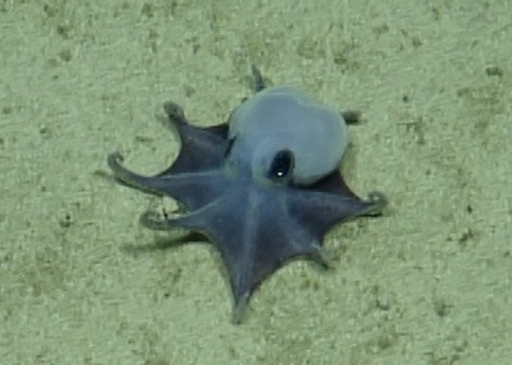
While on a deep-sea expedition in the Galapagos in 2015, scientists found a golf-ball sized, short-armed blue octopus. In a recent study, they confirmed that it’s new to science. The newly described octopus, named Microeledone galapagensis, was first sighted with a remotely operated vehicle (ROV) near an underwater mountain, roughly 1,773 meters (5,800 feet) below the Pacific Ocean surface close to Darwin Island. Expedition researchers from the Charles Darwin Foundation and the Galápagos National Park Directorate collected it with their ROV. They saw two more octopus individuals on video. The body of the collected specimen was preserved and sent to octopus expert Janet Voight at the Field Museum in Chicago, Illinois, U.S. Voight and colleagues at the museum scanned the octopus using computed tomography (CT) to create a 3D model of the individual. The researchers then used the CT model to examine its internal organs and mouth parts. “When you describe a new species of octopus, you have to look at all the parts, including the mouth, the beak, and the teeth. And to see those things, you have to cut the specimen open. We only had the one specimen, so I didn’t want to take it apart,” Voight said in a press release. A comparison of the blue octopus’ parts with those from other octopus species revealed that it was a new-to-science species. Unlike many octopuses, Microeledone galapagensis is small, squat, and has short, stubby arms with few arm suckers. “One of the interesting questions about…This article was originally published on Mongabay
From Conservation news via This RSS Feed.
those islands are a funky critter spawnpoint