

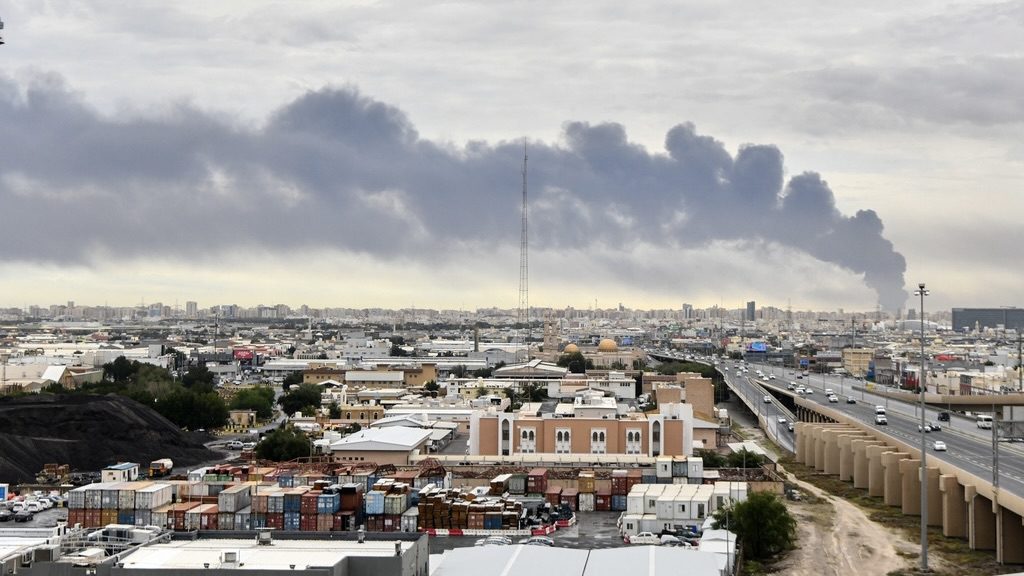
At least one person was reportedly killed and dozens more were injured in the attacks in Kuwait that Iran claimed it launched on Wednesday, June 3. Iran claimed its missiles and drones were targeting US air bases in Kuwait and the headquarters of its fifth fleet in Bahrain.
Kuwait claimed one of the terminals of its international airport was damaged in the Iranian strikes, leading to the suspension of flights for a while.
In a statement issued later, the Islamic Revolutionary Guards Corp (IRGC) claimed that its first retaliation (after Tuesday’s attack on its vessel in the Persian Gulf) targeted a vessel jointly owned by the US and Israel.
However, the US carried out follow up air strikes on its communication tower in Qeshm Island, which led to a renewed Iranian response on Wednesday.
“In response to this aggression [attacks on Qeshm Island], their air and helicopter base stationed in one of the countries of the region, as well as the headquarters of the US fifth fleet, were subjected to missile and drone attacks,” the IRGC claimed.
“We had previously warned that any act of aggression would be met with a different and heavier response, and we acted accordingly. These responses should serve as a lesson,” the IRGC declared.
US Central Command denied attacks on its fifth fleet base in Bahrain, claiming Iran’s ballistic missiles failed to reach its target.
Following the Iranian attacks, Kuwait declared two Iranian diplomats persona non grata on Wednesday, asking them to leave the country within 24 hours.
Iran warned of more such attacks if the countries in the region keep allowing their land and air space to be used for US attacks.
Most of the countries in the region, including Oman, condemned Iran’s attacks on Kuwait and Bahrain.
Abbas Araghchi, Iran’s foreign minister, defended the Iranian strikes, claiming they were launched in “self-defense” on “sites the US is permitted to use to attack civilian shipping and violate the ceasefire.”
Uncertainties around talks
Despite the recent phase of strikes and counter strikes, US President Donald Trump claimed on Wednesday that talks with Iran are progressing well and the situation in the Strait of Hormuz “will resolve itself fairly quickly.”
Trump also claimed that Iran has already agreed to not have nuclear weapons and he is even ready to meet Iran’s Supreme Leader Ayatollah Mojtaba Khamenei at some point in time.
Iran has repeatedly said that it does not want to develop a nuclear weapon and its nuclear program is only for civilian purposes.
Iran has also denied having any discussions about the future of enrichment in the country and the fate of its highly-enriched uranium during the current round of talks with the US.
Iran has asserted that all such discussions would depend on the success of the current round of talks to end the war and start a process of “confidence building.”
Trump’s expression of willingness to meet Mojtaba Khamenei is widely considered “unrealistic” given the fact that the US has declared “regime change” to be one of the central objectives of the war on Iran launched on February 28.
Contrary to Trump’s claims, Iranian Tasnim News Agency denied any progress was made in talks with the US in recent days, with Iran refusing even to reply to US messages.
Last week there were high expectations for the finalization of a peace deal between Iran and the US. However, there has been no clarity on the progress in the last couple of days with the US launching fresh strikes inside Iran and imposing new rounds of sanctions.
Iran has retaliated to those strikes mostly targeting US bases in the region and its vessels in the Persian Gulf. It has claimed to have downed some of the US drones as well.
On Monday, Iran had declared that there will be no peace deal with the US until there is a ceasefire in Lebanon as well.
Read more: Iran: No deal with US unless Israeli attacks on Lebanon stop
Following the Iranian declaration, Trump had announced there would be no Israeli attacks in Lebanon. He made the announcement after a phone conversation with Prime Minister Benjamin Netanyahu.
Netanyahu later issued a statement contradicting Trump’s claims declaring that Israel will continue to attack targets inside Lebanon.
According to various reports, scores of Lebanese were killed and wounded in fresh Israeli attacks on Wednesday.
elevation , June 5, 2026
From BT News via This RSS Feed.