

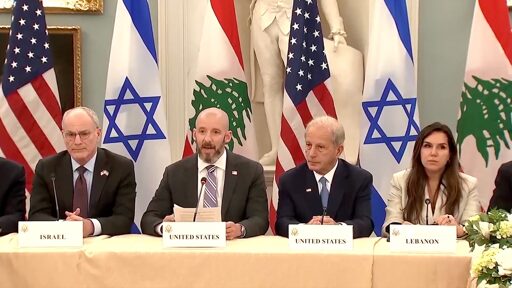
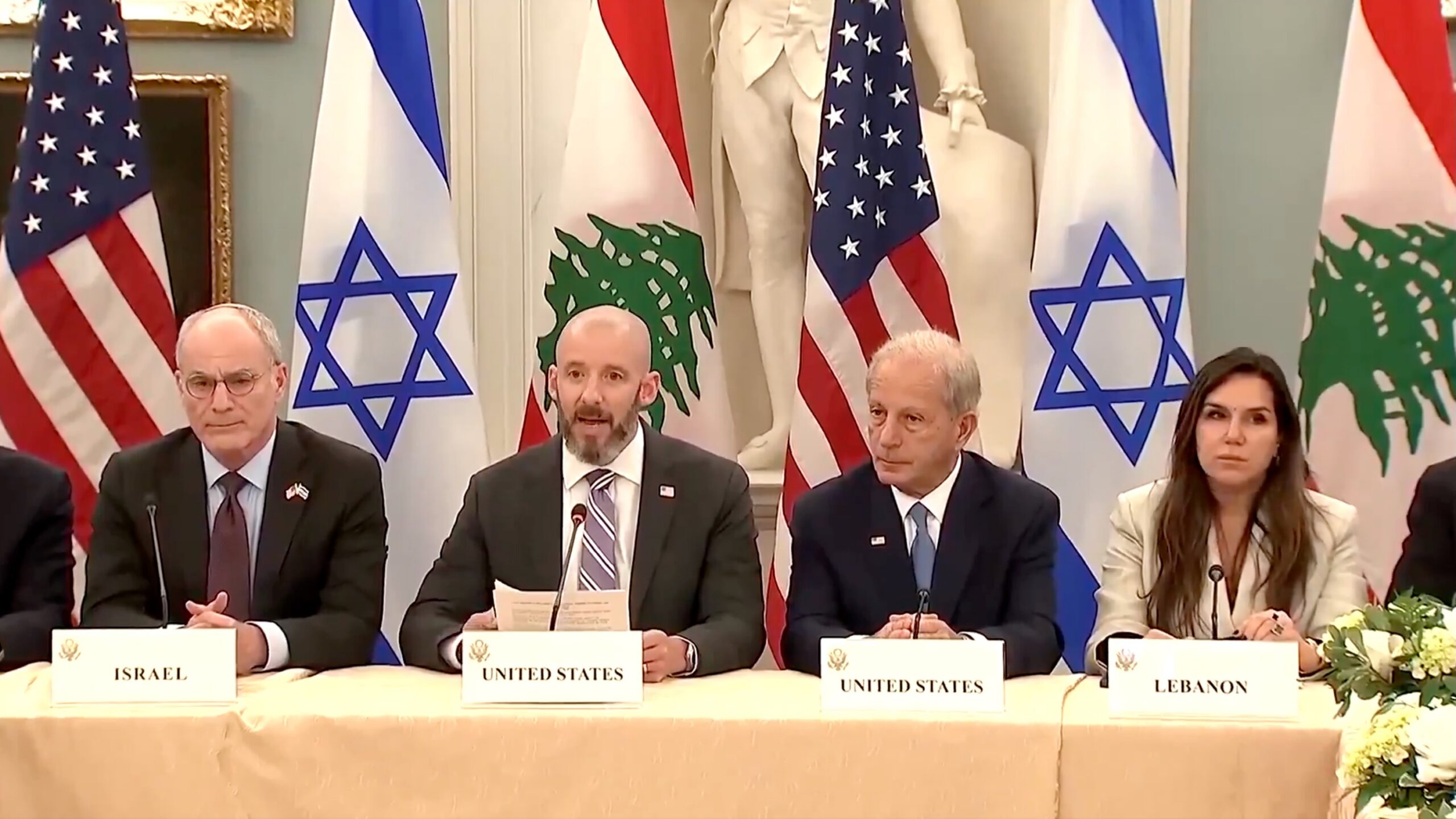
The United States, the Lebanese State, and Israel issued a joint statement on Thursday, June 4, announcing that Beirut and Tel Aviv agreed to the implementation of a conditional ceasefire.
The agreement was reached after weeks of US-mediated direct talks between the two countries, which sparked the indignation of the Lebanese grassroots, who for decades opposed all forms of normalization with the Israeli occupation.
The agreement stipulates a complete cessation of fighting by Hezbollah and the evacuation of the Lebanese resistance group fighters from the South Litani Sector. It also demanded “the dismantlement of non-state armed groups, and the prevention of their re-emergence.”
The swift creation of “pilot zones,” where the Lebanese Armed Forces will take exclusive control of the territory, with no presence of “non-state actors” was among the primary terms of the pact.
The statement uses inflammatory language that obviously aims to incite the Lebanese people, and peoples of the West Asia region against Hezbollah and Iran.
On the one hand it reiterated a previous statement of US Secretary of State Marco Rubio, in which he described Hezbollah as “an enemy of Lebanon” besides being an enemy of the US and Israel. On the other hand, it accused Iran of undermining stability across the region.
The statement also pointed out that the Lebanese and Israeli delegations are scheduled to resume political and security discussions for reaching a “comprehensive agreement” in the week of June 22.
The ceasefire could come into force within 24 hours, says Joseph Aoun
Lebanese President Joseph Aoun told reporters on Thursday that the implementation of the ceasefire agreement “could begin within 24 hours” after receiving final approval and guarantees by all concerned parties, including Hezbollah.
Aoun added that US President Donald Trump is “the direct guarantor of the agreement’s implementation”, asserting that the agreement constitutes “the last chance” that may pave the way for a “final and comprehensive ceasefire”. The Lebanese president further warned that each party would bear responsibility in case of not being responsive.
Sheikh Naim Qassem slams the agreement as a “submission to the Greater Israel project“
For its part, Hezbollah rejected the announced agreement, insisting that the ceasefire should be comprehensive, by ensuring the cessation of the Israeli aggression on all parts of the country, including southern Lebanon, and the complete withdrawal of the Israeli Occupation Forces (IOF) from all the Lebanese territories.
Hezbollah Secretary General Sheikh Naim Qassem, issued a statement on Thursday denouncing the announcement of the agreement, which he said “outlines the basic principles as seen by America and Israel for Lebanon’s submission to the ‘Greater Israel’ project.”
The Lebanese resistance leader confirmed that the outcome of “the futile, humiliating, and disgraceful direct negotiations imposed upon Lebanon” were “rejected entirely by broad segments of the Lebanese people.”
The head of Hezbollah further cautioned that “making the disarmament of the Resistance the primary objective of any agreement means eliminating Lebanon’s strength and creating an existential threat aimed at the destruction of its resisting people.”
He also pointed out that the agreement threatens Lebanon’s integrity and stability, and aims to sow discord among the Lebanese for the benefit of Israel.
Qassem affirmed that the pact would allow Israel “to achieve through politics what it failed to achieve through war.”
Al-Jamaa al-Islamiyya rejects the agreement as vague and broadly worded
The Al-Jamaa al-Islamiyya was among the Lebanese resistance groups that rejected the agreement.
The group condemned Washington’s statement about the agreement, because of its “ambiguous, broadly-worded and imprecise language that would be interpreted in multiple ways, raising legitimate concerns about circumventing Lebanese national rights”.
Moreover, the group asserted that “any understanding or agreement that does not clearly and explicitly stipulate a comprehensive and immediate ceasefire, a halt to all air, land and sea assaults and violations, a halt to the policy of assassinations, a complete and unconditional withdrawal from all occupied Lebanese territories, and the release of prisoners and detainees, cannot be considered a just or sustainable settlement. Rather, it remains an incomplete agreement that provides the enemy with a new opportunity to maneuver, buy time and complete its aggressive plans.”
Zoe. , June 5, 2026
From BT News via This RSS Feed.