

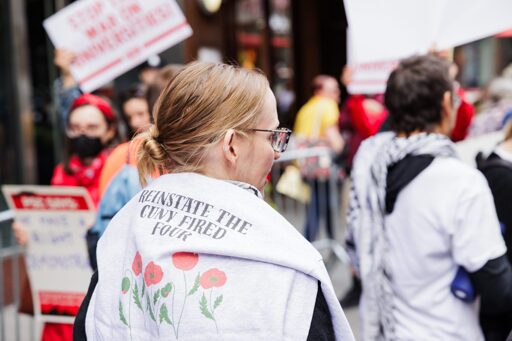
One year ago, four adjunct faculty members at Brooklyn College, known as the “Fired Four,” received letters of non-reappointment for the fall semester, and one was fired from her summer class. This occurred even though their department chairs wanted to retain them. What all four had in common was their advocacy for Palestine, their status as adjuncts, and their participation in the Professional Staff Congress (PSC), the union representing faculty, staff, and graduate assistants at the City University of New York (CUNY)’s 26 colleges. The union, alongside students and other community supporters, has been fighting hard for their reinstatement and against this “new McCarthyism.” Their efforts have included organizing several protests, distributing flyers to spread the word, and sending thousands of letters to CUNY officials. Three of the four were reinstated for the spring 2026 semester, and one, “the Fired Fourth,” continues to fight for her job.
In response to what happened to the Fired Four, as well as to “Don’t Say Gay” bills in other states and the many other faculty members fired for pro-Palestine speech and union activity across the country, two state legislators have proposed a new bill. If passed, this bill will further protect academic freedom for instructional staff at public higher educational institutions statewide. The bill was jointly introduced by Diana Moreno (a DSA member who was elected to Zohran Mamdani’s seat in the state assembly after he became mayor) and Julia Salazar (also a DSA member, who was elected to the state senate in 2018).
What Does the Bill Say?
The bill establishes public higher education workers’ right to submit alleged academic freedom violations to binding arbitration with the employer. This means the university could be compelled to reinstate fired workers with backpay or to drop other disciplinary proceedings against a worker.
Some discussions of academic freedom limit the concept to faculty’s freedom to teach how and what they wish, to discuss controversial matters in the classroom, and to research topics of their choosing with conclusions of their choosing, free from political pressure and prejudice. This bill, following the lead of the American Association of University Professors (AAUP)’s 1940 statement, expands that definition to include “extramural speech” (that is, speech unrelated to one’s work responsibilities, such as a speech made at an off-campus protest or on a social media post on one’s personal account) and “intramural speech,” such as statements made at a faculty meeting or at an on-campus protest.
The bill also includes language applying the academic freedom protections to “faculty, librarians, and other staff.” This is important because academic freedom is rarely extended to nonfaculty positions, and the PSC’s own collective bargaining agreement applies academic freedom to staff only insofar as their jobs involve teaching, research, selection of educational materials, and formation of academic policy. This prevents staff from participating in the academic community — intramural discussions — in the same way that students and faculty can, and further cements staff as a separate tier of workers. With fewer protections on campus, staff are expected to continue making the university machine run without weighing in on the direction in which it is running, even when faculty and students are organizing against it.
What Does This Mean?
This means the citywide movement for the Fired Four is having an impact beyond the reinstatement of the Three.
A group of CUNY archivists, who met at a Fired Four event at Brooklyn College, were inspired to create a research guide exploring “red scares at CUNY.” In April one of the Fired Four did a joint event with Tom Atler (fired from Texas State University for his comments at a socialism conference), linking their struggles and bringing more attention to both firings. The reinstatement campaign has brought hundreds of CUNY students, faculty, and staff together, forming new social and organizing relationships and strengthening old ones.
James Davis, the president of the PSC and a faculty member at Brooklyn College himself, says an academic freedom law has been in the works since before the Four were fired. But according to the union’s newspaper, he also believes that “the flashpoint of the Fired Four has rightfully made academic freedom a bread-and-butter issue for academic unionists” by concretizing and humanizing the stakes of the issue while making it more urgent.
Even though the bill existed beforehand, it’s entirely possible that the ongoing force of the campaign pushed it through the final drafting stages to be formally introduced to the legislature one year after the Four received their notices. The official justification for the Senate version of the bill opens with a discussion of the Four before connecting their struggle to those fired in other states for Palestine, for union organizing, and for teaching LGBTQ+ topics. It returns to issues of pro-Palestine speech and the particular precarity of non-tenure-track faculty later in the rationale section.
The bill is being considered by the State Assembly and Senate committees on higher education. Given many politicians’ (including the governor’s) open hostility toward pro-Palestine faculty, and the reluctance of many more to take a stand for fear of backlash, it is unclear how much support the bill will receive from other legislators or how fast (if at all) it might become law. For the bill to have any chance at success, it will need a continued united movement of both public sector higher education workers and our private sector siblings acting in solidarity, insisting on the need for academic freedom and for the reinstatement of our colleague, the Fired Fourth.
The post New York Legislators Propose “Academic Freedom Protection Act” appeared first on Left Voice.
From Left Voice via This RSS Feed.