

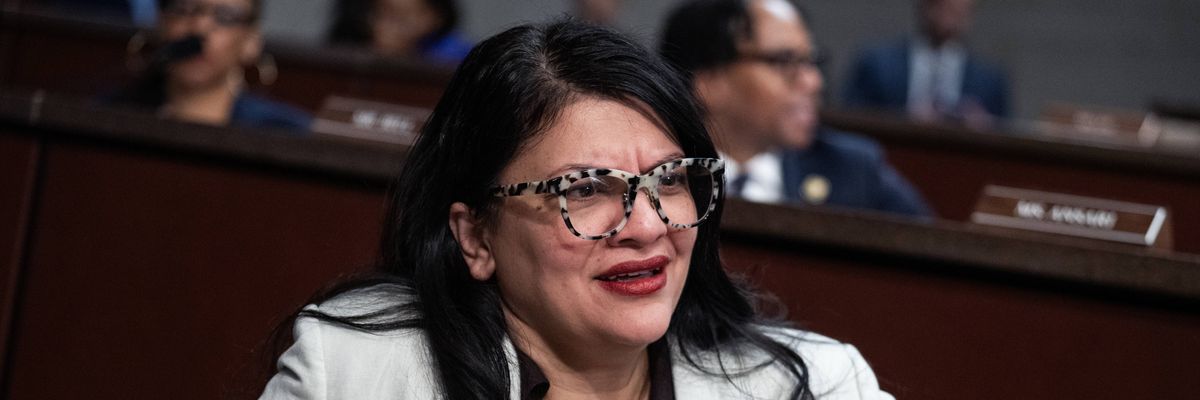
House Democratic leader Hakeem Jeffries helped Republicans tank Rep. Rashida Tlaib’s war powers resolution to limit US military involvement in Lebanon on Thursday, holding up the effort to curb the conflict for at least another several weeks.
Despite Israel’s invasion of Lebanon pushing deeper, with more than 3,500 people killed and 1.2 million displaced since early March, the Michigan Democrat’s resolution was defeated in a 324-92 vote, with a large number in her own party joining Jeffries (D-NY) and the Republican majority against it.
In a joint statement shortly ahead of the vote on Tlaib’s resolution, House Minority Leader Jeffries of New York, along with Whip Katherine Clark (D-Mass.), and Caucus Chair Pete Aguilar (D-Calif.), said: “We stand with the Lebanese people, the government of Lebanon, and the Lebanese Armed Forces in their efforts to live peacefully and defeat Hezbollah." The statement included no mention of Israel.
The lawmakers said they’d support a different resolution introduced by Tlaib on Wednesday, which was crafted in tandem with Rep. Gregory Meeks (D-NY), the ranking Democrat on the House Foreign Affairs Committee.
That resolution likewise required President Donald Trump to remove US forces “from any hostilities in Lebanon” within seven days of passage. But it also added the caveat that it could not be construed to “prevent or limit security cooperation with the Lebanese Armed Forces.”
Jeffries, Clark, and Aguilar said, “There are no US servicemembers involved in combat operations or hostilities in Lebanon.”
However, supporters of Tlaib’s original measure have noted that the US military is heavily involved in Israel’s actions in the country without having boots on the ground.
“The US is actively cooperating with Israel on coordinating strikes, intelligence sharing, and planning, including Trump green-lighting major attacks on Lebanon multiple times,” Janet Abou-Elias, a researcher at the Democratizing Foreign Policy Project at the Quincy Institute for Responsible Statecraft, told Common Dreams.
While the resolution’s passage wouldn’t “end US involvement overnight,” she said, “it fundamentally changes the landscape of accountability” by giving opponents of US collaboration a legal mechanism to conduct oversight.
And while the resolution would not cut off US military aid to Israel, Abou-Elias said Israel could continue its occupation “only for a limited period of time” without US assistance.
“Israel would be absorbing losses while also draining its broader manpower and firepower reserves,” she said. “At some point, the cost-benefit of continuing their occupation without US support would shift.”
Because war powers resolutions are privileged, they can be forced to a vote even without approval from the Republican majority.
However, committees are given 15 days to act before a resolution is forced onto the floor, followed by three days for a House vote. This means it could take until June 21 for the new version to pass. The Senate would also have to pass it, and it would then take another week to go into effect.
“The people of Lebanon can’t wait another month for Congress to act,” Tlaib said on social media following news that the proposal would be voted down. “Every day that we do nothing, 11 more Lebanese children are killed or injured by the Israeli military in this US-supported invasion. Congress must pass today’s Lebanon war powers resolution.”
Abou-Elias said that despite the setback, Tlaib’s introduction of the measure was not a wasted effort.
“Even if the resolution doesn’t pass today, the vote forces every representative on record on the US participation in the attacks on Lebanon,” she said. “That alone has value.”
From Common Dreams via This RSS Feed.