

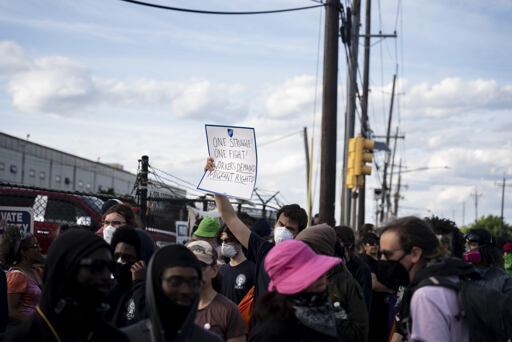
A new front has opened up in the nationwide resistance to Trump’s war on immigrants… New Jersey. Buried deep in the industrial arteries of Newark — an area referred to by residents as the “Chemical Corridor” where the air smells of sewage and toxic waste — is the one-year-old ICE detention center, Delaney Hall.
Community organizations have been fighting to close Delaney Hall since before it even opened. In the last week of May, that fight escalated when around 300 immigrants imprisoned inside the detention center launched a hunger and labor strike to demand their freedom. In fact, the action coincided with hunger strikes in ICE detention centers in quite a few states, but what quickly turned New Jersey into a national flashpoint was the way that day after day, night after night, for an entire week, community members protesting in solidarity outside Delaney Hall were attacked by ICE agents, enduring pepper spray, pepper balls, tasers, and beatings. And they didn’t just endure these attacks. They fought back.
As a participant of the protests wrote for Left Voice:
Normal, everyday people arrived with useful respirators, shatterproof goggles — even homemade shields — to better hold the line, insisting that not another van leave with anyone as the hunger and labor strikers heroically persisted.
In response to these nightly confrontations with ICE, New Jersey governor Mikie Sherrill replaced the ICE agents with NJ state police who spent three nights attacking immigrant rights activists even more aggressively than ICE had. This culminated in the arrest of at least 60 people, including several journalists, who were held in Essex County Jail for over 24 hours without even being charged or processed. Sherrill was aided by the supposedly progressive mayor of Newark, Ras Baraka, who imposed a nighttime curfew and banned all foot traffic within a half-mile radius of Delaney Hall, setting up the pretext for the dozens of arrests on Sunday, May 31.
This has turned New Jersey into a national flashpoint in the fight against ICE. As the confrontation with Delaney Hall shows, the desire of Americans to bring about an end to ICE terror, while temporarily subdued following the powerful struggle in Minneapolis, remains alive. So long as ICE continues to terrorize immigrants across the United States, community opposition could flare up at any moment.
This is exactly why the fight against Delaney Hall has galvanized people across the country, drawing activists from New York, Pennsylvania, and even Minnesota. It is exactly why Sherrill and NJ Attorney General Jennifer Davenport have slandered supporters from other states as “outside agitators” in a desperate effort to isolate New Jerseyans and contain the struggle. And it is exactly why it is essential that those fighting in the state seize the current moment. This requires pursuing a strategy that can build off of the growing attention and solidarity our fight is receiving, and to develop our own collective power independent of the Democrats who are trying to channel our movement back into the safety valves of the courts and the midterm elections.
The Post-Minneapolis Moment
There is no separating the fight in Newark from the one that arose in Minneapolis. Throughout 2025, cities like Los Angeles and Chicago showed that there is an advanced sector of the immigrant rights movement willing to confront the terror that ICE is inflicting on our communities. Minneapolis was the apex and brought the movement to the center of national politics.
But Minneapolis was not just important because of how much attention it received. It was important because of how people fought back. As Daniel Kovacs recently argued in the Left Voice magazine:
Minneapolis was not only the site of the most impressive fight against ICE and the Trump administration. It was the stage where the past, present, and future characteristics of class struggle came into being. It posed questions that go to the heart of the challenges of developing a political force capable of counterattacking the Far-Right, the relationship between community and the workplace, and the reorganization of a political terrain where the interests of the working class and the oppressed come to the fore. The importance of the lessons of Minneapolis to the socialist Left cannot be underestimated.
In particular, Minneapolis showed the potential for an advanced sector of the movement against ICE to reach a much broader community. While this broader community may not be made up of already radicalized and experienced activists, its strength lies in how widespread outrage was able to mobilize a massive force that is deeply touched by the attack on immigrants. Importantly, these broader sectors are not satisfied with the leadership of the Democratic Party which works to keep the movement for immigrant rights within the logic of the capitalist state, betting on negotiations in Congress and elections instead of deepening class struggle.
This work of directing class struggle back into the confines of the Democratic Party is also carried out by union and social movement bureaucracies which have large bases of supporters, but reinforce the logic that the main purpose of our collective power is to pressure politicians with predetermined phone blasts and letter writing campaigns, rather than creating spaces for us to hold collective discussions over strategy for the movement.
This contradiction of a broader community willing to fight and a leadership working to contain class struggle exploded in Minneapolis, with the movement finding creative ways to organize itself from below. Some of the most advanced expressions of this were the whistle networks and ICE-watch networks, the initiatives of rank-and-file teachers organizing with parents to protect and financially support immigrant families, and the emergence of a workers’ assembly which served as a democratic body for those in the movement to debate strategy and vote on proposals for next steps. And while there have been important debates over whether or not Minneapolis carried out an actual general strike, what cannot be denied is that the economic shutdown which took place on January 23 demonstrated that sectors of the U.S. working class are beginning to understand our power as workers and are finding ways to fight as a class — not just for bread and butter demands, but against the oppression which is ingrained in the capitalist system.
The advance of class struggle in Minneapolis did not bring about an end to ICE operations. But it defeated Trump in that he had to retreat and revise his strategy. An aggressive war on immigrants, once the glue that held his coalition together and one of the most popular points of his reactionary program, has rapidly lost support from the broader U.S. public. The contradiction of Minneapolis, however, is that the Democratic Party, seeing class struggle begin to develop outside of their control, collaborated with the Right to de-escalate the situation, with help from their affiliated union and social movement bureaucracies. The result is a post-Minneapolis moment in which people across the country saw the power of class struggle demonstrated in Minneapolis and maintain the desire to fight, but are constrained by a leadership that seeks to keep class struggle from escalating, instead working to channel the anger into electing Democrats in the upcoming midterms.
The Democrats were walking a difficult tightrope, needing to do just enough to appear as if they’re fighting the Far Right, without doing anything that might unleash a new wave of class struggle. New Jersey presents the first post-Minneapolis opportunity to break that containment.
Minneapolis Showed Other States How to Organize from Below
Here in Jersey, we love a good underdog story and we love a good fight. Right now, how we fight has implications for how the movement against ICE develops across the country. The Democrats here know that, which is why after using state police and curfews to attack our protests, both the state of New Jersey and the city of Newark have announced that they’re suing GEO Group, the private prison company that runs Delaney Hall.
The stick failed to contain our movement, so now they’re using the carrot. But we already have an experience of using the courts to try to end ICE detention in our state. In 2021, under immense pressure from combative protests, New Jersey closed three county-run ICE detention centers and sought to ban the last remaining one — Elizabeth Detention Center run by private prison company CoreCivic — by passing a state ban on private prison companies. This was an important concession brought about through the power of our movement, but in 2023 CoreCivic sued New Jersey in order to keep Elizabeth Detention Center open, the Biden administration publicly supported CoreCivic, and local Democrats across the board, including Sherrill, Baraka, Cory Booker, and Andy Kim (to name just a few) were silent, not wanting to cause trouble for Biden’s (and later Kamala Harris’s) presidential campaigns. This paved the way for the Third Circuit Court of Appeals to overrule our state’s ban on private prisons, setting the very conditions for Delaney Hall to open a year later.
It would be absurd to expect the courts, now even more in alignment with the Far Right, to be any more on the movement’s side this time. Many longtime immigrant rights activists in Jersey are already saying they don’t have faith in these new lawsuits and that we need to find new avenues to fight back. Those avenues are already available, and Minneapolis shows us how to use them.
First, we need to learn from Minneapolis how valuable it is when our local struggle becomes an example for the entire country. It bears repeating that Sherrill wouldn’t be coming out so strongly against “outside agitators” if the prospect of this fight reaching beyond New Jersey wasn’t such a serious risk.
In fact, part of what made the organizing in Jersey so strong in 2021 was that it was led by a coalition of activists from New York and New Jersey who had a strong analysis of how ICE detention centers are used to ramp up operations not just throughout our state, but also in New York and Pennsylvania. Now, as New Yorkers and Pennsylvanians join the fight against Delaney Hall, we have an opportunity to rebuild that cross-state solidarity.
Delaney Hall is located where it is because ICE hopes that its worst abuses will be out of sight and out of mind. But the center’s existence has led to an uptick in ICE activity throughout New Jersey. From our cities to our suburbs, we’ve witnessed agents abduct people off the streets, lurk around our schools, and stomp through our neighborhoods. We also know that immigrants are our neighbors. One in four of all New Jersey residents are immigrants, making us second only to California in having the largest immigrant population of any state. For most people in New Jersey, it is impossible to go about life without at least some form of relationship with immigrants.
The result of these conditions is that every week there’s a non-profit, or a church, or just some well-meaning neighbors holding “know your rights” trainings or teach-ins on how to monitor ICE activity. In my town, most small businesses have signs in their windows expressing opposition to ICE. These small expressions paint a larger picture of just how widespread support for the movement is, and that’s why all of Mikie Sherrill’s latest Instagram posts have been flooded with comments calling her a “traitor,” expressing outrage that she attacked protesters, and in some cases, expressing regret for voting for her and calling on her to resign.
Instead of directing broader sectors to call and email politicians who’ve shown no interest in putting up a fight against the Far Right, the movement must find ways to organize the combative desire of our larger communities. This is where the idea of self organization from below in the form of assemblies can provide a way forward. If the mutual aid, socialist, and labor organizations that have been resisting Delaney Hall called an open assembly for people to debate how to carry forward our fight, promoted it, and made sure it was actually run openly and democratically, people would participate. Religious centers and community centers that have held countless know your rights trainings can be used as spaces to host neighborhood assemblies, allowing for even more gatherings in different townships.
And there is already a coalition of unions called Labor Eyes On ICE, which has spent the past year working to bring the working class into the fight. Many of these are small, local unions, but it also includes Rutgers AAUP-AFT and the Rutgers Adjunct Faculty Union, representing workers at the largest public university in our state. They, too, can issue calls for assemblies to organize a fight that unites faculty and students who are interested in confronting ICE together. Importantly, PSC-CUNY, representing faculty and staff at the City University of New York, recently joined Labor Eyes On ICE. They already have the experience of holding an assembly during the Gaza solidarity encampments, meaning that along with bringing solidarity from New York, they can offer valuable insights about the experience of self-organization.
Democrats Aren’t Our Allies
National organizations like DSA have an important role to play in building these broader connections, both with other states and with broader layers of the community and working class. In fact, the North Jersey chapter of DSA has been one of the most consistent groups organizing against ICE in New Jersey, and as the situation escalated outside Delaney Hall, many NYC-DSA members with large social media platforms called on people in the area to mobilize. On June 2, DSA national put out a statement in solidarity with the fight around Delaney Hall. These are important shows of solidarity and they express the willingness of DSA membership to mobilize for immigrant rights and expand the fight.
However, DSA’s relationship with the Democratic Party creates an important obstacle for it to organize the social force we need to defeat ICE with class struggle and class independence. Holding executive positions and boasting internationally recognized public figures within the capitalist state has not turned into a consistent opposition to ICE expansion.
Zohran Mamdani, for example, has not called for the closure of Delaney Hall since taking office. Demanding that he do so is not pie in the sky — it also imprisons New Yorkers, making it an issue for the mayor of New York. And Mamdani previously traveled to Delaney Hall and used his massive platform to publicize the fight against it when he was campaigning for mayor. Now, he has an even larger bully pulpit at his disposal. Jake Ephros, a DSA member and city councilor representing Jersey City’s Ward D, for his part, did visit Delaney Hall in support of the protests and called to close the jail, abolish ICE, and echoed the demand of the movement to “free them all” (all being every single person languishing in ICE jails).
The only way for politicians who call themselves socialists to advance a combative agenda in local legislatures to fight the Far Right is by challenging the Democratic Party, which does everything in its power to stifle our struggle. Key to confronting the Democratic Party is challenging their practice of demobilizing the working class whenever it shows a desire to fight on its own terms. The energy of thousands of DSA members actively standing in solidarity with immigrants must not be turned into paper votes for a party that will continue its anti-immigrant policies but with a friendlier face, thus keeping people with one foot in and one foot out of the graveyard of social movements at a time when people are questioning if the Democrats can ever really represent their interests.
We cannot hope to transform one of the major parties of capital, the architect of the mass deportation policies during the Obama era, into an instrument of our class and of the immigrant rights struggle. That is not the job of capitalist electeds, and it will never be their job.
Free Them All!
Our movement in New Jersey is not homogeneous, as it is not homogeneous in the rest of the country. Some people may want to continue directing supporters to phone blast Sherrill and other politicians. Others may argue that time and energy is better spent talking to co-workers and inviting people out to Delaney Hall. Some will say we can do both (walk and chew gum), while others will argue this sows strategic confusion.
If genuine self-organized bodies emerge, made up by workers, students, neighbors, unions, and our communities, we will need to engage in discussions with even more people and a greater diversity of ideas. But it is through democratic and horizontal debate — discussing which tactics and politics and demands we should adopt to build a national movement against ICE — that we can work through our differences and act together in protests, blockades, picket lines, strikes, and in the face of repression. It is with this momentum, the lessons from past fights in mind, and discussions of strategy, that we can close Delaney Hall, move towards abolishing ICE, take the fight even further by championing full citizenship and rights for all immigrants, and, as we have been demanding for years, FREE THEM ALL!
Our movement does not need to be confined to the practices we’ve tried before. There are opportunities to build out and build from below. There is momentum to carry forward this fight not just in Newark, not just in New Jersey, not just in the region, but across the entire country.
The post The Fight to Close Delaney Hall has Reignited the Movement Against ICE appeared first on Left Voice.
From Left Voice via This RSS Feed.