


By FABIO BOSCO
(Vea el artículo en español abajo)
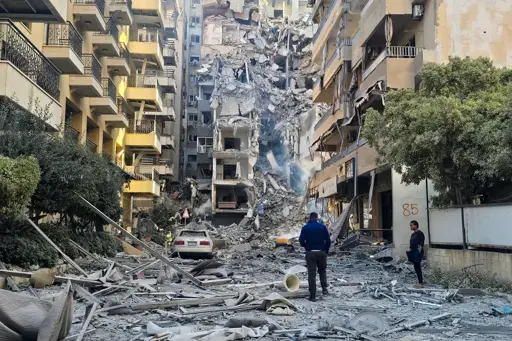
Since March 2, the State of Israel has been carrying out devastating attacks against Lebanon, particularly against the southern region and southern Beirut. There are already more than 3100 dead, over a million displaced, and many areas in ruins. How far will Israel go?
To understand these attacks, one must understand the Zionists’ historical view of Lebanon. On May 16, 1955, Israeli Prime Minister Moshe Sharett described in his diary the meeting he had with Ben-Gurion, then Minister of Defense, and his Chief of Staff, Moshe Dayan:“According to him [Dayan], all that is needed is to find an officer, even if he is only a major. We must win his heart or buy him with money, to get him to agree to declare himself the savior of the Maronite population. Then the Israeli army will enter Lebanon, occupy the necessary territory, and establish a Christian regime that will ally itself with Israel. The territory from the Litani River southward will be fully annexed to Israel…”.
This plan was put into practice in 1978 when Israel invaded southern Lebanon and established a puppet army led by Major Saad Haddad, who was replaced after his death by General Antoine Lahad, both of whom were Maronite Christians. Four years later, Israeli forces advanced to the capital, Beirut, to expel Palestinian forces, defeat leftist forces, and install their ally Bashir Gemayel as president.
Gemayel championed an Israeli agenda: the expulsion of the Palestinians, whom he considered a “surplus population,” and the establishment of an authoritarian government to advance the interests of the Lebanese Christian bourgeoisie.
To achieve this, Gemayel needed time to expel the Palestinians and Syrian forces before normalizing relations with the Zionist state. This was the pact between Gemayel and Israeli General Ariel Sharon in Bikfaya two days before his assassination in the bombing of the building housing his party’s headquarters.
Later, in 1983, the Lebanese resistance, led by left-wing parties, drove Israeli forces out of Beirut and southward. In 2000, the Lebanese resistance, now under Hezbollah’s leadership, expelled Israeli forces and their puppet army.
The second attempt to impose a colonial plan on Lebanon began in October 2024 with devastating attacks on Lebanese territory, particularly the south and the southern outskirts of the capital, as well as towns and cities in the Bekaa Valley. This aggression was suspended at Trump’s behest, but the ceasefire was violated by Israel 15,000 times by March 2, 2026, when Israel resumed large-scale aggression.
In the negotiations imposed by U.S. imperialism, Israel’s objectives are clear: to force the Lebanese government to instigate a civil war to disarm Hezbollah while Israeli forces occupy the south of the country, enabling them to attack any point in Lebanese territory at any time. The Israeli plan would transform the Lebanese government into a representative of its interests in the colonization of Arab lands.
Israel as an outpost of U.S. imperialism
This Israeli plan depends directly on its main sponsor: U.S. imperialism. Since 1973, U.S. imperialism has made the state of Israel its outpost to control the entire Levant region, Iraq, and the Arabian Peninsula. To this end, Israel receives, free of charge, modern weaponry superior to any other in the region, while the United States sells arms to the rest of the region that would be insufficient for countering the Zionists. Since the Obama administration, Israel has received $3.8 billion annually, and even more when necessary, as was the case during the genocide against the Palestinians in Gaza.
Furthermore, U.S. imperialism has developed a series of diplomatic strategies to force Arab countries to normalize relations with Israel. This was the case in 1979 with Egypt, and later with Jordan. Also in 1993, the Oslo Accords transformed the PLO into the manager of the Israeli occupation; and in 2020, the Abraham Accords with the United Arab Emirates, Bahrain, Morocco, and Sudan, as well as ongoing processes of normalization with nearly all of the Arab regimes, with the exception of Algeria, Tunisia, and Kuwait.
This process of expanded normalization was interrupted by the action of the Palestinian resistance, led by Hamas, on October 7, 2023, which put the Palestinian issue back on the international agenda, froze the ongoing normalization negotiations—particularly with Saudi Arabia—and shattered Zionist self-confidence in its security scheme.
Since then, the United States, under Biden and Trump, has provided unconditional support to the state of Israel in the genocide in Gaza, the ethnic cleansing in the West Bank, and the apartheid in the Palestinian territories occupied in 1948.
The failed objectives of the attacks on Iran
Following a 12-day aggression in 2025, U.S. imperialism and Israeli forces launched a brutal attack against Iran on February 28.
Their plan was to impose an allied government to serve U.S. objectives in the inter-imperialist dispute with China, and to eliminate the Iranian regime’s regional ambitions, leaving the field open for Israel’s hegemonic ambitions.
This plan failed due to the success of the Iranian efforts to block the Strait of Hormuz and strangle the international economy. At this moment, there is a stalemate, and Trump is seeking a way out to reopen the Strait of Hormuz to prevent a further decline in the global economy, which would affect the interests of corporations and the U.S. population, as well as those of allied countries.
At the same time, a Plan B is underway on the part of the United States through its representative, Tom Barrack, who is visiting all Arab capitals with the aim of building a regional alliance against Iran. This objective has already made progress with the military alliance under negotiation between Israel and the United Arab Emirates, and with the replacement of the Iraqi prime minister.
Saudi ambitions towards a third way
However, this plan faces resistance. First and foremost from the leader of the Arab League, the Saudi regime, which has its own ambitions to become the hegemonic regional power, as an alternative to Iran and Israel.
Eleven years ago, the Saudi regime launched an unsuccessful war against the Yemeni Houthis, which ended after two drones struck the country’s main oil complex in 2019.
Simultaneously, the regime launched the 2030 Vision to diversify the Saudi economy, making it less dependent on oil. However, this plan failed to secure all the necessary resources for its implementation, and is now being called into question in the wake of the imperialist aggression against Iran, which has hit the Gulf countries hard.
Today, the Saudi regime seeks an alternative regional alliance to Israel and Iran, aligning its enormous economic resources with Turkiye and its arms industry, with Egypt and its massive population, and with Pakistan and its nuclear bombs: an explosive alliance. This alliance remains allied with the United States but maintains excellent relations with Chinese imperialism.
One of this bloc’s key positions is to freeze normalization with Israel, making it contingent on the so-called 2002 Arab Initiative, which demands the recognition of a Palestinian state in the territories occupied by Israel in 1967. The Saudi regime is already active in Lebanon, seeking to prevent the normalization of relations with Israel.
A divided Lebanon
The majority opinion among the Lebanese bourgeoisie and the Lebanese population is opposed to full normalization with Israel. But it is divided along religious lines regarding how to end Israeli aggression.
The Christian bourgeoisie wants a ceasefire agreement with Israel and the disarmament of Hezbollah. The Shiite bourgeoisie rejects negotiations with Israel because they represent Lebanon’s colonialist subordination, and supports the armed resistance currently led by Hezbollah, which needs weapons to carry it out. Between these two positions stand the Sunni and Druze bourgeoisie: they want a ceasefire with Israel without this implying normalization, and a negotiated disarmament of Hezbollah.
The division among the population is somewhat different. According to a public opinion poll conducted by the local channel Al-Jadeed, the majority of Christians, Druze, and Sunnis want Hezbollah to be disarmed, while 87% of Shiites oppose it. As for direct negotiations with Israel, over 70% of Christians and Druze support them. Sunnis are divided: 52% support peace with Israel, but 46% reject it. And 53% of Sunnis reject negotiations between Netanyahu and Lebanese President Joseph Aoun.
Among Shiites, 93% reject it, demonstrating that the rift between Hezbollah and the Shiite population has not occurred, even though there is discontent regarding the party’s various policies, ranging from the 2013 invasion of Syria to the recent Israeli attacks on the country.
As for normalization with Israel, only the Druze are largely in favor: 70% support the opening of an Israeli embassy in Beirut. This rapprochement between the Druze community and Israel occurred following the conflicts in Suwayda between Syrian government forces and the forces led by Sheikh al-Hijri. It is interesting to note the rift between the main Druze leader, Walid Jumblatt, and the Druze population. Jumblatt advocates for a rapprochement between the Syrian government and the Druze population in Suwayda, and a distancing from Israel.
The relationship between the left-wing public and Hezbollah is also complex. Scholar Ziad Majed assesses that the Lebanese left is divided into four groupings: the first supports Hezbollah for its role in resisting Israel. The second grouping harshly criticizes Hezbollah for its domestic policies but prioritizes the struggle against Israel over these disagreements. The third grouping opposes Hezbollah regarding its relationship with Iran and the invasion of Syria, but does not align with anti-Hezbollah forces and believes that Israel is the greatest threat to Lebanon. The fourth group believes that an agreement with Israel is necessary to end the aggression.
Other imperialist countries
Still on the international stage, European imperialism, once highly influential in the Middle East, today limits itself to diplomatic statements criticizing Israeli excesses—such as Israel’s actions in Lebanon—but largely remains silent in the face of the Palestinian genocide while maintaining all its diplomatic and commercial channels with the State of Israel.
China positions itself as an ally of Israel, Iran, and Saudi Arabia at the same time, and has no interest in the fall of the regimes in any of these countries. Russia, meanwhile, maintains important relations with both Iran and Israel, but its actions are currently limited by the massive war effort against Ukraine.
Expel Israel and overthrow the sectarian state
In this situation, it is important to identify the political orientation for the Lebanese working class, which necessarily begins with the need to expel Israeli forces from Lebanese territory and to participate, in whatever way possible, in the resistance. For this to be realized, the main obstacle is the sectarian state and the majority of its bourgeois parties. The sectarian state structure in Lebanon was the result of an imperialist scheme to divide the Lebanese working class into illusory communal interests led by their respective bourgeois sectors. This sectarian state was on the verge of being defeated at the start of the Lebanese civil war, but it was stopped by Syrian military intervention in 1976, which prevented the defeat of the Christian far right.
This sectarian capitalist state is responsible for the country’s economic decline. It is incapable of guaranteeing basic services such as garbage collection or 24-hour electricity. Furthermore, in 2019, the Lebanese bourgeoisie withdrew its capital from the country, leading to a sharp decline in the Lebanese pound and the economy in general, followed by a catastrophic explosion at the port of Beirut that, in addition to the total destruction of the area, claimed the lives of 300 people.
Against the sectarian state, the uprising of October 19, 2019, rose up once more. This uprising called for the end of the sectarian state and brought together different sectors, ranging from a radicalized proletarian sector centered in the city of Tripoli to middle-class sectors centered in the city of Beirut.
The orientation for the workers’ movement must stem from the struggle against Israel, building an independent camp of the working class and youth, separate from the sectarian parties, and inspired by the proletarian youth of Tripoli.
Translated from the original Portuguese
Photo: Bomb damage from an Israeli strike on the city of Tyre.
El futuro del Líbano y el impasse en el Golfo
Por FABIO BOSCO
Desde el 2 de marzo, el Estado de Israel se ha dedicado a promover ataques devastadores contra el Líbano, en particular contra la región sur y el sur de Beirut. Ya son más de 3.100 muertos, más de un millón de desplazados y muchas zonas devastadas. ¿Hasta dónde llegará Israel?
Para entender estos ataques, es necesario comprender cuál es la visión histórica de los sionistas respecto al Líbano. El 16 de mayo de 1955, el primer ministro israelí Moshe Sharett describió en su diario la reunión que tuvo con David Ben-Gurion, entonces ministro de Defensa, y con su jefe del Estado Mayor, Moshe Dayan:
“Según él [Dayan], todo lo que se necesita es encontrar un oficial, aunque sea apenas un mayor. Debemos conquistar su corazón o comprarlo con dinero, para lograr que acepte declararse salvador de la población maronita. Entonces el ejército israelí entrará en el Líbano, ocupará el territorio necesario y creará un régimen cristiano aliado con Israel. El territorio desde el Litani hacia el sur será totalmente anexado a Israel…”.
Ese plan fue puesto en práctica en 1978, cuando Israel invadió el sur del Líbano y constituyó un ejército títere dirigido por el mayor Saad Haddad, sustituido tras su muerte por el general Antoine Lahad, ambos cristianos maronitas. Cuatro años después, las fuerzas israelíes avanzaron hasta la capital, Beirut, para expulsar a las fuerzas palestinas, derrotar a las fuerzas de izquierda e imponer a su aliado Bashir Gemayel en la presidencia.
Gemayel defendía una agenda israelí: la expulsión de los palestinos, a quienes consideraba una “población excedente”, y la imposición de un gobierno autoritario para garantizar los intereses de la burguesía cristiana libanesa.
Para ello, Gemayel necesitaba tiempo para expulsar a los palestinos y a las fuerzas sirias antes de normalizar las relaciones con el Estado sionista. Ese fue el pacto entre Gemayel y el general israelí Ariel Sharon en Bikfaya, dos días antes de su ejecución mediante la explosión del edificio donde se encontraba la sede de su partido.
Posteriormente, en 1983, la resistencia libanesa hegemonizada por los partidos de izquierda expulsó a las fuerzas israelíes de Beirut hacia el sur. En 2000, la resistencia libanesa, ya bajo hegemonía de Hezbollah, expulsó a las fuerzas israelíes y a su ejército fantoche.
El segundo intento de imponer un plan colonial sobre el Líbano comenzó en octubre de 2024 con ataques devastadores contra el territorio libanés, particularmente el sur y el sur de la capital, pero también aldeas y ciudades del valle de la Bekaa. Esa agresión fue suspendida por imposición de Donald Trump, pero el alto el fuego fue violado por Israel 15.000 veces hasta el 2 de marzo de 2026, cuando Israel retomó la agresión a gran escala.
En las negociaciones impuestas por el imperialismo estadounidense, los objetivos israelíes son claros: obligar al gobierno libanés a impulsar una guerra civil para desarmar a Hezbollah, mientras las fuerzas israelíes ocupan el sur del país y pueden atacar cualquier punto del territorio libanés en cualquier momento. El plan israelí transformaría al gobierno libanés en un representante de sus intereses de colonización de las tierras árabes.
Israel como puesto avanzado del imperialismo estadounidense
Ese plan de Israel depende directamente de su principal patrocinador: el imperialismo estadounidense. Desde 1973, el imperialismo estadounidense convirtió al Estado de Israel en su puesto avanzado para controlar toda la región del Levante, Irak y la península arábiga. Para ello, Israel recibe gratuitamente armamento moderno superior al de cualquier otro país de la región, mientras que Estados Unidos vende al resto armamento insuficiente para enfrentar a los sionistas. Desde el gobierno de Barack Obama, Israel recibe 3.800 millones de dólares anuales, e incluso más cuando es necesario, como ocurrió durante el genocidio contra los palestinos en Gaza.
Además, el imperialismo estadounidense desarrolló una serie de estrategias diplomáticas para obligar a los países árabes a normalizar relaciones con Israel. Así ocurrió en 1979 con Egipto, y después con Jordania. También en 1993, los Acuerdos de Oslo transformaron a la OLP en administradora de la ocupación israelí; y en 2020, los Acuerdos de Abraham con Emiratos Árabes Unidos, Bahréin, Marruecos y Sudán impulsaron procesos de normalización con casi todos los regímenes árabes, con excepción de Argelia, Túnez y Kuwait.
Ese proceso de normalización ampliada fue interrumpido por la acción de la resistencia palestina, liderada por Hamas, el 7 de octubre de 2023, que volvió a colocar la cuestión palestina en la agenda internacional, congeló las negociaciones de normalización —en particular con Arabia Saudita— y quebró la autoconfianza sionista en su esquema de seguridad.
Desde entonces, Estados Unidos, bajo Joe Biden y Trump, brinda apoyo incondicional al Estado de Israel en el genocidio en Gaza, la limpieza étnica en Cisjordania y el apartheid en los territorios palestinos ocupados desde 1948.
Los objetivos fracasados en la agresión contra Irán
Tras una agresión de 12 días en 2025, el imperialismo estadounidense y las fuerzas israelíes iniciaron una brutal agresión contra Irán el 28 de febrero.
Su plan era imponer un gobierno aliado para atender los objetivos estadounidenses en la disputa interimperialista con China y eliminar las ambiciones regionales del régimen iraní, dejando el camino libre para las ambiciones hegemónicas de Israel.
Ese plan fracasó debido al éxito de la estrategia iraní de bloquear el estrecho de Ormuz y estrangular la economía internacional. En este momento existe un impasse y Trump busca una salida para reabrir Ormuz y evitar una caída mayor de la economía mundial, afectando los intereses de las corporaciones y de la población estadounidense, así como de los países aliados.
Simultáneamente, Estados Unidos impulsa un “plan B” a través de su representante Tom Barrack, quien visita todas las capitales árabes con el objetivo de construir una alianza regional contra Irán. Ese objetivo ya avanzó con la alianza militar en negociación entre Israel y Emiratos Árabes Unidos, y con el reemplazo del primer ministro iraquí.
Las ambiciones sauditas y la construcción de una tercera vía
Sin embargo, ese plan enfrenta resistencias. En primer lugar, por parte del líder de la Liga Árabe, el régimen saudita, que tiene sus propias ambiciones de convertirse en la potencia regional hegemónica, como alternativa tanto a Irán como a Israel.
Hace once años, el régimen saudita inició una guerra contra los hutíes yemeníes sin éxito, que terminó después de que dos drones alcanzaran el principal complejo petrolero del país en 2019.
Al mismo tiempo, el régimen lanzó el proyecto 2030 para diversificar la economía saudita y hacerla menos dependiente del petróleo. Sin embargo, ese plan no logró reunir todos los recursos necesarios para concretarse y ahora se encuentra cuestionado a partir de la agresión imperialista contra Irán, que golpeó de lleno a los países del Golfo.
Hoy el régimen saudita busca una alianza regional alternativa tanto a Israel como a Irán, combinando sus enormes recursos económicos con Turquía y su industria armamentística, Egipto y su enorme población, y Pakistán y sus bombas atómicas: una alianza explosiva. Esa alianza se mantiene como aliada de Estados Unidos, pero conserva excelentes relaciones con el imperialismo chino.
Una de sus banderas es congelar la normalización con Israel subordinándola a la llamada iniciativa árabe de 2002, que exige el reconocimiento de un Estado palestino en los territorios ocupados por Israel en 1967. El régimen saudita ya actúa en el Líbano buscando impedir la normalización de relaciones con Israel.
Líbano dividido
La opinión mayoritaria de la burguesía libanesa y de la población libanesa es contraria a la normalización plena con Israel. Pero está dividida por grupos religiosos respecto a cómo terminar con la agresión israelí.
La burguesía cristiana quiere un acuerdo de alto el fuego con Israel y el desarme de Hezbollah. La burguesía chiita rechaza las negociaciones con Israel porque representan la subordinación colonialista del Líbano, y apoya la resistencia armada hoy liderada por Hezbollah, que necesita armas para llevarla adelante. Entre esas dos posiciones se ubican la burguesía sunita y drusa: quieren un alto el fuego con Israel sin que eso implique normalización, y un desarme negociado de Hezbollah.
La división entre la población es algo diferente. Según una encuesta de opinión pública realizada por el canal local Al-Jadeed, la mayoría de los cristianos, drusos y sunitas quieren el desarme de Hezbollah, mientras que el 87% de los chiitas se opone. Respecto a las negociaciones directas con Israel, cristianos y drusos apoyan en más de un 70%. Los sunitas están divididos: el 52% apoya la paz con Israel, pero el 46% la rechaza. Y el 53% de los sunitas rechaza una negociación entre Benjamin Netanyahu y el presidente libanés Joseph Aoun.
Entre los chiitas, el 93% rechaza cualquier negociación, demostrando que el divorcio entre Hezbollah y la población chiita no ocurrió, aunque exista descontento respecto a las políticas del partido desde la invasión de Siria en 2013 hasta los recientes ataques israelíes al país.
En cuanto a la normalización con Israel, solo los drusos son mayoritariamente favorables: el 70% apoya la apertura de una embajada israelí en Beirut. Ese acercamiento de la comunidad drusa con Israel ocurrió después de los conflictos en Suwayda entre las fuerzas del gobierno sirio y las fuerzas lideradas por el sheikh al-Hijri. Resulta interesante el divorcio entre el principal dirigente druso, Walid Jumblatt, y la población drusa. Jumblatt defiende un reacercamiento entre el gobierno sirio y la población drusa en Suwayda, así como un alejamiento de Israel.
La relación de la izquierda con Hezbollah también es compleja. El académico Ziad Majed considera que la izquierda libanesa está dividida en cuatro grupos: el primero apoya a Hezbollah por su papel de resistencia contra Israel. El segundo critica duramente a Hezbollah por su política interna, pero coloca la lucha contra Israel por encima de los desacuerdos. El tercer grupo se opone a Hezbollah por su relación con Irán y la invasión de Siria, pero no se alinea con las fuerzas anti-Hezbollah y entiende que Israel es la mayor amenaza para el Líbano. El cuarto grupo cree que es necesario un acuerdo con Israel para terminar con la agresión.
Otros países imperialistas
En el plano internacional, el imperialismo europeo, que antes tenía gran influencia en Medio Oriente, hoy se limita a declaraciones diplomáticas criticando los excesos israelíes —por ejemplo, la acción israelí en el Líbano—, pero en general se omite frente al genocidio palestino y mantiene todos los canales diplomáticos y comerciales con el Estado de Israel.
China se presenta simultáneamente como aliada de Israel, Irán y Arabia Saudita, y no tiene interés en la caída de los regímenes de ninguno de esos países. Rusia, por su parte, mantiene relaciones importantes tanto con Irán como con Israel, aunque actualmente tiene limitada su capacidad de acción debido al enorme esfuerzo bélico en Ucrania.
Expulsar a Israel y derribar el régimen sectario
En esta situación, es importante identificar cuál es la orientación política para la clase trabajadora libanesa, que necesariamente comienza por la necesidad de expulsar a las fuerzas israelíes del territorio libanés y participar, de la forma que sea posible, en la resistencia. Para concretar eso, el principal obstáculo es el Estado sectario y la mayoría de sus partidos burgueses.
El Estado sectario fue producto de una maniobra imperialista destinada a dividir a la clase trabajadora libanesa en ilusorios intereses comunitarios dirigidos por los respectivos sectores burgueses. Ese Estado sectario estuvo cerca de ser derrotado al inicio de la guerra civil libanesa, algo que no ocurrió debido a la intervención militar siria en 1976, que impidió la derrota de la extrema derecha cristiana.
Ese Estado capitalista sectario es responsable de la decadencia económica del país. Es incapaz de garantizar servicios básicos como la recolección de basura o el suministro eléctrico durante 24 horas. Además, en 2019, la burguesía libanesa retiró sus capitales del país, provocando una caída abrupta de la libra libanesa y de la economía en general, seguida de una criminal explosión en el puerto de Beirut que, además de destruir completamente la zona, causó la muerte de 300 personas.
Contra el Estado sectario se levantó, una vez más, la rebelión del 19 de octubre de 2019. Ese levantamiento defendía el fin del Estado sectario y reunió sectores diferentes, desde un sector proletario radicalizado, centrado en la ciudad de Trablous (Trípoli), hasta sectores medios concentrados en Beirut. La orientación para el movimiento obrero debe partir de la lucha contra Israel, construyendo un campo independiente de la clase trabajadora y de la juventud, separado de los partidos sectarios e inspirado en la juventud proletaria de Trablous (Trípoli).
The post The future of Lebanon and the stalemate in the Gulf (en inglés y español) first appeared on Workers’ Voice/La Voz de los Trabajadores.
From Workers’ Voice/La Voz de los Trabajadores via This RSS Feed.